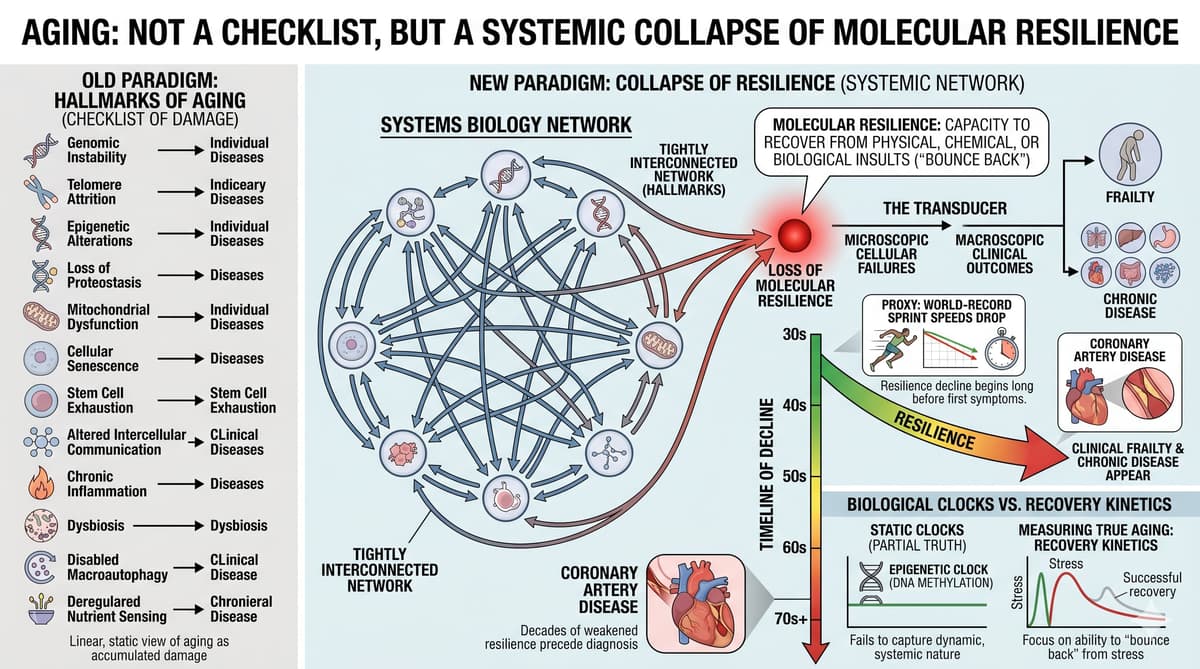
Loss of Resilience as the Key Measure of Aging, And How to Track It
Key Takeaways
- •OGTT clearance velocity predicts metabolic resilience decline
- •HRR under 12 bpm signals autonomic aging
- •hs‑CRP lingering past 48h indicates inflammatory resilience loss
- •Wearable recovery slope tracks nightly HRV after stressors
- •Biannual kinetic testing reveals deviation from age‑expected trajectories
Pulse Analysis
The concept of biological age is evolving from static epigenetic clocks to a kinetic view that gauges how fast the body rebounds from stress. Traditional markers such as HbA1c or DNA methylation capture accumulated damage but miss the real‑time coordination among hallmarks like insulin signaling, mitochondrial function and immune regulation. By introducing standardized perturbations—glucose loads, VO₂ max tests, and controlled inflammatory challenges—researchers can quantify a "Resilience Signature" that reflects the integrated health of multiple systems. This shift aligns with a broader systems‑biology paradigm, where the speed of recovery becomes a more sensitive predictor of future decline than any single snapshot.
Practically, the protocol leverages tools already familiar to clinicians and consumers. Continuous glucose monitors provide granular glycemic variability data, while wearables such as Oura or Whoop capture heart‑rate‑variability recovery slopes after alcohol, travel or intense workouts. Flow‑mediated dilation assesses endothelial function, and a simple 100‑meter sprint offers a proxy for whole‑body power output. By establishing a personal baseline in the 30‑45 age window and repeating the battery every two years, individuals can detect accelerated loss of clearance velocity or heart‑rate‑recovery before clinical thresholds are crossed. Opportunistic data from illnesses or surgeries further enriches the longitudinal profile, turning everyday stressors into valuable diagnostic experiments.
For the longevity market, kinetic resilience testing opens a lucrative frontier. Pharmaceutical and biotech firms gain a quantifiable endpoint to evaluate anti‑aging interventions, while digital health startups can package wearable‑derived recovery metrics as subscription services. Investors are likely to fund platforms that integrate CGM data, HRV analytics and inflammatory markers into unified dashboards, creating a new class of precision‑longevity products. As insurers explore value‑based models, demonstrable improvements in resilience could translate into lower claims, accelerating adoption across both consumer and clinical settings.
Loss of Resilience as the Key Measure of Aging, And How to Track It
Comments
Want to join the conversation?