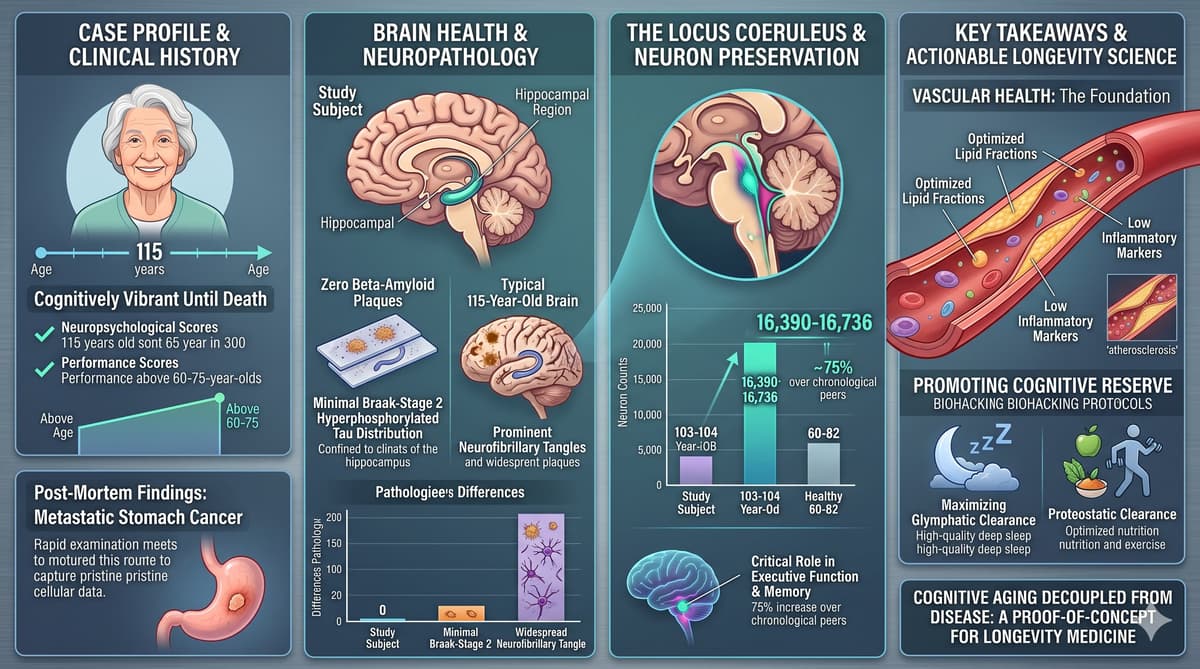
The 115-Year-Old Brain That Escaped Aging: Supercentenarian Autopsy Challenges the Inevitability of Cognitive Decline
Key Takeaways
- •MMSE ≥26 predicts 44% lower mortality in centenarians
- •73% of high‑scoring centenarians retain cognition until death
- •18.6% of stable centenarians carry APOE‑e4, showing resilience
- •Physical frailty does not predict cognitive decline in this subgroup
Pulse Analysis
The prevalence of dementia skyrockets after age 100, yet a small subset of centenarians defies this trend. The Dutch 100‑plus Study tracked 340 individuals and identified a simple cognitive benchmark—an MMSE score of 26 or above—that separates those who continue thinking clearly from those who experience rapid decline. This metric not only forecasts mental health but also correlates with a 44% reduction in mortality, underscoring the intertwined nature of brain function and longevity.
Beyond the MMSE threshold, the study uncovers a paradox in genetic risk. While the APOE‑e4 allele is the strongest known predictor of Alzheimer’s disease, nearly one‑fifth of the cognitively stable centenarians carried it. Their resilience suggests the presence of protective modifiers—perhaps rare variants in genes like PLCG2—that can neutralize APOE‑e4’s harmful effects. This challenges clinicians to look beyond single‑gene risk scores and consider a broader genomic context when assessing dementia risk in the elderly.
For the longevity field, the decoupling of cognitive health from cardiovascular and physical decline is a game‑changer. It implies that brain‑specific defense mechanisms can be bolstered independently of systemic aging processes. Therapeutic strategies may therefore focus on enhancing neuroprotective pathways, such as autophagy or senescent cell clearance, rather than solely targeting vascular health. As research delves into the molecular signatures of these “super‑maintainers,” the prospect of extending sharp cognition deep into senescence becomes increasingly tangible.
The 115-Year-Old Brain That Escaped Aging: Supercentenarian Autopsy Challenges the Inevitability of Cognitive Decline
Comments
Want to join the conversation?