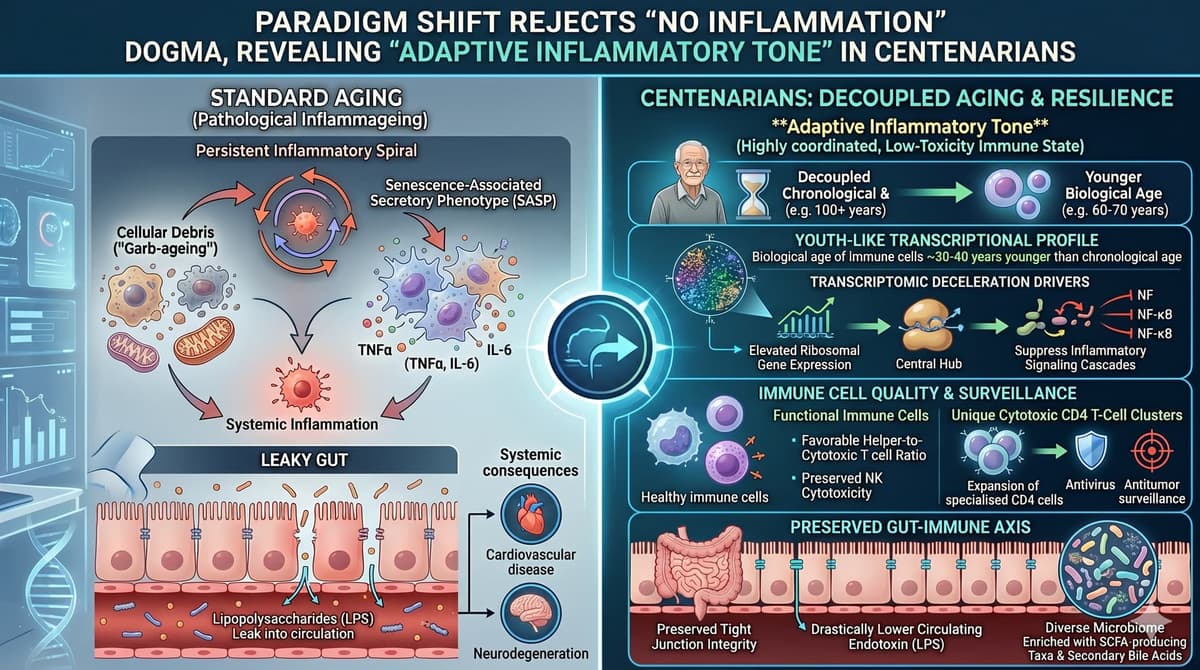
The Century-Old Immunome: Learning From the Adaptive Shield of Human Centenarians
Key Takeaways
- •Epigenetic agents like AKG and EGCG keep RNASEH2C active.
- •Centenarian-derived exosomes boost RNASEH2C expression in senescent cells.
- •PGC‑1α activation via exercise or PPAR‑γ agonists limits mtDNA leakage.
- •Urolithin A induces mitophagy, reducing cytoplasmic nucleic acid load.
- •STING inhibitor H‑151 and NLRP3 blocker MCC950 curb inflammaging.
Pulse Analysis
Centenarians exhibit a unique molecular shield: overexpression of the RNASEH2C subunit of RNase H2, which efficiently degrades cytoplasmic RNA:DNA hybrids. These hybrids otherwise trigger the cGAS‑STING axis and chronic type‑I interferon signaling, fueling the low‑grade inflammation that accelerates tissue degeneration. Understanding why this enzyme remains active in the oldest humans has sparked a wave of research into epigenetic regulation, mitochondrial health, and innate‑immune modulation as levers for extending healthspan.
Translational efforts coalesce around four practical pillars. First, epigenetic maintenance—using alpha‑ketoglutarate to fuel TET‑mediated demethylation and mild DNMT inhibitors such as EGCG—aims to keep the RNASEH2C locus hypomethylated. Second, centenarian‑derived extracellular vesicles deliver micro‑RNAs and proteins that directly up‑regulate RNASEH2C in recipient cells, offering a biologic “youth‑boost.” Third, upstream protection focuses on preserving mitochondrial and nuclear membrane integrity; PGC‑1α activation through endurance exercise, cold exposure, or PPAR‑γ agonists, combined with mitophagy inducers like Urolithin A, reduces the leak of immunogenic DNA fragments. Finally, downstream blockade with STING inhibitors (e.g., H‑151) or NLRP3 antagonists (MCC950) can blunt residual inflammatory signaling when clearance is incomplete.
The therapeutic promise is balanced by safety considerations. Chronic inhibition of STING or NLRP3 may impair antiviral defenses, necessitating intermittent dosing or patient‑specific monitoring. Nonetheless, the market is rapidly embracing these modalities: biotech pipelines feature several STING inhibitors in early‑phase trials, while nutraceuticals targeting epigenetic enzymes gain consumer traction. If clinical data confirm efficacy without undue immunosuppression, these strategies could redefine anti‑aging interventions, positioning precision immunometabolism at the forefront of next‑generation longevity medicine.
The Century-Old Immunome: Learning from the Adaptive Shield of Human Centenarians
Comments
Want to join the conversation?