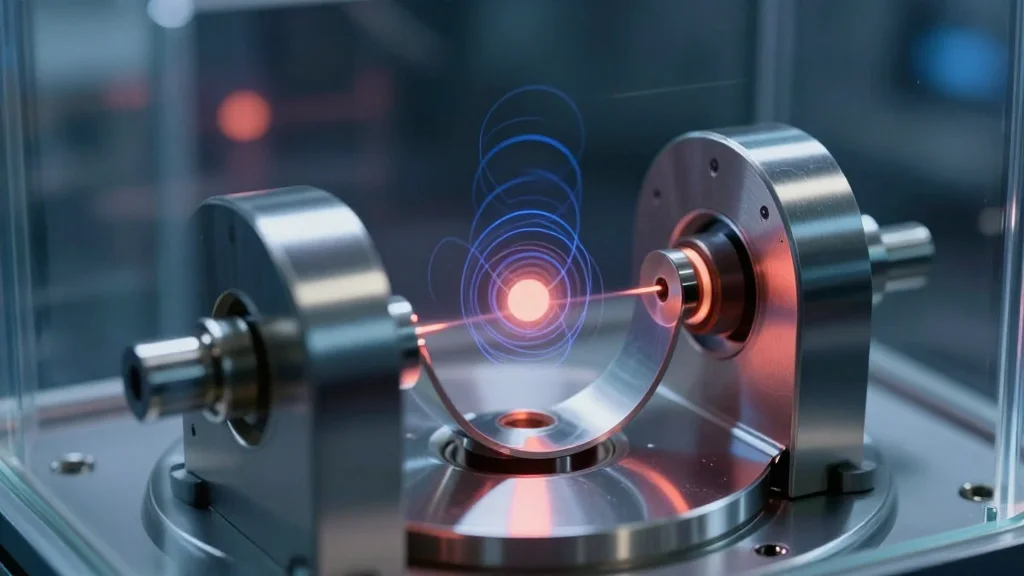
Dual‑Frequency Paul Trap Captures Electrons and Ions, Paving Way for Antihydrogen

Why It Matters
The dual‑frequency Paul trap resolves a fundamental engineering bottleneck that has limited experiments requiring simultaneous control of light and heavy charged particles. By enabling co‑trapping of electrons and ions, the technology directly supports the production of antihydrogen, which is essential for high‑precision tests of charge‑parity‑time symmetry and the gravitational behavior of antimatter. Moreover, the approach could accelerate hybrid quantum‑information schemes that combine the long coherence times of trapped ions with the rapid manipulation capabilities of electrons, potentially reshaping the architecture of future quantum processors. Beyond immediate scientific goals, the trap’s modular PCB construction offers a reproducible, cost‑effective pathway for laboratories worldwide to adopt multi‑frequency trapping. This democratization could spur a wave of experiments in fields ranging from precision spectroscopy to novel sensor development, amplifying the impact of the Mainz team's innovation across the broader physics community.
Key Takeaways
- •Physicists at JGU and Helmholtz Institute Mainz built a dual‑frequency Paul trap using three stacked PCBs.
- •The trap simultaneously confines electrons (GHz field) and calcium‑40 ions (MHz field) in the same vacuum chamber.
- •Electron loss increases with higher MHz field amplitude, while ions remain robust against GHz variations.
- •Mechanical imperfections—surface roughness, PCB misalignment, dielectric charging—limit trap stability.
- •Next‑generation hardware will feature laser‑etched electrodes and tighter tolerances to enable antihydrogen experiments.
Pulse Analysis
The Mainz dual‑frequency trap represents a strategic shift from single‑species confinement toward integrated, multi‑species platforms. Historically, Paul traps have been optimized for a narrow band of particle parameters, forcing researchers to build separate apparatuses for each species and then shuttle particles between them—a process that introduces loss and decoherence. By embedding two RF drives within a single, compact structure, the Mainz team not only simplifies experimental layouts but also opens the door to continuous, in‑situ interactions between disparate particles. This could dramatically improve the efficiency of sympathetic cooling, where a cold ion bath extracts energy from a hotter species, a technique already central to quantum‑logic spectroscopy.
From a competitive standpoint, the breakthrough puts European antimatter research on a more equal footing with U.S. initiatives such as CERN’s ALPHA and AEgIS collaborations, which have relied on complex, multi‑stage trapping sequences. If the Mainz trap can be scaled to handle antiprotons and positrons without prohibitive electron loss, it may become the preferred architecture for next‑generation antihydrogen factories, potentially attracting funding and talent away from larger, more cumbersome setups.
Looking ahead, the real test will be whether the asymmetric sensitivity observed can be engineered away. Active feedback control of the RF amplitudes, or the introduction of tailored electrode geometries that decouple the fields, could provide a path forward. Success would not only validate the trap for antimatter work but also cement its role in hybrid quantum devices, where co‑trapped electrons could mediate fast entangling gates between ion qubits. The coming months will therefore be critical in determining whether this proof‑of‑concept evolves into a workhorse technology for precision physics and quantum engineering.
Dual‑Frequency Paul Trap Captures Electrons and Ions, Paving Way for Antihydrogen
Comments
Want to join the conversation?
Loading comments...