Why It Matters
The uneven state‑level growth signals shifting economic momentum, guiding investors and policymakers toward sectors and regions with the strongest upside. Understanding these patterns helps allocate capital and tailor fiscal strategies for balanced national growth.
Key Takeaways
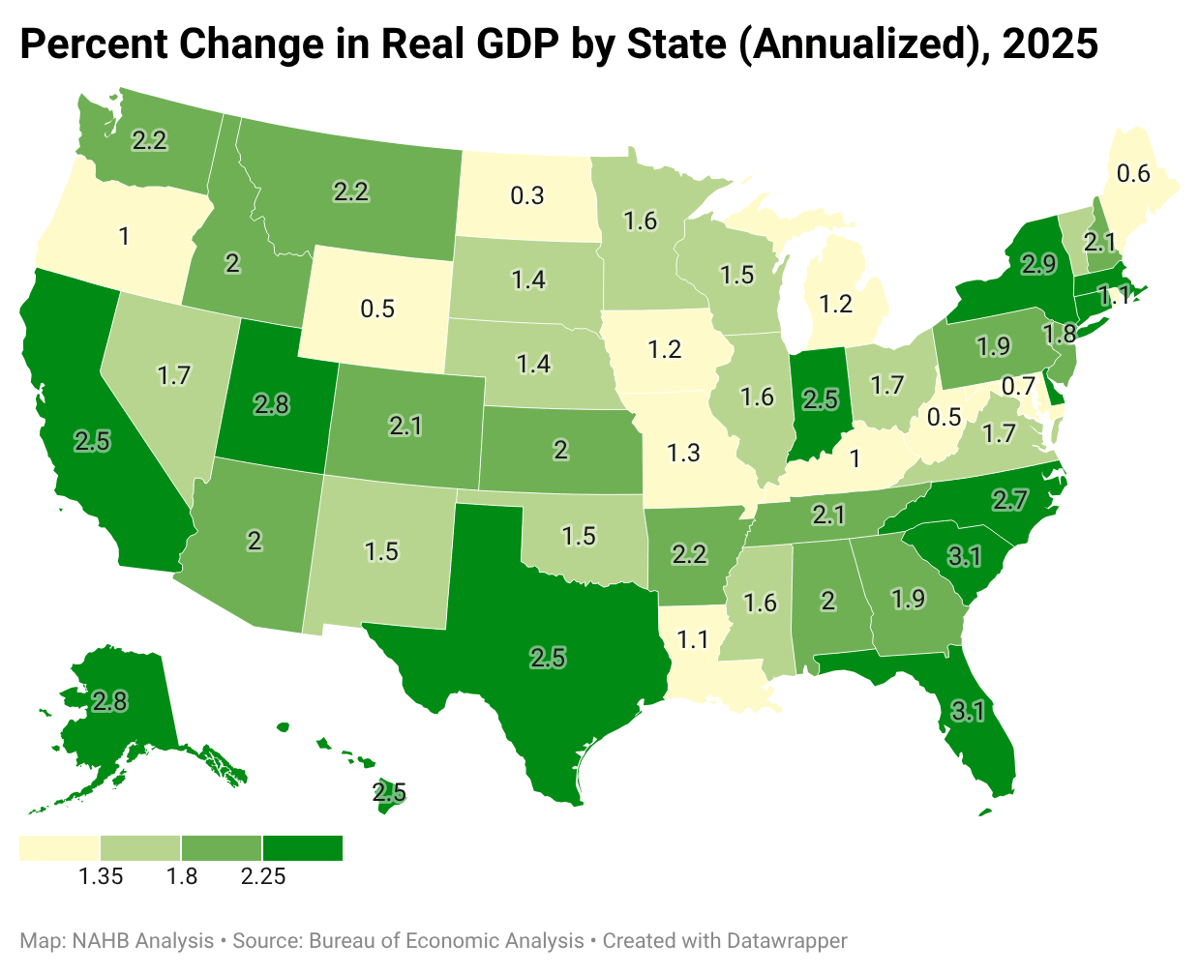
- •Florida and South Carolina posted 3.1% real GDP growth
- •National GDP rose 2.1% driven by consumer spending
- •Far West, Southeast, Southwest each gained 2.3% regionally
- •North Dakota lagged with only 0.3% growth
- •Growth variation tied to energy, manufacturing, professional services
Pulse Analysis
The BEA’s 2025 real GDP release underscores a deceleration in national economic momentum, with growth slipping to 2.1% after a series of double‑digit expansions. Consumer spending, bolstered by resilient household incomes, remained the primary engine, while business investment contributed modestly. This slowdown, however, masks a more nuanced picture at the sub‑national level, where state and regional dynamics diverge sharply based on industry composition and labor market health.
At the state level, Florida and South Carolina led with 3.1% growth, reflecting strong tourism, construction, and manufacturing rebounds. New York’s 2.9% increase highlighted robust professional services and finance activity, while Alaska and Utah’s 2.8% gains pointed to energy and tech sector resilience. Conversely, North Dakota’s 0.3% rise illustrates the lingering impact of weaker energy prices. Regional aggregates echo these trends: the Far West, Southeast, and Southwest each posted 2.3% growth, driven by tech, logistics, and renewable energy investments, whereas the Plains lagged at 1.4% due to agricultural price pressures.
For investors and policymakers, the data suggests a strategic pivot toward high‑growth clusters and sectors less exposed to commodity cycles. Capital allocation may favor states with diversified economies and strong professional services bases, while fiscal initiatives could target lagging regions to stimulate infrastructure and workforce development. Monitoring these state‑level shifts will be crucial for anticipating where the next wave of economic expansion will originate, shaping both private sector strategies and public policy in the years ahead.
2025 Regional and State-Level GDP Data
Comments
Want to join the conversation?
Loading comments...