Americans Are Spending Faster than Their Income Is Growing
Companies Mentioned

Why It Matters
A shrinking savings cushion limits households’ ability to sustain spending, raising risks for broader economic growth and potentially influencing upcoming elections.
Key Takeaways
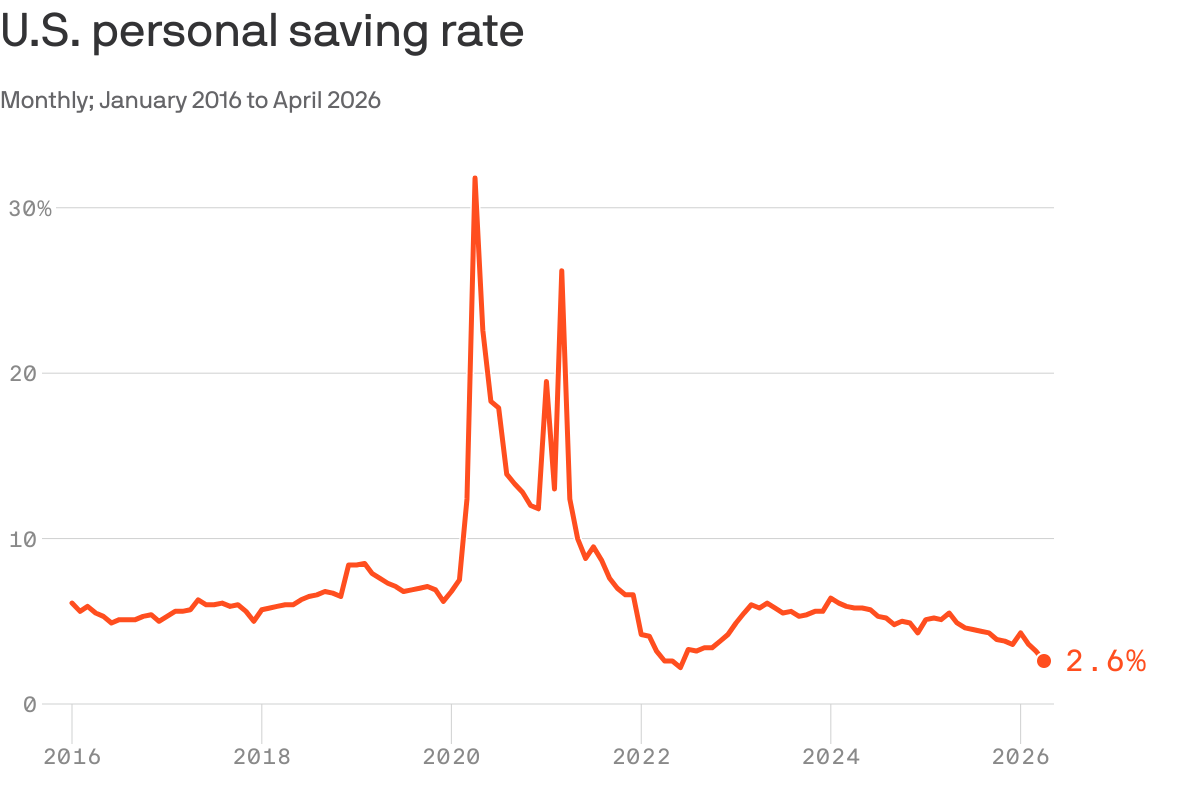
- •Saving rate fell to 2.6%, lowest since mid‑2022.
- •Consumer spending up 0.5% despite income dropping 0.1%.
- •Energy goods, especially gasoline, drove April’s spending increase.
- •Real disposable income down 1.4% YoY, first back‑to‑back decline.
- •Fitch warns spending reliance on wealth effect, making growth fragile.
Pulse Analysis
The latest BEA data reveal a widening chasm between U.S. household outlays and income growth. While consumer spending modestly expanded in April, disposable personal income contracted, pulling the personal saving rate to 2.6%, its lowest level since mid‑2022. Energy costs, amplified by the Iran conflict, accounted for the bulk of the spending lift, underscoring how external shocks can quickly erode the post‑pandemic savings buffer that many families relied on during previous downturns.
For policymakers, the divergence poses a dilemma. The Federal Reserve’s preferred inflation gauge, the PCE price index, cooled to a 0.4% monthly rise, yet core PCE—excluding food and energy—remains above the 2% target at 0.2% month‑over‑month and 3.3% year‑over‑year. Persistent core inflation, combined with dwindling savings, limits the Fed’s room to pause rate hikes without risking a sharper pullback in consumer demand. Analysts therefore watch real disposable‑income trends as a leading indicator of both spending resilience and inflationary pressure.
The broader economic narrative points to an uneven, K‑shaped recovery. Upper‑income households continue to benefit from wealth effects, sustaining aggregate spending, while lower‑ and middle‑income families feel the squeeze of stagnant wages and rising energy bills. This fragility could spill into the political arena, as real disposable‑income declines have historically correlated with electoral shifts. With savings eroding and income growth lagging, the U.S. economy faces a delicate balance between maintaining consumption momentum and averting a broader slowdown.
Americans are spending faster than their income is growing
Comments
Want to join the conversation?
Loading comments...