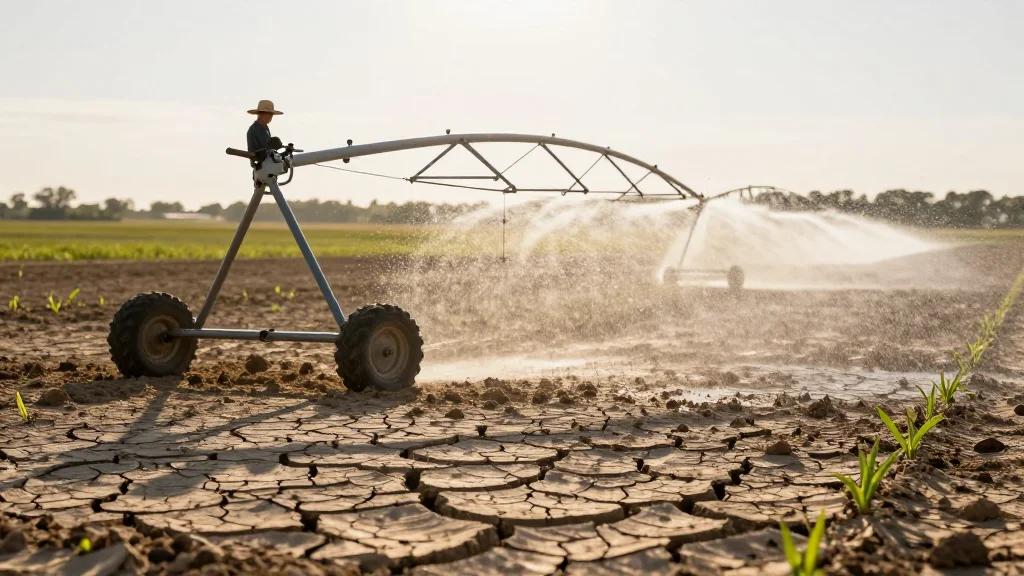
Arkansas Farmers Turn to Irrigation as Drought Threatens Planting and Prices

Why It Matters
The drought in Arkansas highlights how regional climate stress can quickly translate into national economic concerns. Agriculture accounts for roughly 5% of U.S. GDP, and any disruption in key grain‑producing states can ripple through food‑price inflation, livestock feed costs, and export revenues. Moreover, the need for increased irrigation raises water‑resource pressures, potentially prompting policy debates over water rights and federal assistance. Beyond immediate market impacts, the situation underscores the importance of integrating climate‑adaptation strategies into farm management. As temperature‑quantile analyses reveal divergent regional trends, policymakers must tailor support—such as drought‑relief funding and infrastructure investments—to the specific challenges faced by states like Arkansas that are not experiencing the same warming extremes but are still vulnerable to moisture deficits.
Key Takeaways
- •Arkansas farmers are irrigating corn silage and rice fields as drought persists.
- •State needs 19‑27 inches of rain in three months to end the moisture deficit.
- •Extension agronomist Jarrod Hardke warns planting delays could shrink harvests.
- •National Weather Service forecasts short‑term showers but not enough to fully relieve drought.
- •Arkansas Index rose 1.05 points to 1,135.92, reflecting investor concern over agricultural volatility.
Pulse Analysis
Arkansas’s current drought illustrates a classic supply‑shock scenario that can quickly feed into broader macroeconomic indicators. While the national conversation often centers on heat‑driven wildfires in the West, the Midwest’s moisture shortfall can be just as consequential for food markets. Historically, drought years in the Corn Belt have spurred spikes in corn futures, prompting higher feed costs for livestock producers and, ultimately, higher meat prices for consumers. If Arkansas’s output falls, grain traders will likely price in a tighter market, nudging the USDA’s projected national corn yield downward.
From a policy perspective, the episode may accelerate discussions around federal drought assistance programs and water‑conservation incentives. The Farm Service Agency’s emergency disaster payments could see a surge in applications, while the USDA’s Conservation Reserve Program might be expanded to encourage more efficient water use. In the longer term, the situation could serve as a catalyst for investment in precision‑irrigation technologies, which promise to reduce water waste but require upfront capital—an area where low‑interest farm loans could play a pivotal role.
Finally, the juxtaposition of Arkansas’s “warming hole” with its severe drought underscores the complexity of climate impacts on agriculture. It challenges the notion that temperature alone drives crop risk, emphasizing that precipitation patterns and soil moisture are equally critical. Stakeholders—from farmers to commodity traders—must therefore adopt a more nuanced risk‑management framework that incorporates both temperature and moisture forecasts to safeguard the U.S. food supply chain.
Arkansas Farmers Turn to Irrigation as Drought Threatens Planting and Prices
Comments
Want to join the conversation?
Loading comments...