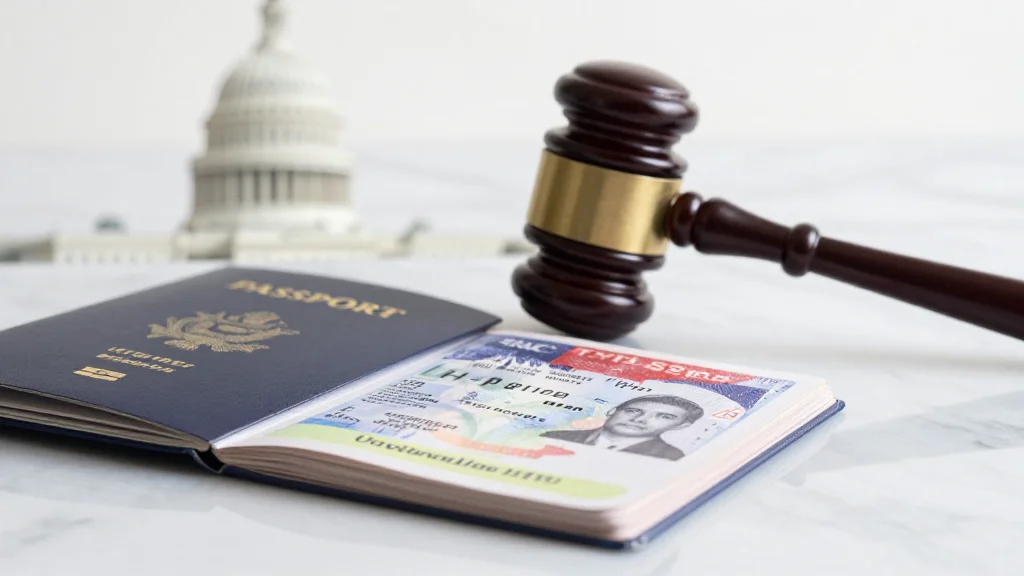
Federal Court Strikes Down $100,000 H‑1B Fee, Citing Lack of Congressional Authority

Why It Matters
The court’s reversal of the $100,000 H‑1B fee reshapes a key channel through which the United States attracts high‑skill talent. By eliminating a prohibitive cost, the decision helps sustain the pipeline of engineers, scientists, and clinicians who drive innovation, research breakthroughs, and high‑value job creation. Moreover, the ruling reasserts congressional authority over taxation, signaling to future administrations that immigration policy cannot be used as a backdoor for revenue generation without explicit legislative backing. The outcome will influence corporate hiring strategies, state‑level economic planning, and the broader debate over the balance of power between the executive and legislative branches. In the short term, universities and tech firms can resume H‑1B sponsorships, potentially averting a slowdown in projects that depend on specialized expertise. Over the longer horizon, the decision may prompt Congress to revisit the H‑1B framework, either to tighten eligibility or to codify a transparent fee structure, thereby providing greater certainty for employers and prospective immigrant workers alike.
Key Takeaways
- •$100,000 payment requirement for new H‑1B petitions declared unlawful by federal court
- •Twenty U.S. states successfully challenged the fee, citing separation of powers and the APA
- •Court ruled the fee functioned as a tax, which Congress had not authorized
- •Removal of fee expected to preserve tens of thousands of high‑skill jobs in tech, academia, and health care
- •Potential for appeal exists; Congress may consider new legislation to address H‑1B program financing
Pulse Analysis
The judgment marks a rare instance where the judiciary directly curtails an executive immigration policy on fiscal grounds. Historically, the H‑1B program has been a bipartisan tool for attracting talent, but the Trump administration’s $100,000 surcharge represented an unprecedented escalation in cost, effectively pricing out many mid‑size employers. By restoring the status quo, the court not only protects the labor market’s elasticity but also sends a clear signal to future administrations: revenue‑raising motives cannot be grafted onto immigration statutes without explicit congressional sanction.
From a market perspective, the decision should buoy sectors that have been on the hiring edge. Silicon Valley startups, which often rely on a mix of domestic and foreign engineers, can now proceed with recruitment plans that were on hold. Similarly, university research labs, which depend on post‑doctoral scholars and visiting professors, will avoid the budgetary shock of an extra six‑figure fee per hire. This could translate into steadier research output and, by extension, a modest boost to U.S. innovation metrics.
Looking ahead, the case may catalyze legislative action. Lawmakers who view the H‑1B program as both an economic engine and a national security concern could seize the moment to introduce reforms that balance talent acquisition with domestic workforce development. Any such reforms will need to navigate the political fault lines between states that benefit from immigrant labor and constituencies that demand tighter immigration controls. The court’s ruling, therefore, is not an endpoint but a pivot point that will shape the next chapter of U.S. immigration and economic policy.
Federal Court Strikes Down $100,000 H‑1B Fee, Citing Lack of Congressional Authority
Comments
Want to join the conversation?
Loading comments...