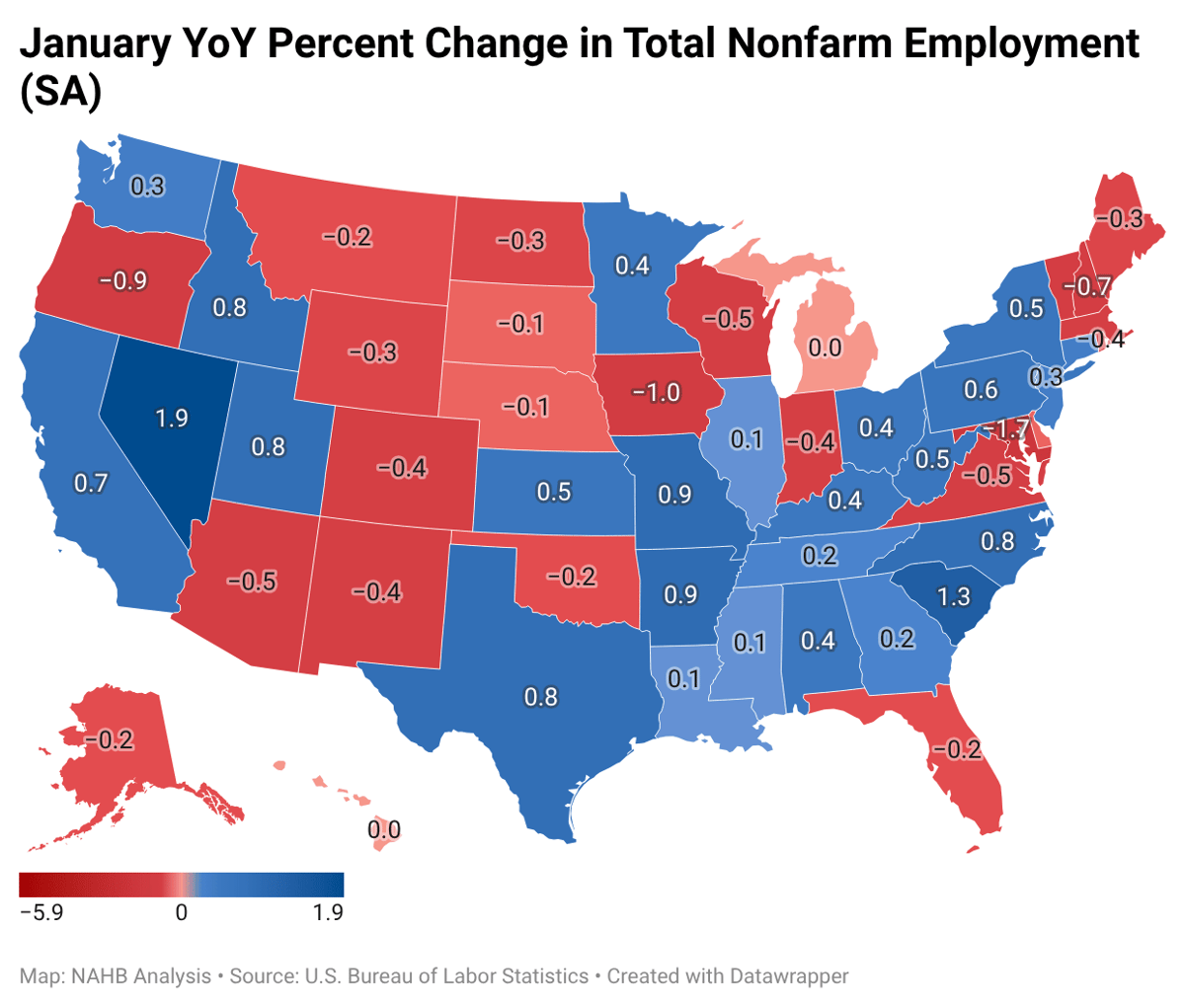
State-Level Employment Situation: January 2026
Why It Matters
The renewed hiring momentum signals a shift from the 2025 slowdown, influencing wage pressures and regional economic resilience. Persistent state‑level gaps, especially in construction and unemployment, will shape policy and corporate location decisions.
Key Takeaways
- •California added 93,500 jobs in January, leading state gains
- •District of Columbia lost 5,400 jobs, highest state decline
- •Construction sector netted 45,000 jobs, Illinois added most
- •Hawaii and South Dakota unemployment fell to 2.2%, lowest rates
Pulse Analysis
January 2026 marked a turning point for the U.S. labor market after a tepid 2025, with the Bureau of Labor Statistics reporting a 160,000‑job increase in nonfarm payrolls. This rebound was broadly distributed, as 45 states posted gains, but the magnitude varied sharply. California’s 93,500‑job surge underscored the state’s continued economic dynamism, while the District of Columbia’s 5,400‑job loss highlighted lingering federal workforce reductions. The modest 0.2 percent year‑over‑year growth suggests that while momentum is returning, the market remains fragile compared with the 2024 average of 168,000 monthly jobs.
The construction sector illustrated the uneven nature of the recovery. Nationwide, the industry added 45,000 jobs, with Illinois contributing the largest absolute gain of 13,500 positions. Yet regional disparities were stark: West Virginia posted a 5.9 percent monthly jump, whereas Idaho experienced a 4.4 percent decline. These shifts affect not only labor demand but also material supply chains and local housing markets, potentially tightening wages in high‑growth areas while leaving lagging regions vulnerable to slower price appreciation.
State unemployment rates further reveal divergent trajectories. Hawaii and South Dakota achieved the lowest rates at 2.2 percent, reflecting tight labor markets that could spur wage inflation. Conversely, the District of Columbia’s 6.7 percent rate, driven by over 300,000 federal layoffs, signals significant local distress. Policymakers and businesses will monitor these metrics closely, as they influence fiscal decisions, talent acquisition strategies, and broader economic forecasts for the remainder of 2026.
State-Level Employment Situation: January 2026
Comments
Want to join the conversation?
Loading comments...