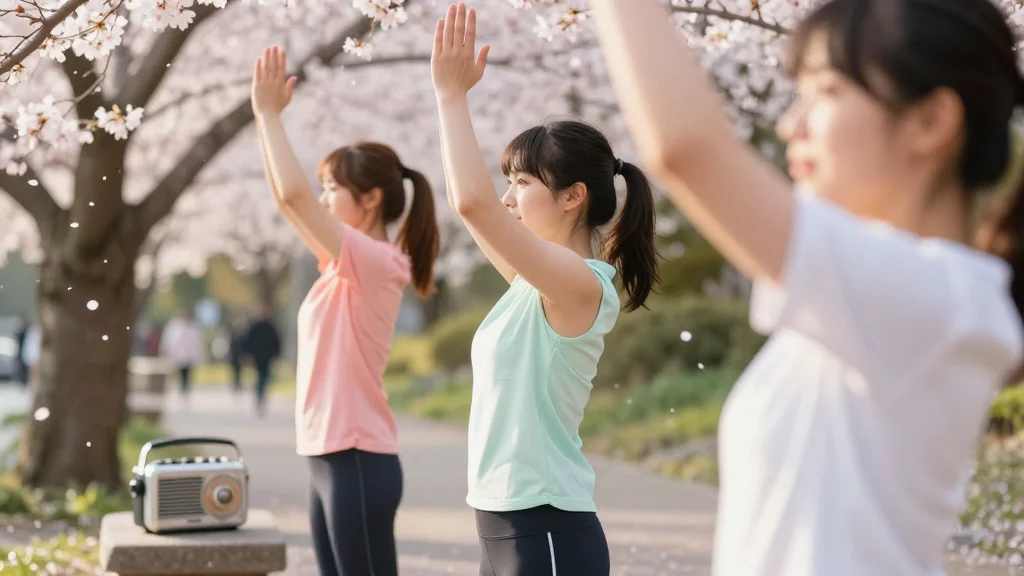
Japan Revives Radio Taiso to Boost Longevity, Mobilizing Millions in Daily 10‑Minute Sessions

Why It Matters
Radio Taiso exemplifies a form of societal biohacking: a low‑cost, culturally embedded practice that leverages collective behavior to improve health outcomes. By normalizing daily movement, the program could reduce the prevalence of age‑related ailments, easing pressure on Japan’s healthcare system and setting a template for other aging societies. The initiative also highlights how traditional practices can be repurposed for modern public‑health goals. As nations grapple with longer lifespans and the need for sustainable health interventions, Japan’s model offers a scalable, community‑driven alternative to high‑tech solutions, reinforcing the idea that biohacking need not be limited to individual gadgets or supplements.
Key Takeaways
- •Radio Taiso broadcasts a 10‑minute calisthenics routine nationwide at 6:30 a.m.
- •Millions of participants, including seniors like 88‑year‑old Mieko Kobayashi, join daily sessions.
- •The program is promoted as a low‑intensity biohack to sustain Japan’s 85‑year average life expectancy.
- •Participation has risen ~15 % since early 2026, with plans to expand into schools and workplaces.
- •First comprehensive health impact report expected in late 2027.
Pulse Analysis
Japan’s revival of Radio Taiso signals a strategic pivot toward low‑tech, culture‑centric health interventions. Unlike wearable‑driven biohacking trends that rely on data analytics and personalized feedback, this program leverages collective habit formation and social cohesion. The approach aligns with behavioral economics insights: repeated, low‑friction activities are more likely to become ingrained than high‑intensity regimens that require equipment or specialized knowledge.
Historically, Japan has blended public policy with cultural practices—post‑war health campaigns, school‑based physical education, and community festivals all served dual social and health functions. Radio Taiso’s resurgence taps into that legacy, offering a scalable model for other high‑age societies. If the upcoming health surveys confirm measurable reductions in cardiovascular incidents or falls among participants, policymakers worldwide may adopt similar community‑driven routines, especially in regions where digital health adoption faces barriers.
However, the initiative’s success hinges on sustained engagement and robust data collection. Without rigorous longitudinal studies, claims of longevity benefits remain anecdotal. Future research should compare health outcomes of regular Radio Taiso participants against control groups, accounting for confounding factors like diet and socioeconomic status. If validated, the program could redefine biohacking from an individual pursuit to a public‑health infrastructure, reshaping how societies approach aging in the coming decades.
Japan Revives Radio Taiso to Boost Longevity, Mobilizing Millions in Daily 10‑Minute Sessions
Comments
Want to join the conversation?
Loading comments...