

Symbolic Learning Replaces Gradient Descent as Scalable Substrate
Symbolic learning is not a replacement for coding agents, it's a replacement for gradient descent & NNs: a low-level, completely general, extremely scalable new learning substrate.

Treat AI-Generated Code as a Black‑box ML Model
Agentic coding is a form of machine learning. Generated code is best treated as a blackbox artifact whose behavior and generalization should be managed via empirical evaluation, like with any ML model.

AI Amplifies Agency: Winners Gain, Losers Lose
It was always the case that agency was self-compounding, but AI is magnifying the effect. Low-agency AI users further lose agency, high-agency AI users further gain agency.

Agentic Coding Powers Instant Data Visualizations, UIs, CLIs
A few major use cases for agentic coding for me: 1. Adhoc data visualizations. Anytime I have a question that can be answered quantitatively, I generate some code to make a plot. 2. Adhoc data annotation UIs. In ML, "make your own...

Best‑selling Deep Learning with Python Now Free Online
I wrote Deep Learning with Python to be the definitive guide to how deep learning works and how to best make use of it. Tens of thousands of people got their career start via this book. 120,000 copies sold, and...

RL Boosts Familiar Tasks, but Triggers Hallucinations on Novel Ones
RL is a bit of a double edged sword: in known territory performance increases, but in unknown territory the model tends to hallucinate that it is performing a completely different task it was trained on
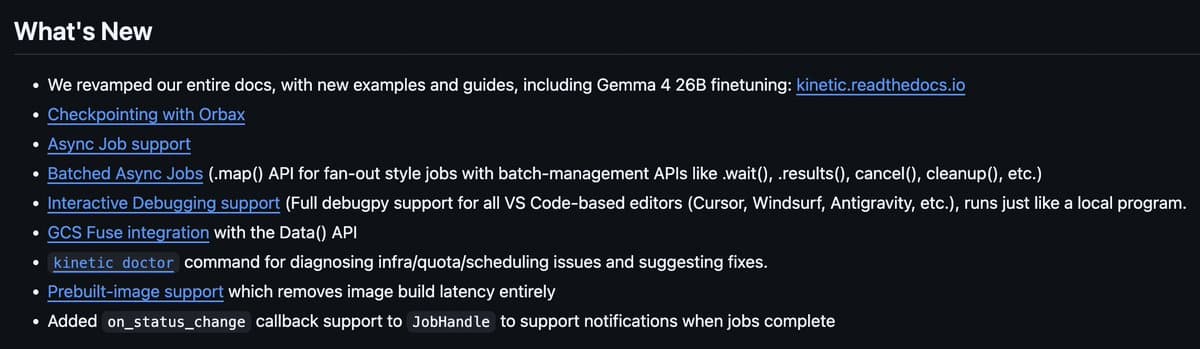
Keras Kinetic Alpha v0.0.
Keras Kinetic has a new alpha release: v0.0.2! Including a new docs website: https://t.co/AjEdkU1Yl1 Kinetic is my favorite new release from the Keras team: a super simple Modal-like API to run training jobs on TPU. https://t.co/tCUK5ftPnX

Judge AGI by Novel Learning, Not Human Mimicry
Judging AGI by how well it can mimic us is a category error, because mimicry isn't intelligence and isn't general. We should judge AGI by how well it learns to do things we didn't teach it (including things we don't...

From 1907 Gyroplane to 2010 Parrot: Quadcopter Era Begins
The very first quadcopter prototype was the Breguet-Richet Gyroplane No. 1, created in 1907 by Breguet Aviation in France. The first consumer quadcopter drone was the Parrot AR.Drone, released in 2010 by French company Parrot SA. It was also the first...

Current AI Lacks Self‑Awareness and Metacognitive Insight
One of the most jarring things about current AI is its lack of introspection ability and metacognition. It doesn't know what it doesn't know, how it knows, or how it could find out. It's a one-way system.

LLM Disintermediation Threatens Software Simplicity, Fuels Complexity
Human cognitive friction has long been acting as a regularizer for a lot of digital infrastructure. It made software APIs less terrible and codebases less complex. Now LLM disintermediation is causing this effect to fade, which in turn will cause runaway...

Token Supply Outpaces Value: Cost Vs. Worth
There's no doubt that the world can consume tokens as fast as they're produced, even in the most maximalist infrastructure buildup scenarios imaginable. That's not the question. The question is whether the economic value of those tokens can match their...

PyTorch or JAX: The Hallmark of Top Talent
When looking at deep learning profiles, one of the most obvious tells between a mediocre and great candidate is whether they list PyTorch or JAX.

Constraints Ignite Innovation, Unlimited Options Paralyze Creativity
Constraints are the catalyst of invention. An infinite search space leads to paralysis. The most creative inventions happen when you are forced to solve a problem within appropriately narrow constraints.

Complex, High‑entropy Models Scale; Simple Methods Do Not
There's a broadly held misconception in AI that methods that scale well are simple methods -- even, that simple methods usually scale. This is completely wrong. Pretty much none of the truly simple methods in ML scale well. SVM, kNN, random...