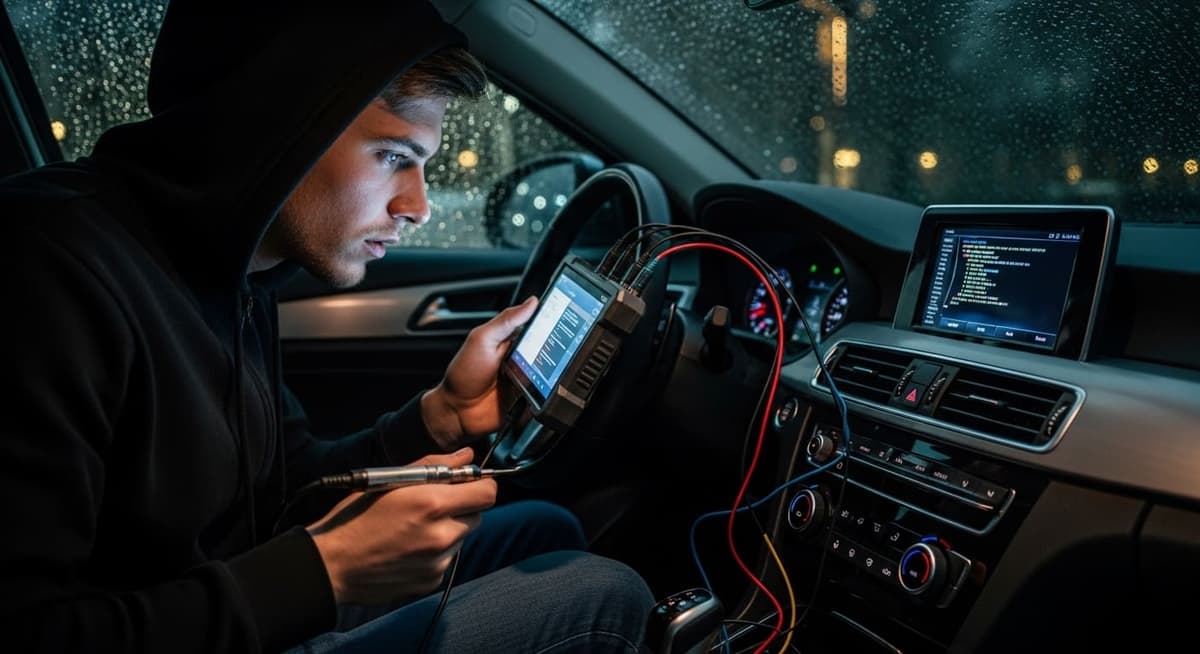
Future Cars Shielded From Quantum Hacking with Adaptable Security System

Key Takeaways
- •Adaptive PQC reduces V2X latency by up to 27%
- •Overhead cuts reach 65% with context‑aware selection
- •Predictive algorithm reacts within 100‑200 ms windows
- •Monotonic‑upgrade protocol blocks downgrade and replay attacks
- •Framework validated on realistic mobility and weather data
Pulse Analysis
The rollout of 6G vehicle‑to‑everything (V2X) services promises ultra‑reliable low‑latency communication for autonomous driving, fleet management, and smart city logistics. However, the emergence of scalable quantum computers threatens the RSA and ECC primitives that currently protect these links. Post‑quantum cryptography (PQC) offers algorithms resistant to quantum attacks, but many candidates impose heavy computational loads and large ciphertexts, which clash with the millisecond‑scale latency budgets of V2X. Bridging this gap requires a security model that can adapt in real time to changing network conditions.
The adaptive PQC framework introduced by Sengupta et al. tackles the problem with a context‑aware optimizer that selects lattice, code, or hash‑based schemes based on a short‑term prediction of vehicle speed, channel quality, weather, and message urgency. Their multi‑objective evolutionary algorithm evaluates latency, bandwidth, and security metrics within 100–200 ms windows, enabling a seamless switch to the most efficient configuration. A monotonic‑upgrade protocol, inspired by TLS 1.3 and QUIC, guarantees that each transition moves toward stronger security, eliminating downgrade, replay, and desynchronisation risks while keeping overhead 65 % lower than static PQC deployments.
From a business perspective, the ability to maintain quantum‑safe communications without sacrificing the sub‑10 ms latency required for collision avoidance or cooperative maneuvering could accelerate 6G V2X adoption across automotive OEMs and telecom operators. The framework’s reliance on existing hardware and its reinforcement‑learning‑based stability make it attractive for incremental rollout in edge‑compute platforms. Future extensions that co‑optimise encryption and digital signatures will further tighten the security envelope, positioning firms that invest early in adaptive PQC as leaders in the emerging quantum‑resilient mobility market.
Future Cars Shielded from Quantum Hacking with Adaptable Security System


Comments
Want to join the conversation?