
Physicists Finally Solve the Strange Mystery of “Breathing” Lasers
Physicists have unveiled a unified mathematical model that explains both above‑threshold and below‑threshold “breather” laser pulses, long‑standing anomalies in ultrafast laser dynamics. The framework merges rapid cavity effects with slower gain‑medium variations, accurately reproducing fast oscillations and slow Q‑switching cycles in a single simulation. Published in Physical Review Letters, the work was led by Dr. Sonia Boscolo of Aston University and an international team. The breakthrough promises to streamline laser design for applications ranging from eye surgery to precision manufacturing.

Scientists Were Wrong About This “Rule-Breaking” Particle
Physicists led by Penn State’s Zoltan Fodor have produced the most precise lattice‑QCD calculation of the muon’s anomalous magnetic moment, eliminating the long‑standing gap between theory and experiment. The new result aligns the Standard Model prediction with measurements to within...

String Theory Suddenly Emerged From Simple Physics Rules
A new study using the bootstrap approach shows that string theory’s core features—such as the infinite tower of particle states—emerge automatically from just two minimal scattering assumptions. Researchers at Caltech, NYU and the Institut de Física d’Altes Energies derived the...

The “Impossible” LED that Could Change Everything
Scientists at Cambridge’s Cavendish Laboratory have created the first LEDs from insulating lanthanide‑doped nanoparticles by attaching organic "molecular antenna" molecules that funnel electrical energy into the particles. The hybrid devices achieve over 98% triplet‑energy transfer, emit ultra‑pure second‑near‑infrared (NIR‑II) light,...
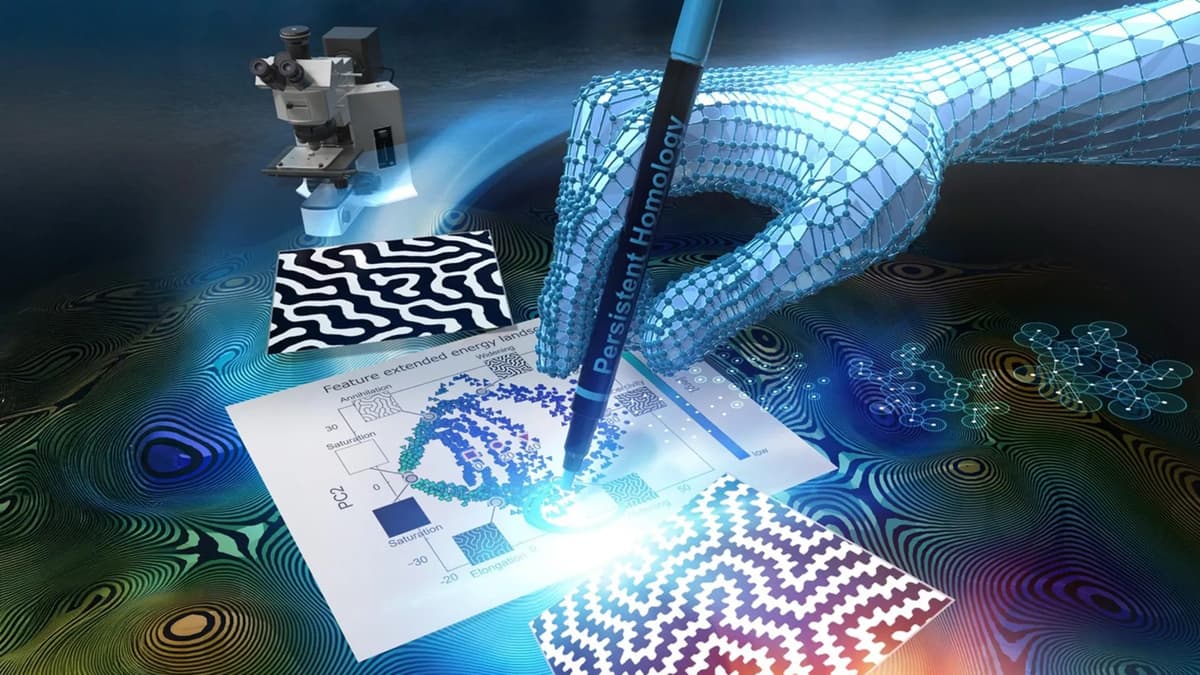
AI Reveals the Invisible Magnetic Chaos Wasting Energy Inside Electric Motors
The rapid expansion of electric vehicles has intensified scrutiny of iron loss—magnetic hysteresis that converts motor energy into heat. Researchers at Tokyo University of Science and partner institutions introduced an entropy‑feature‑extended Ginzburg‑Landau (eX‑GL) model that blends physics‑based AI with persistent...

Scientists Finally Solve the 100-Year Mystery Behind Tough Tires
Researchers at the University of South Florida solved the century‑old mystery of why carbon‑black reinforcement makes rubber exceptionally strong. By running 1,500 molecular‑dynamics simulations equivalent to 15 years of compute time, they discovered that carbon‑black particles suppress rubber’s Poisson contraction,...

“Cannot Be Explained” – New Ultra Stainless Steel Stuns Researchers
University of Hong Kong researchers introduced SS‑H₂, a stainless‑steel alloy that resists corrosion at voltages up to 1700 mV, enabling seawater electrolysis for green hydrogen. The material employs a sequential dual‑passivation strategy, adding a manganese‑based protective layer atop the conventional chromium...
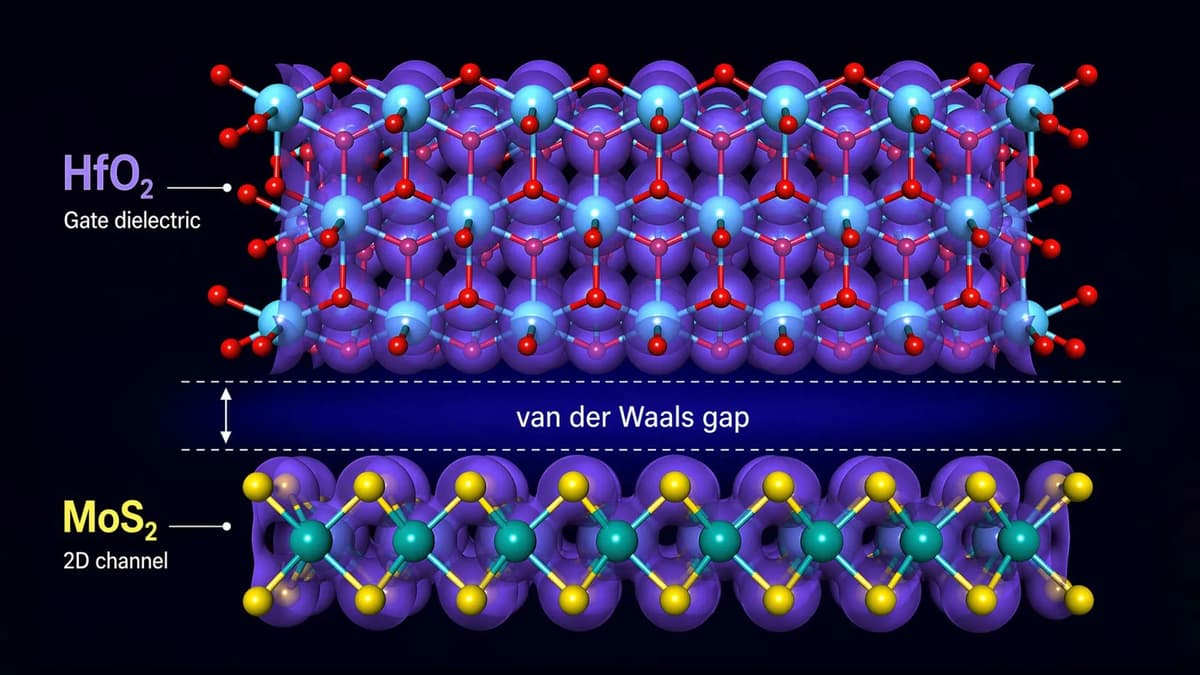
The Hidden Atomic Gap that Could Break Next-Generation Computer Chips
Researchers at TU Wien discovered that a sub‑nanometer gap—about 0.14 nm—forms between 2D semiconductors and their insulating oxide layers, weakening capacitive coupling and limiting device scaling. The gap arises from weak van der Waals bonding, which persists even when the insulating layer is...

Physicists Discover Quantum Particles that Break the Rules of Reality
Physicists from the Okinawa Institute of Science and Technology and the University of Oklahoma have theoretically identified a one‑dimensional system that can host anyons, particles that defy the traditional boson‑fermion classification. Their findings, published in Physical Review A, demonstrate that...

This Laser Turns Metal Into a Star-Like Plasma in Trillionths of a Second
Researchers at Helmholtz‑Zentrum Dresden‑Rossendorf combined an X‑ray free‑electron laser with a high‑intensity optical laser to film the ionization of a copper wire in trillionths of a second. The pump‑probe experiment recorded the rise and fall of Cu²²⁺ ions, showing a...

A Photon Was Teleported Across 270 Meters in Stunning Quantum Breakthrough
An international team led by Paderborn University has teleported the polarization state of a single photon between two independent quantum dots separated by a 270‑meter free‑space optical link. The experiment achieved a state‑fidelity of 82 % ± 1 %, well above the classical threshold....
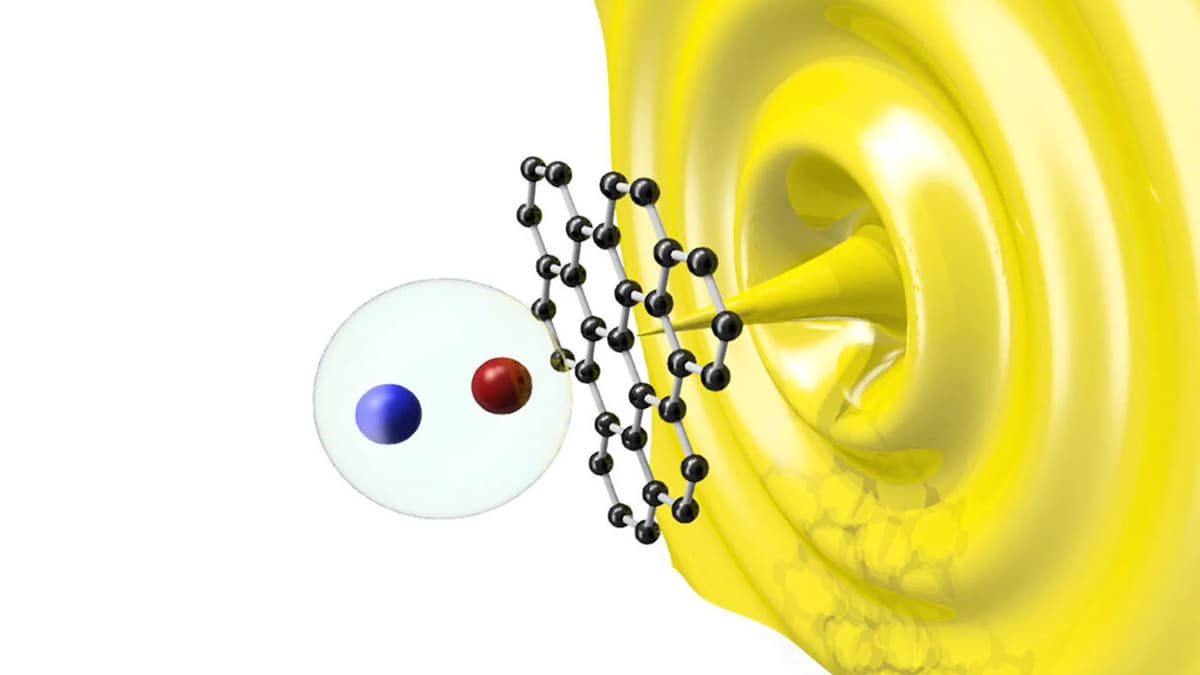
Scientists Catch Antimatter “Atom” Acting Like a Wave for the First Time
A team from Tokyo University of Science has, for the first time, observed matter‑wave diffraction in a beam of positronium, the electron‑positron bound atom. By generating a high‑energy (up to 3.3 keV), coherent positronium stream and directing it through a few‑layer...

Scientists Just Captured a Mysterious Quantum “Dance” Inside Superconductors
Physicists have, for the first time, directly visualized the quantum behavior that underlies superconductivity by imaging paired lithium atoms in an ultracold Fermi gas. The images revealed that the pairs move in a coordinated “dance,” maintaining specific distances from each...
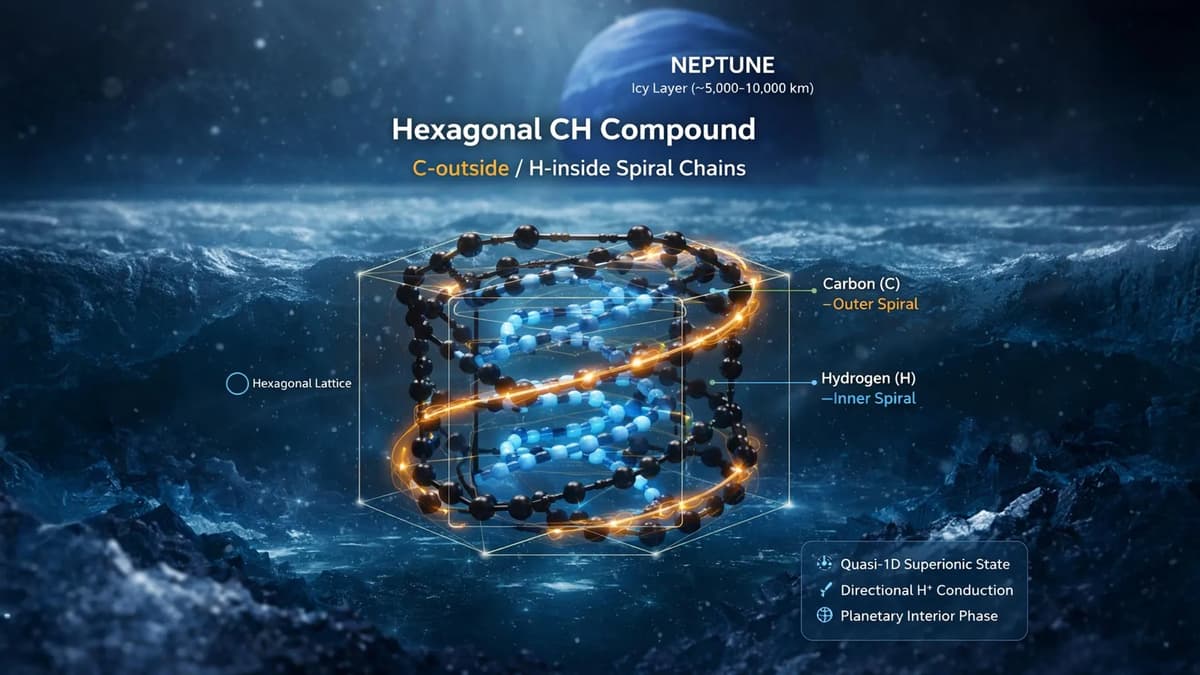
A Bizarre New State of Matter May Be Hiding Inside Uranus and Neptune
Carnegie researchers Cong Liu and Ronald Cohen used quantum simulations to predict a previously unknown quasi‑one‑dimensional superionic phase of carbon‑hydride deep inside Uranus and Neptune. The phase features a hexagonal carbon framework with hydrogen atoms spiraling through it, emerging under...

Scientists Sculpt Einstein Onto a Crystal Using only Light
Researchers at XPANCEO, together with Nobel laureate Konstantin Novoselov, demonstrated that the van der Waals semiconductor arsenic trisulfide (As₂S₃) can be permanently reshaped using only continuous‑wave light. The crystal exhibits an unprecedented photorefractive index shift of up to Δn≈0.3 under low‑intensity UV exposure,...