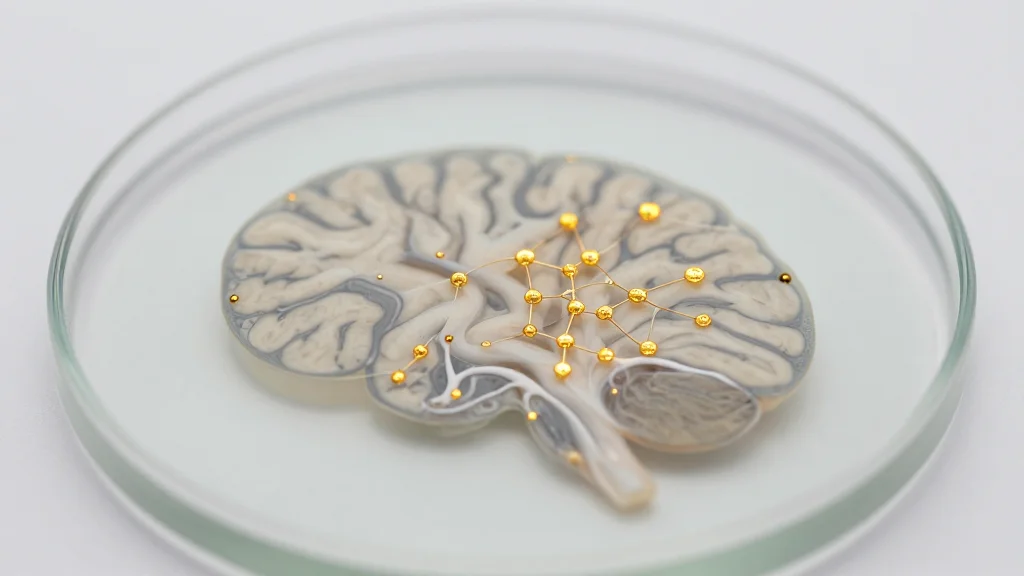
Nanoparticles Slash Brain Amyloid‑Beta by 50% in Alzheimer’s Mice

Why It Matters
Alzheimer’s disease has resisted decades of drug development, with most candidates targeting amyloid plaques directly and often failing due to limited brain penetration or adverse effects. By shifting the therapeutic target to the brain’s vascular clearance system, the new approach offers a disease‑modifying strategy that could halt or even reverse pathology rather than merely managing symptoms. For the biohacking community, which seeks to extend cognitive health span, a method that restores the brain’s natural housekeeping could become a cornerstone of personalized longevity protocols. Beyond Alzheimer’s, the glymphatic pathway is implicated in a range of neurodegenerative conditions, including Parkinson’s disease and chronic traumatic encephalopathy. Demonstrating that engineered nanoparticles can safely modulate this system may catalyze a new class of interventions that address the root cause of protein aggregation across multiple disorders, reshaping research priorities and investment flows in the broader neuro‑biohacking ecosystem.
Key Takeaways
- •Supramolecular nanoparticles cut brain amyloid‑beta by ~50 % within one hour in mouse models
- •Treated mice retained normal memory performance for six months after a single dose
- •Nanoparticles engage LRP1 to reactivate the glymphatic waste‑clearance pathway
- •The particles act as the therapeutic agent rather than merely a drug carrier
- •Collaboration spans Institute for Bioengineering of Catalonia, West China Hospital, and University of Cambridge
Pulse Analysis
The glymphatic‑targeted nanoparticle platform arrives at a moment when the biotech industry is pivoting from antibody‑centric Alzheimer’s therapies to mechanisms that address upstream clearance deficits. Antibody approaches, such as aducanumab, have faced regulatory hurdles and mixed clinical outcomes, creating a vacuum for alternatives that can demonstrate both efficacy and safety. By leveraging a small‑molecule‑like particle that can cross the blood‑brain barrier without provoking an immune response, the new strategy sidesteps many of the pharmacokinetic challenges that have plagued larger biologics.
From a market perspective, the neuro‑longevity segment is attracting both venture capital and consumer‑focused biohacking investors. A therapy that can be administered intravenously and produce lasting effects may appeal to a growing demographic willing to invest in preventive brain health. However, the path to commercialization will be fraught with regulatory scrutiny, especially given the novelty of using engineered nanoparticles as active agents. Early engagement with the FDA’s Center for Drug Evaluation and Research will be critical to define acceptable safety endpoints and to design trials that can capture both cognitive and biomarker outcomes.
Looking ahead, the platform’s modularity could enable rapid adaptation to other proteinopathies. If the same nanoparticle scaffold can be retuned to bind tau or alpha‑synuclein, the technology could become a versatile toolkit for a suite of neurodegenerative diseases. For biohackers, this translates into a potential future where a single, customizable nanomedicine could be part of a broader self‑optimization regimen, blurring the line between clinical therapeutics and DIY longevity interventions. The coming years will reveal whether the scientific promise can survive the translational gauntlet and deliver on the biohacking community’s aspirations for a healthier brain.
Nanoparticles Slash Brain Amyloid‑Beta by 50% in Alzheimer’s Mice
Comments
Want to join the conversation?
Loading comments...