Today's Meditation Pulse
Updated 2h ago
SZA credits Indian yoga retreat for creative breakthrough
Grammy‑winner SZA says yoga and meditation at the Isha Foundation reshaped her creative workflow. A viral Mahashivratri appearance highlighted her embrace of the retreat, and a 30‑day silent Samyama program deepened her focus before major performances. She points to breathwork and prolonged meditation as tools for overcoming creative blocks.

News•Mar 11, 2026
Carrying Heavy Secrets Alone: Sexual Trauma Disclosure in Boys and Men
A new systematic review examined sexual trauma disclosure among boys and men, synthesizing 69 studies that included 10,517 survivors across 23 countries. The analysis found that men typically wait 15‑21 years before disclosing, with shame, fear of disbelief, and masculine norms acting as dominant barriers. Social support emerged as a powerful facilitator, increasing the odds of disclosure up to threefold, while abuse by close family members further suppresses reporting. The review highlights the urgent need for gender‑sensitive, trauma‑informed interventions.
By The National Elf Service (Mental Elf)

News•Mar 10, 2026
How Your Brain Charts Your Emotions
A recent Nature Communications study reveals that the hippocampus and ventromedial prefrontal cortex (vmPFC) collaborate to form a cognitive map of emotions, organizing feelings along valence and arousal dimensions. Using fMRI data combined with the Tolman‑Eichenbaum Machine, researchers showed a...
By Neuroscience News

Blog•Mar 10, 2026
Moral Injury: When the People Meant to Protect You Fail
Allison Briggs describes moral injury as the deep wound caused when trusted adults or systems betray a child’s disclosure of abuse. She recounts her own experience of reporting family violence to a teacher who promised protection, only to be let...
By Tiny Buddha
News•Mar 10, 2026
SZA on How Yoga and Meditative Experiences in India Have Influenced Her Creative Process
Grammy‑winner SZA has credited yoga and meditation practices at India’s Isha Foundation for reshaping her creative workflow. A viral moment at the Mahashivratri celebration highlighted her public embrace of the spiritual retreat, while a 30‑day silent Samyama program deepened her...
By Rolling Stone India

News•Mar 10, 2026
The Uses of Equanimity
The article explains that equanimity, while appearing as calm concentration, can conceal subtle attachment and delusion. It warns that staying absorbed in a state of equanimity without probing can prevent genuine insight. Practitioners are urged to use equanimity as a...
By Tricycle: The Buddhist Review

Social•Mar 10, 2026
Limit News Consumption to Preserve Your Nervous System
Staying glued to the news doesn’t make you more informed. It makes you more dysregulated. Protect your nervous system so you can actually help people. 💜🙏🏼🌈
By Sara Syms

Social•Mar 9, 2026
Choose Balance: Neither Stuck Here Nor Lost Beyond
Your nervous system speaks two languages: HERE — grounded, boundaried, present in your body BEYOND — expanded, permeable, dissolved into something larger Your therapist tells you to stay HERE. Spiritual gurus tell you to go BEYOND. Wellness culture sells you expensive retreats that...
By Brian Maierhofer
Video•Mar 9, 2026
Signs You Were Emotionally Neglected and Don’t Realize It #shorts
The short video spotlights emotional neglect as an invisible wound that often goes unnoticed because it leaves no physical marks. It explains that neglect is defined by what wasn’t done—no one asked how you felt, no one validated your emotions—leading...
By Dr. Tracey Marks

Social•Mar 9, 2026
New Study Examines Psychedelic Use–Schizophrenia Connection
Exciting & important new study from my lab. Have you ever wondered how strong that alleged connection is between psychedelic use and #Schizophrenia? This project aims to point the telescope there & give it a focused look. Please share widely. @AlexaM_Molinaro...
By Robin Carhart‑Harris, PhD

Social•Mar 9, 2026
Mindfulness: Simple Pauses Over Long Meditations
Mindfulness doesn’t have to mean long meditation sessions. It can be as simple as pausing during the day and fully experiencing a moment. Put the phone down. Notice the light, the air, the people around you. Let yourself actually experience the...
By Leo Babauta

Blog•Mar 9, 2026
Why Trauma Is Stored in the Body (Not Just the Mind)
Modern neuroscience shows trauma resides not only in memory but also in the nervous system, muscles, and stress pathways. Persistent physical symptoms—such as chronic tension, sleep disruption, and hypervigilance—signal that the body remains in a survival state long after the...
By Serene Mind Counseling + Evaluations – Mindfulness Therapy Blog

News•Mar 9, 2026
Massive Global Study Links the Habit of Forgiving Others to Better Overall Well-Being
Researchers analyzed data from the Global Flourishing Study, covering 207,919 adults in 23 nations, to examine whether a dispositional tendency to forgive predicts later well‑being. Using two waves of surveys spaced a year apart, they found that higher forgivingness was...
By PsyPost

News•Mar 9, 2026
The Sound of Silence
The essay explores how incessant internal dialogue functions as a form of noise pollution, clouding clarity and driving dualistic thinking. It presents chanting the name of Kanzeon—or any pure, intention‑free sound—as a pathway to a pre‑conceptual awareness that transcends mental...
By Tricycle: The Buddhist Review
News•Mar 9, 2026
Break Negative Thinking: 7 Habits that Build Resilience
The article outlines seven mental habits that can curb chronic negative thinking, ranging from self‑awareness to daily gratitude and mindfulness. It explains how each habit interrupts automatic pessimistic loops and replaces them with more balanced, controllable thought patterns. By practicing...
By YourStory

Social•Mar 9, 2026
Presence Is Default; Notice It by Stopping Effort
There is no point in "trying to be present." You're always in the present moment, but you're too stuck in identity and mental constructs to notice "Being present" thus is less about "doing something" and more about NOT doing much at...
By Kevin Espiritu

Blog•Mar 9, 2026
How I Found Focus and Presence When Meditation Didn’t Work
The author describes how conventional seated meditation felt hostile, prompting a shift to spontaneous, nature‑based attention. A simple pause by a tree, observing a leaf without intent, softened her tension and revealed a gentler path to presence. Repeated micro‑moments of...
By Tiny Buddha

Video•Mar 8, 2026
The Story in Your Head Is Not Your Life | Eckhart Tolle
In a recent video, spiritual teacher Eckhart Tolle argues that the narrative most people call “my life” is merely a mental construct, not the reality of existence. He frames the discussion as an invitation to recognize an ongoing awakening process...
By Eckhart Tolle
Video•Mar 7, 2026
Guided Meditation: Inhabiting Awake Awareness | Tara Brach
Tara Brach’s guided meditation, titled “Inhabiting Awake Awareness,” leads listeners through a structured breath‑centered body scan designed to cultivate a continuous state of mindful presence. The practice begins with a six‑count inhalation and exhalation, creating a matched rhythm that steadies attention....
By Tara Brach

Video•Mar 6, 2026
Panic Attacks Don’t Always Look Like Panic #shorts
The video spotlights a lesser‑known form of panic attack that unfolds silently, leaving the individual outwardly composed while an internal cascade of anxiety rages. Unlike the classic, dramatic episodes of hyperventilation and tears, these attacks manifest as tight chest, pounding...
By Dr. Tracey Marks
Video•Mar 5, 2026
The Power of Spiritual Inquiry (Part 1) | Awakening Through Mindful Investigation – Tara Brach
Tara Brach opens the talk by recalling a voicemail that asked, “Who are you and what do you really want?” She frames this as a gateway out of the everyday, problem‑driven mental chatter and into a practice of spiritual inquiry...
By Tara Brach

Video•Mar 4, 2026
If You Overthink Everything, You Need to Watch This Immediately
The video explains that chronic overthinking is not a character flaw but a learned protection mechanism that develops when a child grows up in an unpredictable, emotionally volatile environment. The brain adopts hyper‑vigilance to anticipate danger, turning uncertainty into a...
By The Mindset Mentor Podcast (Rob Dial)
Video•Mar 3, 2026
Guided Meditation: Awakening Spiritual Audacity | Courageous Love & Compassion – Tara Brach
Tara Brach’s guided meditation, titled “Awakening Spiritual Audacity,” invites listeners to sit comfortably, focus on breath, and open themselves to a presence of fearless love. The practice frames spiritual audacity as a skill the world needs, linking personal belonging with...
By Tara Brach
Video•Feb 26, 2026
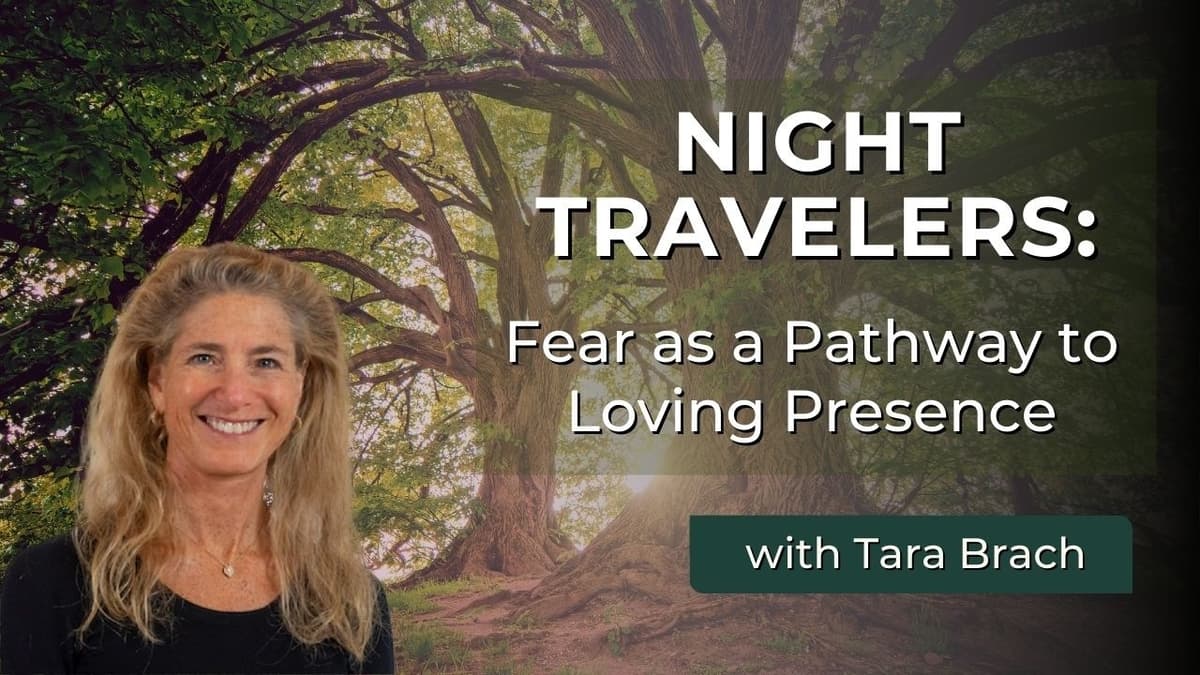
Night Travelers: Fear As A Pathway To Loving Presence | Tara Brach (Retreat Talk)
In a retreat‑style talk titled “Night Travelers: Fear As A Pathway To Loving Presence,” meditation teacher Tara Brach explores how fear, rather than being eliminated, can become a doorway to what she calls the “fearless heart” or bodhicitta. She frames...
By Tara Brach

Video•Feb 26, 2026
Guided Meditation: Know That You're Here | Tara Brach
The video presents a guided meditation that starts with a deliberate breathing exercise—four-count inhalations and exhalations—to anchor the listener’s attention. Tara Brach then instructs participants to shift from actively controlling the breath to simply observing its natural rhythm, fostering a...
By Tara Brach
Video•Feb 23, 2026
Guided Meditation: Letting Go of Judgment Through Presence and Imagination | Tara Brach
In this guided meditation, Tara Brach invites listeners to dissolve judgment by anchoring in present‑moment awareness and then expanding into imaginative compassion. The practice is framed as a two‑step process: first, notice the breath and bodily sensations, then deliberately shift...
By Tara Brach