
Kim Launches Enterprise AI Execution Layer
Kim, founded by legal‑tech pioneer Karl Chapman, has launched an execution layer that converts AI‑generated requests into deterministic, governed workflows for enterprises. The platform offers a no‑code configuration tool that integrates across existing systems, ensuring reliable outcomes without locking customers into a single AI provider. It is model‑agnostic, supporting frontier models such as Claude, Gemini, and Microsoft Copilot. By automating the translation from probabilistic AI output to concrete actions, Kim aims to cut manual effort, lower costs, and improve data quality.

Exterro: Am I Ready to Bring Document Review In-House?
In-house legal teams face rising litigation, investigations, and tighter budgets, with document review consuming roughly 75% of e‑discovery costs. Over 70% of companies generating more than $1 billion in revenue already have or plan to acquire document‑review technology. Exterro argues that...

Justin Smith, Everlaw: How London & Naor P.C. Leveraged Everlaw to Deliver Big Results with a Small Team
London & Naor P.C., a boutique civil litigation and white‑collar defense firm in Oakland, used Everlaw’s cloud‑based e‑discovery platform to handle terabytes of data and complex cases with a lean staff. By leveraging Everlaw’s AI‑driven document review, analytics, and collaborative...

Opus 2 Empowers Law Firms to Extend Innovation Beyond Disputes with Its Adaptable, AI-Enabled Software Platform
Opus 2 announced that its AI‑enabled intelligent legal solution platform is now available to law firms beyond litigation, allowing them to design custom workspaces, trackers, and client portals. The adaptable platform combines structured data worksheets, collaboration portals, dashboards and AI...

Joe Calve: Judgment as a Service: The Business Model That Replaces the Billable Hour
Legal analyst Jordan Furlong predicts that AI will become the productivity engine for law firms, shifting lawyers from billable‑hour tasks to relationship‑building, empathy, advocacy, and judgment. Joe Calve argues that this shift creates a new business model—"Judgment as a Service"—where...

The EDRM Isn’t Broken; It’s Misunderstood.
The Electronic Discovery Reference Model (EDRM) is a conceptual framework, not a prescriptive workflow or technology stack. It maps the essential stages of e‑discovery—information governance, identification, preservation, collection, processing, review, production, and presentation—without dictating how they must be executed. Misunderstanding...
Why Screenshots Fail in Mobile Ediscovery: Brett Burney Talks Defensible Collection with Nextpoint Partner ModeOne
Brett Burney, senior director at Nextpoint, explained to Legal Tech Daily that using screenshots to capture mobile device data in eDiscovery is unreliable because screenshots lack metadata, can be altered, and fail to preserve the full context of the original...

India Just Redrew the Map on Cross-Border Discovery
An appellate ruling by the Madras High Court in Softgel Healthcare v. Pfizer refused to execute U.S. Letters Rogatory seeking manufacturing records from an Indian API supplier, citing four provisions of the Hague Evidence Convention. The court rejected the request...

Syllo CEO: Firms Will Become &Lsquo;More Selective and Discerning' In Adopting AI Tools
Law firm AI adoption is becoming more selective, according to Jeffrey Chivers, CEO of Syllo. While competitive pressures push firms to integrate AI, the technology also threatens traditional billable‑hour models, prompting careful evaluation of tools. Syllo, a recent Legalweek Leaders...
The EDRM Isn’t Broken; It’s Misunderstood.
Craig Ball argues that the Electronic Discovery Reference Model (EDRM) isn’t fundamentally broken; its perceived flaws stem from widespread misunderstanding. He outlines common misconceptions, such as conflating distinct stages and applying outdated workflows to modern technology. The piece stresses that...

Product Walk Through: TransLegal
TransLegal unveiled a multilingual legal translation engine that tackles the inaccuracies of generic large language models. Leveraging the world’s largest legal terminology database covering 75 jurisdictions, the platform embeds verified terms and comparative‑law context directly into legal‑tech workflows. The solution...

Third-Party Risk Management Must Now Confront AI, Cybersecurity, and Technology Risk Head-On
Third‑party risk management is undergoing a fundamental shift, requiring AI, cybersecurity and broader technology risk to be embedded in core vendor assessments. Traditional categories like corruption and sanctions remain relevant but are insufficient as vendors now provide cloud services, AI...

Truth on Trial: Deepfakes and the Future of Evidence
The legal community is confronting deepfakes—AI‑generated audio, video and images—as a credible evidentiary threat, prompting courts to demand rigorous authentication rather than deference. Existing Federal Rules of Evidence lack specific guidance, leaving judges to apply case‑by‑case standards while experts and...

☕🤖Tutorial: Turn ChatGPT Into Your Contract Analyzer (Review Any Agreement in 10 Minutes)
The post walks readers through building a Contract Analyzer using ChatGPT or Claude, turning any agreement into a plain‑English clause‑by‑clause summary, risk ranking, obligation map, and negotiation playbook. By feeding the contract text into a series of four prompts, users...

Will Anthropic’s Claude Partner Network Impact Legal Tech?
Anthropic has unveiled the Claude Partner Network, a $100 million initiative to accelerate enterprise adoption of its Claude large‑language model. The program enlists consulting giants such as Deloitte and Accenture to provide implementation, engineering, and go‑to‑market support. While the network promises...
Lawyers and Cybersecurity: Talk to An Experts. Before It’s Too Late
At Legalweek, Michel Sahyoun of NopalCyber warned that law firms are dangerously complacent about cybersecurity in the era of generative AI. Breaches are exploited in an average of 29 minutes, and AI tools can scan for vulnerabilities at scale. The...

Lawyers and Cybersecurity: Talk to An Experts. Before It’s Too Late
At Legalweek, Michel Sahyoun of NopalCyber warned that law firms are overlooking cybersecurity as generative AI becomes mainstream. He highlighted that the average time to exploit a breach is just 29 minutes, and AI tools can continuously scan for weaknesses....

August Wins Big Law Firm Hughes Hubbard
August, a legal‑AI platform aimed at midsize and boutique firms, announced that AmLaw 200 firm Hughes Hubbard & Reed has selected it as a firm‑wide solution. The adoption spans practice areas and core business functions such as finance, billing, marketing, and...
Exterro Director of Product Marketing: Focus Will Shift From AI Strategies to Data Strategies
Exterro’s director of product marketing, Fahad Diwan, announced that the company will shift its strategic emphasis from artificial intelligence initiatives to comprehensive data strategies. He emphasized data minimization and governance as critical in an era of expanding AI use, tightening...
IManage EVP of Product Management: Legal Tech Buyers Moving Toward Strategic Selectivity”
iManage’s EVP of product management Shawn Misquitta told Legal Tech Monitor that the wave of short‑term AI pilots is waning as legal departments shift toward strategic, selective procurement. Buyers now prioritize platforms that deliver measurable ROI, seamless integration, and strong...
Factor's Chief Strategy Officer: Industry Shifting From AI Access to AI Fluency
Factor’s chief strategy officer, Chris DeConti, says legal‑tech buyers are moving beyond simple AI access toward true AI fluency. The shift reflects a maturation in procurement, with firms seeking integrated, strategy‑driven deployments rather than isolated pilots. Factor’s award‑winning training program,...

Harvey Announces Heavyweight Inaugural In-House Advisory Board
Harvey, a legal‑AI startup, announced its inaugural in‑house customer advisory board on March 16. The board brings together senior legal leaders from HSBC, MongoDB, Dentsu, NBCUniversal, Koch and Bridgewater. Harvey already supports more than 500 corporate legal teams worldwide and...

Redaction Done Right: How Legal Professionals Can Strengthen Confidentiality Using Tungsten Automation Power PDF
Tungsten Automation Power PDF is gaining traction in law firms as a cost‑effective alternative to legacy PDF tools, offering true, irreversible redaction that permanently removes sensitive content. Its automation features—search‑and‑redact, pattern recognition, and batch processing—address common redaction failures that expose...

5 Key Takeaways From Legal Week
Artificial Lawyer reported that LexisNexis unveiled plans for 10,000 pre‑built AI workflows, signaling that legal AI has moved beyond the modest assistant role most firms currently use. The segmented‑workflow approach lets AI handle extensive, billable tasks, a capability many large...

ComplexDiscovery OÜ and EDRM Release Complete Analysis of the Winter 2026 eDiscovery Pricing Survey
ComplexDiscovery OÜ and the Electronic Discovery Reference Model released the full analysis of the Winter 2026 eDiscovery Pricing Survey, the fifteenth semi‑annual Pricing Pulse study. The survey gathered 53 practitioner responses between December 2025 and February 2026, covering forensic collection, data processing, hosting,...

Managed IT Solutions for Birmingham Alabama Law Firms
Law firms in Birmingham, Alabama are turning to managed IT services to safeguard confidential client data and maintain uninterrupted operations. Providers like Vulcan Telecom deliver continuous network monitoring, rapid issue resolution, and robust cybersecurity measures tailored to legal workflows. Structured...

Legalweek 2026: HYCU Showcases Legal 360, the First Matter-Centric Resilience Solution for Law Firms
HYCU unveiled Legal 360 at Legalweek 2026, a matter‑centric resilience platform built for law firms and legal departments. The solution unifies protection for iManage Cloud, Microsoft 365, Entra ID, DocuSign and hybrid infrastructure, delivering automated backups, granular recovery, and immutable copies. A previewed...

Comment: Legalweek’s GenAI Mock Courtroom May Be the Warning Nobody Heeded
LegalWeek’s 2026 mock courtroom debated the defensibility of generative AI (GenAI) for document review, with the mock judge accepting validation statistics as sufficient. The article argues that recall and precision metrics only measure retrieval, not the interpretive judgments that GenAI...
Legalweek 2026 Post-Show News Rundown: Avvoka Closes $18.5M Funding Round, FTI Consulting Launches IQ.AI Studio and More
Avvoka announced an $18.5 million Series B round at Legalweek 2026, aimed at accelerating its contract‑automation platform and expanding global sales teams. The round was led by existing backers alongside new venture capital partners. In parallel, FTI Consulting unveiled IQ.AI Studio, an...
Overheard at Legalweek 2026: Moving Past &Lsquo;Yes or No?' To AI
Legalweek 2026 highlighted a pivotal shift in legal AI from simple yes‑or‑no outputs toward nuanced, context‑aware reasoning. Panels and keynotes emphasized that firms are demanding tools that can interpret complex statutes, weigh competing interests, and provide risk‑adjusted recommendations. Vendors showcased...

BLTF 2026 Video – “What’s the Hardest Truth About AI ROI that Firms Aren’t Ready to Hear Yet?”
At the British Legal Technology Forum on March 11, Legal IT Insider asked leading legal‑tech vendors what the toughest truth about AI return on investment is. Representatives from Jylo, Wavenet, Novaplex, NetDocuments, Jigsaw, Trakti and Elite all highlighted that firms...

SKILLS 2026 Unveils Top 10 Recommended Legal Tech Vendors
The Strategic Knowledge and Innovation Legal Leaders Summit (SKILLS) released its 2026 top‑10 legal‑tech vendor rankings, based on recommendations from 106 large law firms. DeepJudge retained the #1 spot, followed by Centari, SimplyAgree, Legora, and Harvey, with DraftWise, Syntheia, Definely,...
Why AI Summarization Is One of the Best Use Cases for GenAI in Legal Today
Legal firms are increasingly deploying generative AI to summarize contracts, pleadings, and discovery material, turning thousands of pages into concise briefs within minutes. The technology leverages large language models fine‑tuned on legal corpora, delivering context‑aware abstracts that preserve critical clauses...

HaystackID: Judicial Guidance on Enhancing Conflicts Screening for Document Reviewers
The article highlights how AI is reshaping document review in civil litigation, enabling faster identification and analysis of responsive materials. While AI-driven workflows promise efficiency, they do not eliminate the need for skilled contract review attorneys. Judicial guidance now emphasizes...

Reveal: Litigation Discovery Software with AI eDiscovery Capabilities
Reveal has launched an AI‑powered litigation discovery platform that automates eDiscovery tasks such as identification, collection, and review of electronic evidence. The solution promises to slash document review time and lower costs, addressing the growing demand from legal professionals—79% of...

An Interview with Jerry Goldman, Founder of the Oyez Project
Jerry Goldman, founder of the Oyez Project, discussed how he spent 25 years digitizing the Supreme Court’s decaying audio archives and making them publicly searchable. He explained the technical hurdles of preserving reel‑to‑reel tapes, the partnership with Cornell’s Legal Information...

Guest Post: The New Physics of Legal Tech: Who Performs Legal Work in the AI Era? (Part 3 of 3)
The third installment of Ken Crutchfield’s series examines how artificial intelligence is redefining who actually performs legal work. It argues that routine tasks—such as document review, contract drafting, and basic research—are increasingly handled by AI engines like ChatGPT, Claude, and...

Microsoft Dynamics Partner Roundup: GRC Requirements for Law Firms; Enhanced Shipping Solutions; Dealer Management System; Teams Phone Capabilities
Microsoft’s Dynamics ecosystem saw four notable partner announcements this week. AllRize introduced a governance, risk, and compliance (GRC) add‑on built on Microsoft Purview to help law firms safeguard client data and manage AI usage. ShipConsole rolled out updates that accelerate...
Why More Law Firms Are Turning to IT Staff Augmentation
Law firms are accelerating legal‑technology upgrades—from cloud migrations to cybersecurity—yet many lack the in‑house expertise to execute them. To bridge this gap, firms increasingly turn to IT staff augmentation, hiring external specialists on a flexible basis. This approach supplies the...

GenAI: A Slippery Slope Of Too Much Kool-Aid?
At Legalweek 2026, industry leaders debated whether generative AI is reshaping legal education or merely creating a new class of prompt engineers. The article argues that law schools and firms risk prioritizing AI fluency over fundamental legal reasoning. It warns...
Case Strategy Software Guide
Litigation teams face mounting pressure from exploding data volumes, tighter deadlines, and heightened client expectations. Traditional case management tools, which only organize data, are increasingly inadequate for modern demands. A new category of AI-enabled case strategy software is emerging to...

Websites Change. Perma Links Don’t.
Perma.cc offers a simple, library‑backed solution to the growing problem of link rot by creating permanent, unalterable snapshots of web pages for citation purposes. Users copy a URL, paste it into the platform, and receive a stable Perma Link that...
Legalweek 2026 Day 2: Activating Data Breach Strategies, Gauging Reactions to AI Adoption
Legalweek 2026’s second day spotlighted two urgent priorities for law firms: fortifying data‑breach response plans and integrating next‑generation AI tools into practice. Panels emphasized proactive incident‑response playbooks, real‑time breach monitoring, and alignment with evolving privacy regulations. Parallel sessions tackled lawyer...

Coercive Sanctions Ordered by Court: EDiscovery Case Law
Illinois District Judge David W. Dugan in Mueller v. City of East St. Louis ordered the defendants to produce complete compensation records and conduct a renewed, good‑faith search for electronic communications. The court imposed coercive sanctions of $100 per business...
Legalweek 2026 Day 1: Identifying Law Firm Return on Investment in AI
Legalweek 2026 opened with a deep‑dive into how law firms can quantify the return on investment (ROI) of artificial intelligence. Panels highlighted three core dimensions—quality of work product, economic gains, and integration potential—as the basis for a unified measurement framework....

Episode 397 — LRN’s Program Effectiveness Report
LRN’s 2026 Ethics & Compliance Program Effectiveness Report, titled “The Next Leap: Technology, Trust, and the Transformation of Compliance,” surveys over 2,500 compliance professionals and employees worldwide. The study reveals that while compliance programs are increasingly sophisticated and tech‑enabled, many...

K&L Gates Earns ISO/IEC 42001:2023 Certification for AI Management System (AIMS)
Global law firm K&L Gates has become one of the first firms worldwide to earn ISO/IEC 42001:2023 certification for its Artificial Intelligence Management System. The audit validated robust controls over accountability, risk, ethics, transparency, data protection and regulatory compliance. The...

The New Face of Discovery: HaystackID’s CoreFlex Brings AI, Slack, and Enterprise Data Into One Legal Workflow
HaystackID unveiled major upgrades to its CoreFlex platform at Legalweek 2026, adding native connectors for Slack, Microsoft Purview, structured chat, and third‑party productions. The enhancements embed AI analytics, forensic scheduling, and end‑to‑end audit logging within a single matter‑centric interface. By...
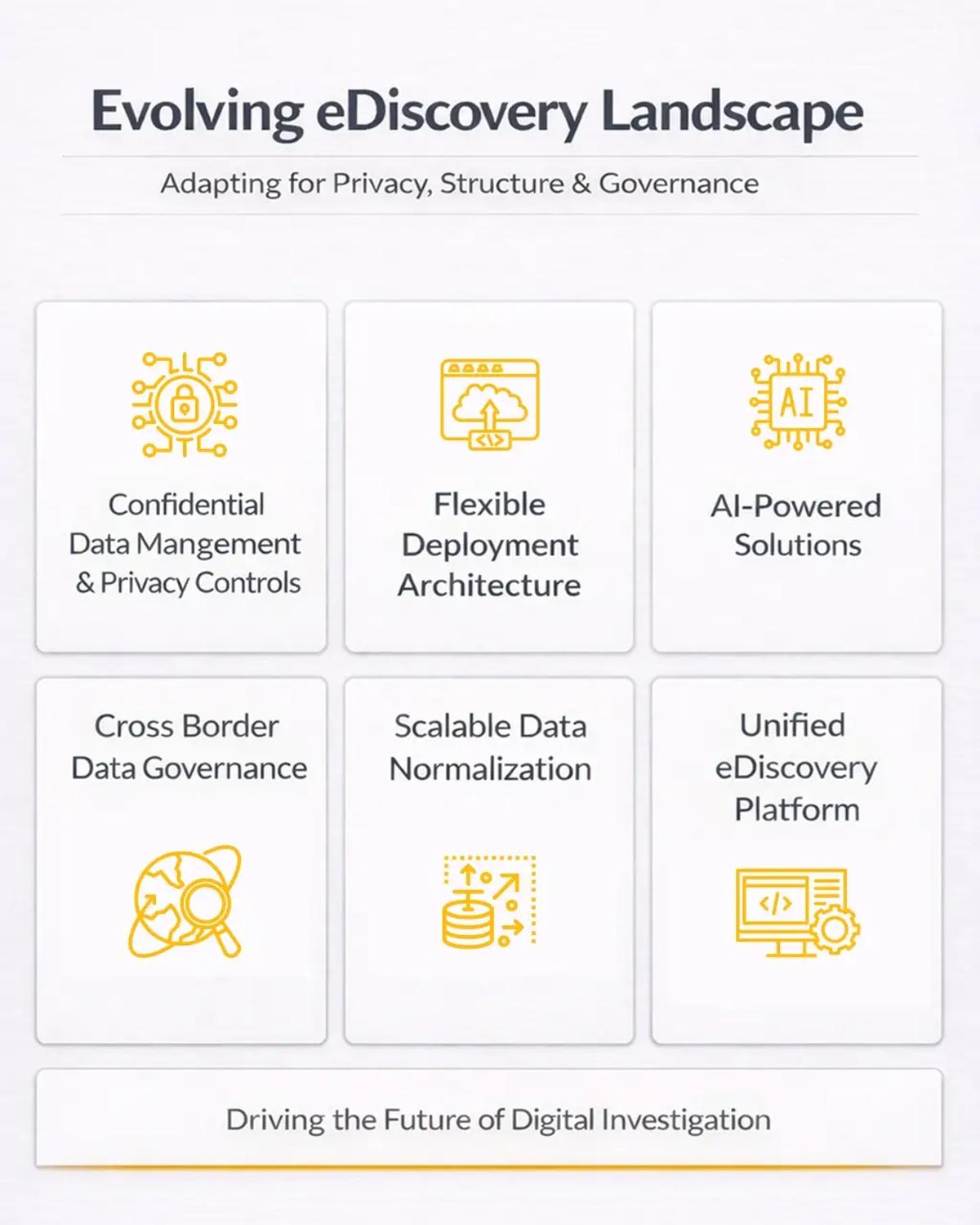
6 Emerging Shifts Reshaping eDiscovery Needs
The eDiscovery sector is undergoing six pivotal shifts, driven by stricter privacy regulations, cloud flexibility, and AI integration. Confidential data management now embeds GDPR‑style controls, while deployment models like BYC and BYAIM offer scalable, jurisdiction‑aware environments. AI‑powered analytics replace manual...
Former Uber AGC: Tech Providers &Lsquo;Overpromising Can Lead to Disappointment'
Ruby Zefo, former Uber AGC for privacy and cybersecurity, warns that technology providers often overstate the capabilities of generative AI tools. She argues that this overpromising fuels disappointment among corporate legal departments that are rapidly insourcing AI-driven workflows. Zefo advises...