
They Called It a Disorder. AI Just Made It the Most Valuable Thing in the Room.
The essay reframes neurodivergent cognition as a unique artistic aesthetic rather than a disorder, arguing that AI’s automation of routine tasks makes this cognitive fingerprint the most valuable asset in any setting. It highlights how traditional environments have been mis‑tuned, failing to recognize the rare, high‑capacity way some minds process ideas. By positioning this neurocomplexity as a scarce resource, the author suggests it will become a decisive competitive advantage in the AI era. The piece calls for a shift in how society and businesses value and integrate such minds.

"Thinkhaven"
Thinkhaven is a proposed intensive writing program designed to train participants to generate novel, useful ideas daily. Participants must publish a 500‑word research journal each day, embed at least one new question, and produce a 2,500‑word effort post every two...

Gentle Techniques to Activate Your Nervous System and Break Free From Stagnation
Feeling stuck often signals an underactive or overwhelmed nervous system. The article outlines gentle, mindful practices—breathing exercises, low‑impact movement, sensory touch, and grounding—to safely stimulate the sympathetic and parasympathetic pathways. These techniques aim to restore energy, clarity, and emotional regulation...

Fair Judgment Under Pressure
Developing sound judgment under pressure requires deliberate, multidimensional reasoning. The article outlines a simple five‑step structure—calm, define, assess high‑risk facts, choose, and adjust—to avoid impulsive, high‑regret choices. It emphasizes pausing, filtering noise, obtaining external perspectives, and preferring reversible decisions. These...

The Deep Code 07: The Miracle Has a Mechanism
The post unveils a six‑part framework that treats the subconscious as a generative substrate whose accumulated patterns dictate conscious behavior. By applying horizontal counter‑accumulation, readers can gradually erode entrenched aversion and attachment loops, while vertical concentration can inject change directly...

Reframing the Problem of Being Human
Jim Palmer’s latest series introduces “existential health,” a nascent discipline that shifts the focus from belief‑based problems to the structural frameworks shaping how people engage reality. Across five interconnected essays, he argues that inherited linguistic, religious, and questioning patterns distort...

The Simplest Way to Stop Feeling Tired
Over 80% of workers report insufficient energy, and more than half feel burned out, according to Microsoft’s Work Trend Index. The post argues that common fixes—relying on coffee, nicotine, or extensive bio‑hacking—create a cycle of spikes and crashes, while obsessive...

The Neuroscience of Being Unapologetically Yourself
The piece outlines how authenticity is a measurable brain state that influences stress, reward, and social connection. When behavior diverges from inner values, the anterior cingulate cortex flags the mismatch, generating discomfort and cortisol spikes. Conversely, genuine self‑expression lights up...

10 Success Habits To Become Unstoppable, According to Charlie Munger
Charlie Munger argues that unstoppable success stems from disciplined habits rather than raw intellect. He outlines ten practices—from delivering genuine value and continuous learning to inverting problems and staying within one’s circle of competence—that compound over decades. The habits emphasize...

I’m OK, You’re Not OK
The post weaves together Transactional Analysis theory, India’s energy‑security gaps, record election turnouts, and a cultural spotlight on Thundercat’s new album. It argues that President Trump’s harsh remarks on India reflect a “Parent” ego state, while India’s strategic crude reserve...

The Multifamily Operations Daily Huddle: Why Leadership Is a Long Game
The article argues that multifamily leadership is a marathon, not a sprint, emphasizing that lasting impact comes from developing people rather than personal accolades. It highlights a regional director whose protégés now manage portfolios across three states, illustrating the power...

3 Ways to Continually Elevate Athletic Performance Throughout Your Career
The article argues that mindset, not raw talent, separates athletes who keep improving from those who plateau, using Michigan star Yaxel Lendeborg’s career as proof. It outlines three mental performance strategies—rejecting comfort, persisting through invisible results, and seeking feedback—to sustain...
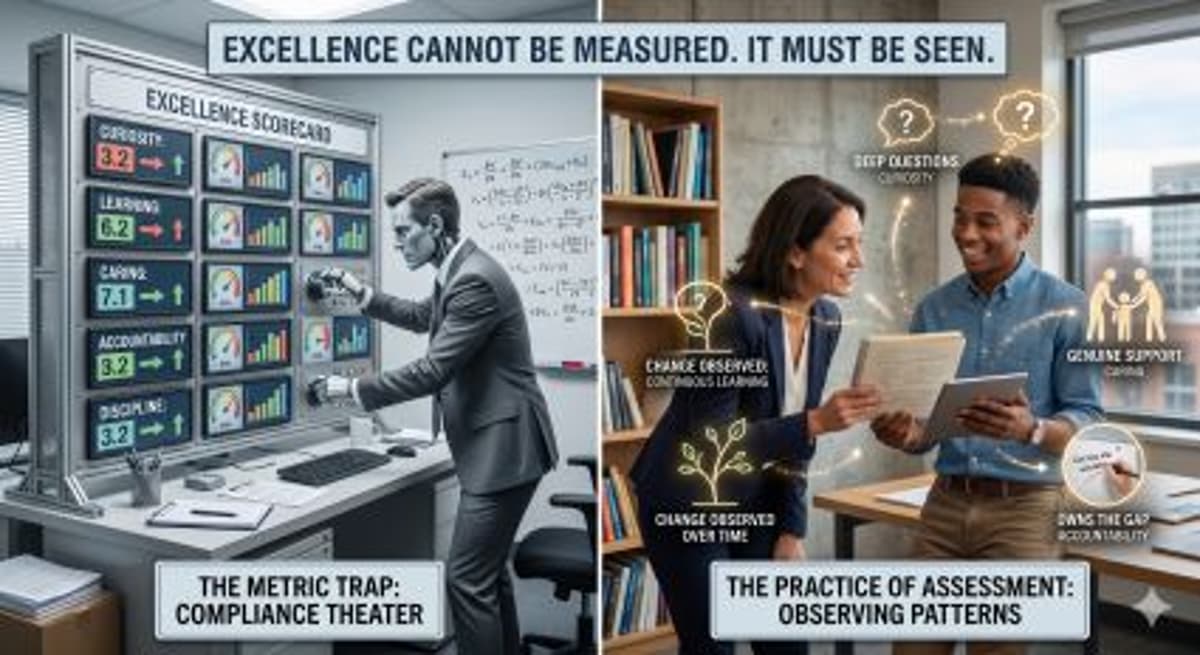
What You Can’t Count, You Have To See
The article warns that turning soft‑skill behaviors—curiosity, learning, caring, customer centricity, adaptability, accountability, discipline, purpose—into numeric scores collapses their essence. When leaders chase metrics, employees game the system, producing compliance theater rather than genuine change. Instead, the author argues these...

5 'Polite' Habits That May Harm Your Relationships
The article argues that many well‑intentioned "polite" habits—such as avoiding uncomfortable feedback, never correcting mispronounced names, or ignoring obvious appearance issues—actually sabotage personal and professional relationships. It draws on Brené Brown’s principle that "clear is kind, unclear is unkind" to...

Takeaways From EXTEMP WITH AMY & MIKE: April 2026
The April 2026 episode of EXTEMP with Amy & Mike turned the post‑test‑prep lull into a strategic planning sprint, mapping summer class schedules and conference marketing. Amy highlighted an AI‑driven itinerary for a multi‑generational Grand Canyon trip, while both hosts shared...

Favourite Naval Tweets:
Naval Ravikant’s curated tweets distill his philosophy on wealth creation, emphasizing the power of specific knowledge, leverage, and relentless learning. He argues that true riches arise from delivering what society needs at scale, using leverage as a force multiplier for...

The Wound That Became the Ministry
The author reflects on how profound loneliness, depression, and adolescent atheism forged an interior depth that later became the foundation of a therapeutic ministry. This “intelligent isolation” created hyper‑vigilant monitoring, which was later reframed as professional attunement and empathy. The...

The Bird That Is Your Life
Emily Ogden’s essay in the collection On Not Knowing uses the bird metaphor to probe the anxiety of living a life that might be deemed an imbecility. Drawing on poets such as Dickinson, Szymborska and Murdoch, she argues that authentic devotion requires...

How To Stop Being Your Own Tragic Hero
The post warns founders against inflating successes and catastrophizing setbacks, urging a realistic view of their stakes. It outlines practical steps—finding joy in small wins, balancing humility with conviction, and prioritizing self‑care—to protect mental health. The author stresses that genuine...

Lead with Trust and Care in the Age of AI: Your Blueprint for Growth
Artificial intelligence is reshaping workplaces at unprecedented speed, creating a "trust gap" as employees grapple with role uncertainty and digital isolation. Leaders who focus solely on technology risk eroding confidence, while those who prioritize transparent communication and empathy can turn...

What Is This Actually For?
Danny Kenny, a behavioral scientist and Associate VP at InspireCorps, launched the "Work Wise" newsletter to help high‑performing professionals uncover purpose behind their work. Drawing on leadership coaching, behavioral research, and interdisciplinary reframes, each issue dissects a real‑world misstep, explains...

Why Doubling Down on Your Position Never Works — and What Does
The article argues that doubling down on one’s own position backfires in persuasion. It promotes a "them‑first" mindset, leading with emotion, using stories, and mastering subconscious signals like tone and pacing. Practical steps include identifying the counterpart’s priorities, swapping arguments...

“Push & Pull” In Talent Upskilling
The article reframes talent development as a dual "push‑pull" system powered by AI. "Push" now means automated, data‑driven learning nudges, compliance guardrails and performance benchmarks, while "pull" relies on purpose, mentoring and self‑managed teams to inspire intrinsic motivation. Leaders must...

No Worry
The poem “No Worry” is a motivational piece that urges readers to release anxiety, embrace courage, and recharge personal energy. It frames resilience as an internal process that can ripple outward, influencing broader cultural attitudes. By encouraging authentic self‑expression and...

A Leadership Reset for ISFJ Personalities
The post spotlights a hidden burnout risk for ISFJ (Defender) leaders, who often become the invisible backbone of their teams. While 87% acknowledge that mental‑health days boost performance, 62% feel guilty taking them, and 23% think they don’t get enough....

The Moving Line
The author recounts chasing a six‑figure salary at 22, hitting it at 23, and later building a million‑dollar business, only to realize each achievement quickly became the new normal. A podcast guest who sold his company for nine figures echoed...

The Hidden Strength of Detached Discipline
The post introduces "detached discipline," a mindset where actions are taken regardless of fleeting emotions. By pre‑deciding when and how to act, individuals sidestep motivation spikes and dips, turning behavior into an automatic habit. The author outlines a simple practice:...

Leverage Is Everything
Kevin Naughton Jr. promotes high-leverage work over busy work, arguing that a small fraction of activities generate the majority of results. He showcases Miro’s AI‑powered Flows feature, which embeds intelligence into the canvas to turn ideas into actionable roadmaps. The...

Aging Minds, Persistent Fears: The Habit Cycle Behind Health Anxiety
Health anxiety, often triggered by minor bodily sensations, follows a habit loop of cue, rumination, and temporary reassurance. This loop solidifies over time, turning occasional worry into a chronic mental‑health condition. The article explains how the cycle fuels repeated doctor...

Falling in Love With the Process Instead of Results
Most people tie discipline to visible results, causing motivation to dip when progress stalls. The blog argues that sustainable discipline emerges when individuals prioritize the process over outcomes. By decoupling effort from immediate rewards, consistency becomes a habit rather than...
Why Your Best Decisions Might Be Your Worst
In a paid episode of The Best Leadership Newsletter Ever, Jeff Matlow explores a subtle decision‑making bias where leaders mistake relative comparisons for optimal choices. He illustrates how hiring the "best" candidate among a limited pool can still be a...

The Productivity Routine: Structure Your Day
The post argues that productivity hinges less on raw discipline and more on daily structure. By giving the day a clear shape, individuals guide their attention and avoid the drift that erodes output. The author contrasts common advice—early rising, harder...
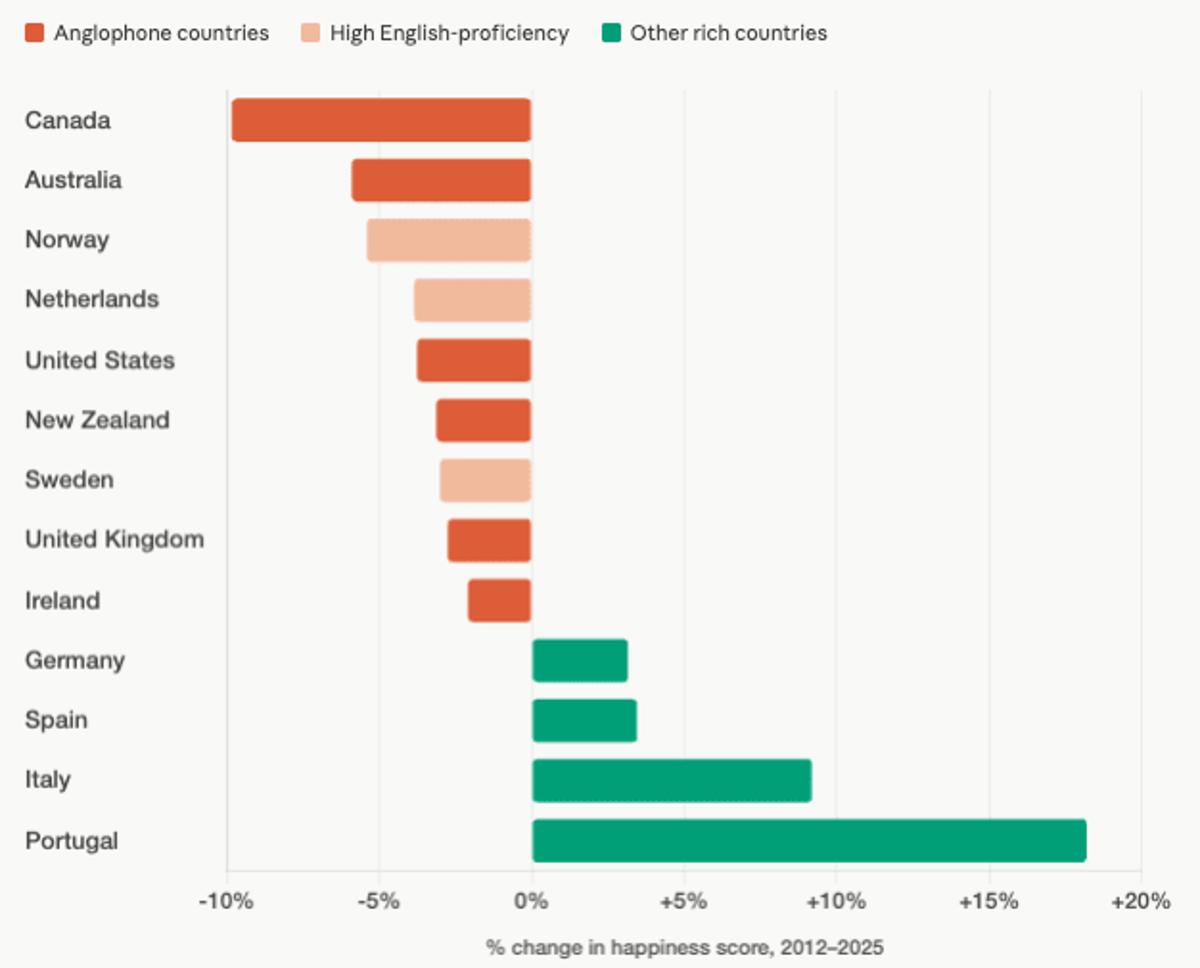
If I’m So Unhappy, Why Aren’t I Worse Off?
A recent New York Times analysis reveals that happiness scores have slipped across wealthy nations despite record financial prosperity. The accompanying bar chart tracks percentage changes from 2012 to 2025, highlighting steeper declines in Anglophone and high‑English‑proficiency countries compared with other...

How to Overcome Ultra-Independence and Receive Love and Support
The article explains ultra‑independence as a trauma‑driven coping mechanism that forces people to handle everything alone, often at the cost of loneliness and mental‑health struggles. It illustrates how early experiences of rejection and conditional love can cement this pattern, leading...

Stop Waiting to Feel More Serious — 24 April
George argues that waiting for a feeling of seriousness before starting work is a self‑defeating habit. He contends that seriousness is a byproduct of consistent action, not a prerequisite. By treating tasks with full attention from the outset, the desired...
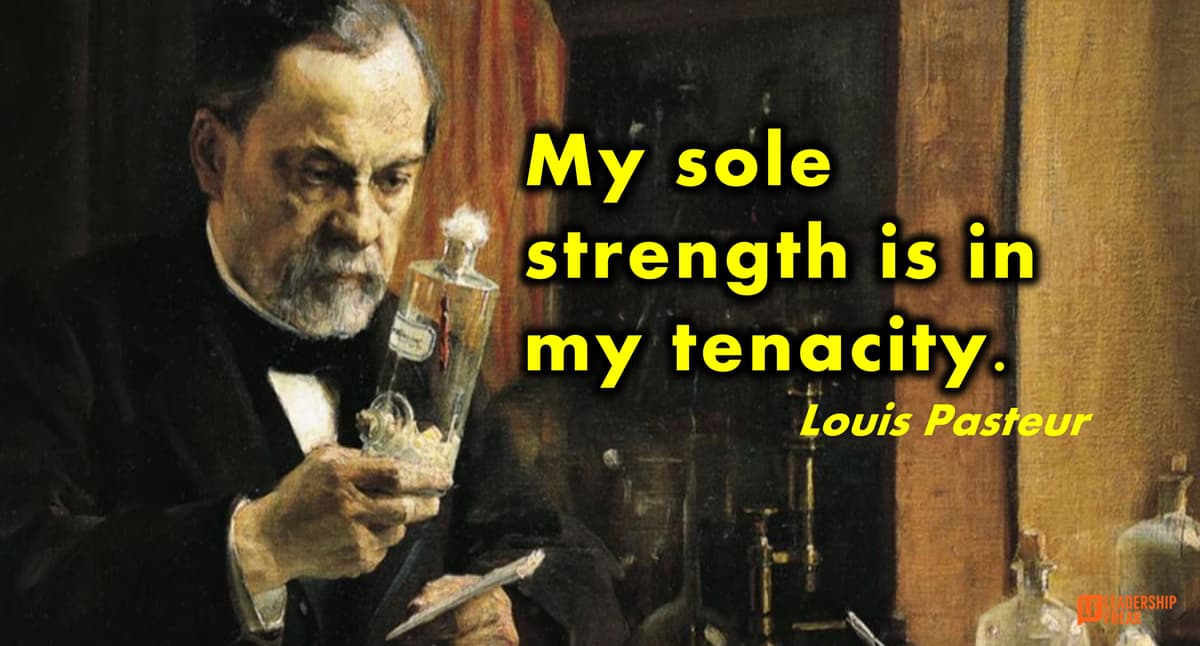
4 Ways to Build Tenacity in Others
The article outlines four practical ways leaders can cultivate tenacity in their teams. First, it urges an “earn‑it” mindset that frames opportunities as rewards for effort. Second, it recommends adding challenge weight incrementally to avoid overwhelming employees. Third, it suggests...

How Successful Leaders Guide Change without Overwhelm or Burnout
Episode 350 of The Change Signal podcast tackles why most change programs now fail, citing an 85‑95% failure rate as organizations wrestle with relentless disruption. Host David and author Michael Bungay Stanier argue that traditional top‑down mandates are outdated and that leaders must...

Mentorship Matters with Dave & Liz: Cicely LaMothe on Mentorship in Corp Fin
The latest episode of "Mentorship Matters with Dave & Liz" features former SEC deputy director Cicely LaMothe, who retired after 24 years of service. LaMothe discusses her leadership experiences, the pivotal role mentorship played in her career, and how mentorship...
23 April 2026 ~ 3 Good Things
Emily Gaines Demsky’s April 23, 2026 post reflects on the metaphor of life as a trajectory shaped by external forces and personal agency. She argues that while daily demands can pull us off course, each individual response is a force...

Monks and Scientists Rethink the Nature of Consciousness
A seven‑year adversarial collaboration at the Allen Institute pitted Integrated Information Theory against Global Neuronal Workspace Theory in a joint experiment with 256 participants and three neuroimaging modalities. Published in Nature, the study found that neither framework outperformed the other,...

Stop Taking Advice From People Who Haven’t Done the Thing
The article warns that most people take advice from unqualified, confident voices, leading to costly missteps. It introduces the "Proof of Reps" framework, urging readers to verify whether advisors have actually performed the task in question. The author categorizes advice...
Are You the Exhausted Hero?
The article names the "Exhausted Hero" pattern that high‑capacity leaders fall into—over‑availability, over‑responsibility, and taking on everything because they can. It explains how this hidden burnout silently drains energy, erodes self‑trust, and fragments decision‑making. Traditional fixes like stricter time management...

Friday Forward - Perceived Scars (#533)
In 1980 Dartmouth psychologists Richard Kleck and Angelo Strenta staged a scar‑making experiment, applying a realistic scar to participants only to remove it before a job interview. The subjects, convinced they bore a visible mark, reported heightened discrimination despite the...

Dumb Ways to Attract Anything You Want
The article argues that attracting success hinges on quiet, disciplined habits rather than loud self‑promotion. It advises whispering goals, honoring a single broken promise, and doing unseen work to rebuild self‑trust. Additional tactics include saying no to easy offers, prioritizing...
Best of Naval From 14 Years Ago
The Substack post curates eleven of Naval Ravikant’s most resonant insights from 14 years ago, ranging from the primacy of people in great companies to the paradox that launching a startup is easier than scaling one. The list emphasizes personal branding...
You Didn’t Get Slower—You Stopped Pretending the Problem Was Simple
The post reflects a personal sense of losing mental speed, describing how once‑sharp professionals now experience a noticeable pause before forming thoughts. It frames this slowdown as a hidden fatigue rather than a lack of ability, suggesting an underlying shift...

Luck? No! How Builders Manufacture the "Accidents" Outsiders Call Magic
The article debunks the myth of "luck" in business, arguing that so‑called accidental breakthroughs are the result of deliberate, high‑velocity experimentation. Historical examples—from Perkin’s mauve dye to Bell’s telephone—show that most “accidents” occurred during focused research, especially in opaque fields...

Why You Need “White Space” (And 5 Prompts to Find It)
The post argues that entrepreneurs must carve out "white space"—unused time for strategic thinking—rather than packing every calendar slot. It illustrates the concept with Victoria, a solo aviation charter broker who, amid a fuel crisis, used an AI‑driven audit to...

The Wisdom Letter #406
Philosophors' latest post, The Wisdom Letter #406, presents three thought‑provoking quotes from Helen Keller, Frank Lloyd Wright, and William Blackstone, each paired with a reflective question. The piece invites readers to contemplate courage amid unavoidable risk, the role of poetry versus science...

19 Ways to Infuse FUN Into Your Writing Process (and Have Fun Consistently)
Alex Mathers shares 19 practical tactics to make daily writing enjoyable, from treating the process as a game to writing fast and editing later. He draws on his experience of nearly 100,000 tweets over 12 years, emphasizing obsession, mindfulness, and...