
AITHON Robotics – How Robotic Drones Are Revolutionizing Infrastructure Maintenance
Aithon Robotics unveiled a hybrid aerial robot designed to transform how critical infrastructure is inspected and repaired. The company argues that two‑thirds of infrastructure budgets go toward upkeep, much of it in hazardous, hard‑to‑reach locations such as under bridges, inside tunnels, and along dam walls. Their drone combines agile flight with industrial‑grade interaction, capable of carrying up to five kilograms and exerting 500 newtons of force with millimeter precision, allowing it to drill concrete, operate core drills, and deploy radar scanners. The video highlights several data points: the robot’s payload and force specifications, its ability to mount real power tools, and its proven performance across multiple European pilot missions. By integrating inspection and intervention, the platform moves beyond traditional visual surveys to actually remediate defects on site, reducing the need for costly rope‑access crews or shutdowns. The technology originated at ETH Zurich and now participates in the Pioneer Fellow Incubation Program, underscoring its academic pedigree and commercial traction. Aithon’s founders cite a simple question—"Can a drone drill into concrete?"—as the catalyst for a prototype that has since earned awards and real‑world deployments. They emphasize that the robot’s capability to perform tasks like drilling and scanning in confined spaces opens new possibilities for preventive maintenance, catching small issues before they evolve into catastrophic failures. If adopted widely, this approach could shift the industry from reactive firefighting to proactive, data‑driven upkeep, enhancing safety, extending asset lifespans, and delivering significant cost savings for utilities, transportation agencies, and private operators.

Drive Your Poultry (and Livestock) Around Autonomously with Zack Smith of Stock Cropper
The episode spotlights Stockcropper’s strategic shift from serving large row‑crop farms to targeting the burgeoning backyard‑chicken and homestead market. Founder Zach Smith introduced the "Drive," a solar‑powered, autonomous motor that can be attached to any movable pen, turning rotational grazing...

Ocean Power Ships First PowerBuoy for U.S. Coast Guard Contract
Ocean Power Technologies announced the shipment of its first PowerBuoy system under a $6.5 million contract with the U.S. Department of Homeland Security, marking a milestone for the company’s ocean‑security portfolio. The CEO, Philipp Stratmann, highlighted that the initial buoy is already en...

Humanoid Teleoperation Explained | How It Works & Why It’s Essential for Robot Training
The video explains teleoperation—real‑time control of humanoid robots by mirroring a human operator’s movements. Using a VR headset, hand controllers and ankle trackers, the operator’s pose is captured and sent to a robot such as the Unitri G1, which reproduces...

Illia Polosukhin: Why AI Agents Are Still Useless (And What Fixes Them) | NEAR Founder on IronClaw
The interview with Illia Polosukhin, co‑author of the seminal "Attention Is All You Need" paper, explores why current AI agents remain impractical and how blockchain can remedy their shortcomings. Polosukhin explains that most generative AI deployments leak sensitive credentials to...

Here’s What It Takes to Get a Robot Ready for the World
X‑Humanoid, a Beijing‑based robotics firm, is subjecting its humanoid prototypes to rigorous eight‑hour endurance trials that combine walking, running and dancing. The tests evaluate coordination, agility and motor‑skill reliability under sustained operation. Engineers aim to identify hardware fatigue points and...

US Robotics Company Steps up Deployment in the Gulf as Companies Review Damage
The interview highlights Gecko, a U.S. robotics firm, accelerating its deployment of AI‑powered robots across the Gulf as the region’s energy infrastructure endures war‑time strikes. The conflict has driven a sharp rise in demand for Gecko’s solutions, with executives citing AI...

The Automation Tech that Keeps Your Robot Vacuum Inside... Most of the Time.
The video explains the automation stack that keeps robot vacuums confined to indoor spaces and why they sometimes wander outside. Modern units combine depth sensors, optical flow, edge detection, and AI‑driven SLAM to map rooms. Some emit LAR pulses (a form...

I Let an AI Run My Life for 50 Days
The video chronicles how a creator let an OpenClaw‑based AI agent, dubbed Aurelian, run virtually every aspect of his personal and professional life for fifty days. From enrolling his son in preschool to handling sponsor negotiations, the system functions as...

Why Fully Self-Driving Cars Are Almost Impossible | The Limit
The video examines why fully self‑driving robo‑taxis remain out of reach, contrasting Waymo’s sensor‑heavy approach with Tesla’s camera‑only strategy. It highlights that neither system has achieved true Level 5 autonomy; both still depend on human oversight, whether via driver attention or...

Wind River Enhances Road Safety with Cellular Vehicle-to-Everything Communication
Wind River showcased a Mustang EV equipped with its CV2X technology, a joint effort with parent company Aptive and Verizon Business’s ETX service. The demonstration highlighted how 5G‑enabled IoT connectivity can turn vehicles into networked computers. Using Verizon’s ETX platform, the...

Demand for Humanoid Robots Off the Charts: Humanoid CTO Cannon
In a recent interview, Humanoid Robotics CTO Cannon outlined the surge in demand for humanoid robots, positioning 2024 as the year they transition from laboratory prototypes to commercial deployments across industrial settings. Cannon said the technology now supports multiple tasks within...

Sodexo Launched an Ottonomy Delivery Robot to Serve Remote Workers
Sodexo has rolled out its first autonomous delivery robot, dubbed Autobot, in the remote Pilbara villages of Western Australia. The launch follows the company’s autonomous store pilot introduced last year and marks the first such robot deployment in the country. The...

How Humanoid Robots Joined This Factory's Workforce
Digit, a humanoid robot built by Agility Robotics, has been deployed at the Sheffller Auto Parts plant in Shiraz, South Carolina, to ferry 25‑lb baskets of bearing components to an industrial washer. The robot, nicknamed Digit, repeats the same motion...

Lucid Lays Out Plan to Turn Cash Flow Positive
Lucid Motors used its latest investor‑day briefing to outline a multi‑year roadmap toward cash‑flow positivity. The automaker emphasized that, despite heightened geopolitical risk from the Iran‑Saudi conflict, its supply chain has experienced only modest cost increases and no material production...

RJ Scaringe: Self-Driving Cars, Next 10 Years Changes EVERYTHING, Robots, AI Impacts Society MORE
Rivian CEO RJ Scaringe declares the next decade pivotal for humanity, spotlighting the company’s 2026 launch of the R2 autonomous platform as a watershed moment. He outlines Rivian’s shift toward a software‑centric architecture that unifies vehicle decisions, leverages vision‑based perception...

The Pentagon Wants to Buy 30,000 New Drones. Here’s the Key Questions.
The Pentagon unveiled its Drone Dominance program, targeting the purchase of up to 30,000 new unmanned aerial systems across the Army, Navy, Air Force and Marine Corps. The effort is designed to replace aging UAV fleets, embed artificial‑intelligence‑driven swarming capabilities,...

NVIDIA’s New AI Just Cracked The Hardest Part Of Self Driving
The video spotlights NVIDIA’s latest breakthrough: an open‑source reasoning engine for autonomous vehicles that ships with model weights, inference code, and a slice of training data. By making the system publicly downloadable, researchers and hobbyists can now experiment with a...

Task-Oriented Robot-Human Handovers on Legged Manipulators
The researchers introduce AFT‑Handover, a framework that combines large language model‑driven affordance reasoning with texture‑based affordance transfer to enable zero‑shot, task‑oriented robot‑to‑human handovers. In a controlled user study, 71.43% of participants preferred AFT‑Handover over existing state‑of‑the‑art methods, citing reduced regrasping...

The FOUR Grades of Train Automation, Explained
The video breaks down four grades of train automation (GOA1‑GOA4), clarifying what “driverless” truly means for urban rail. GOA1 is fully manual; GOA2 automates traction while a driver still controls doors and handles exceptions; GOA3 removes the driver from the cab,...

Inside Hong Kong’s Smart Airport: The $18 Billion Upgrade (Rare Access)
The video offers a rare walkthrough of Hong Kong International Airport’s $18 billion smart‑airport upgrade, focusing on the Integrated Airport Center (IC) that serves as the brain of the world’s busiest cargo hub and a top‑ranking passenger airport. The IC consolidates...

From Automation to Autonomy: Building Self-Driving Networks
At MWC26, HPE’s EVP Sujay Haja outlined how AI is turning traditional network automation into truly autonomous, self‑driving networks that prioritize user experience over mere uptime. Haja emphasized that ‘up is not the same as good,’ arguing that networks must learn,...

Gazebo Community: Terrain Generation in Gazebo Using Satellite Imagery (Feb, 2026)
The February 2026 Gazebo Community meeting opened with a shift in schedule to accommodate a guest speaker from Japan and featured a series of announcements about the simulator’s roadmap. The PMC presented a new release‑cadence proposal that synchronises Gazebo’s versioning and...

Stanford AA228 Decision Making Under Uncertainty | Autumn 2025 | Offline Belief State Planning
The lecture introduced offline belief‑state planning for partially observable Markov decision processes, emphasizing that exact POMDP solvers quickly become intractable and motivating scalable approximations. Students were shown how the number of alpha vectors grows exponentially—e.g., a ten‑step horizon can generate...
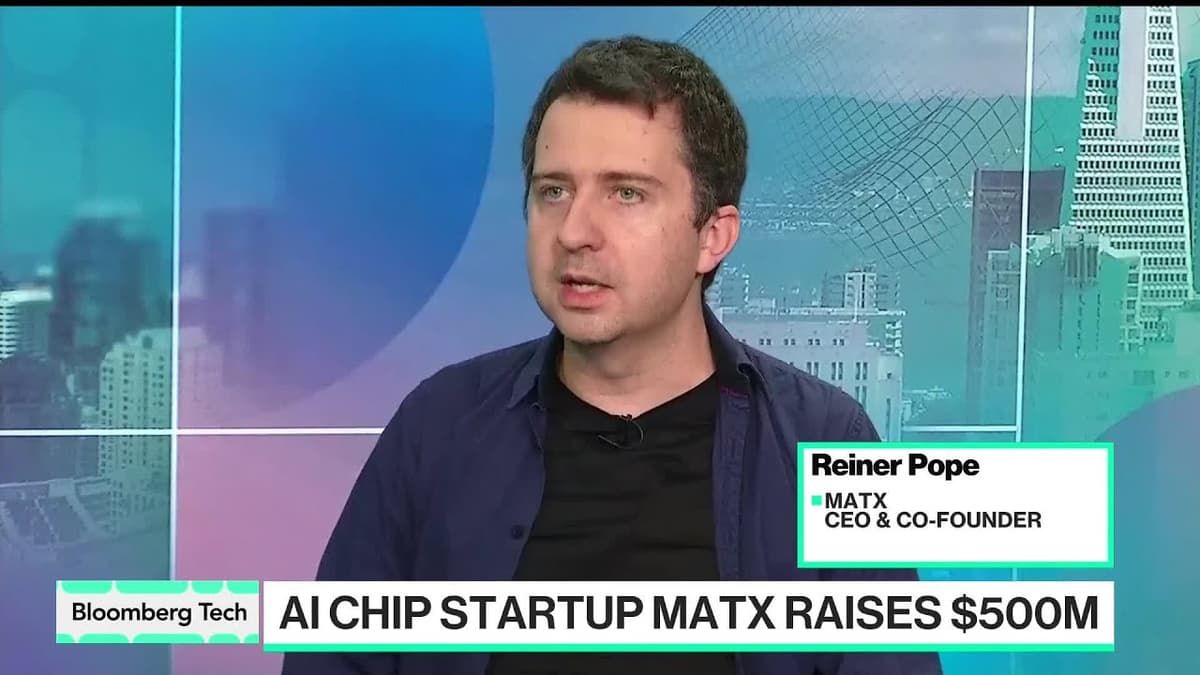
Google Alum Raises $500M to Compete With Nvidia
The video announces a $500 million Series B round for a Google‑alumni startup aiming to challenge Nvidia’s dominance in large‑language‑model (LLM) hardware. Backed by quantitative‑trading firm Jane Street and AI‑focused investor Leopold Ashenbrenner, the company says the capital will fund a hybrid chip...
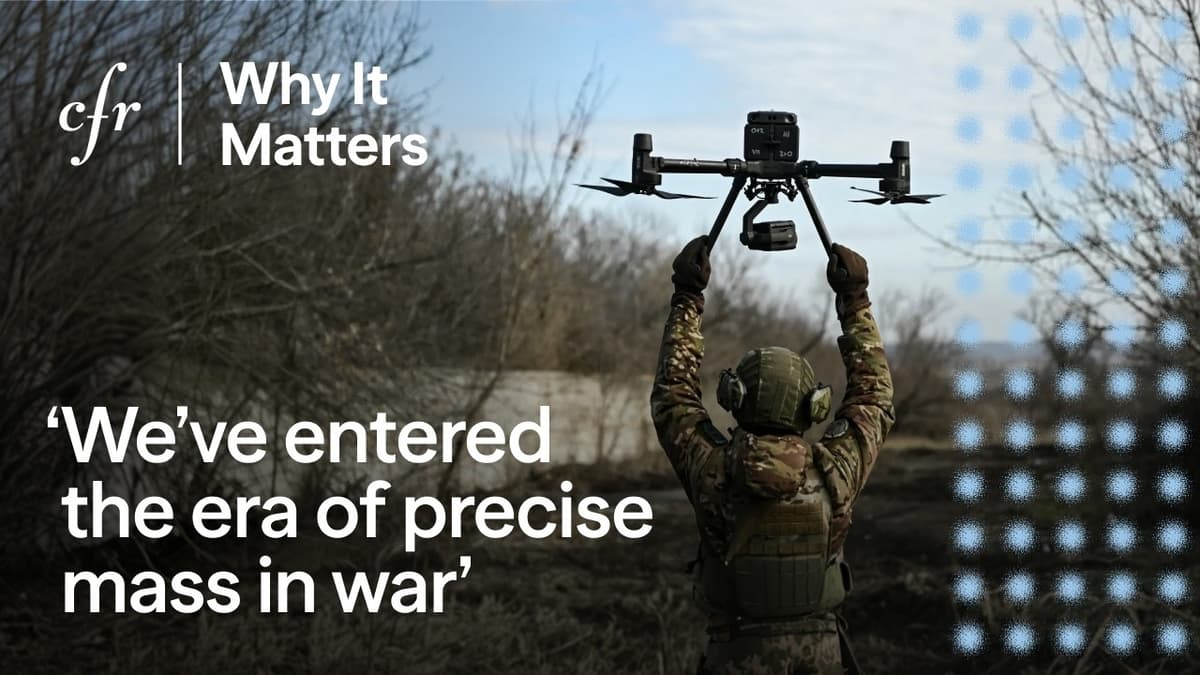
Autonomous Ukraine: We Are in a New Era of Warfare
Ukraine's ongoing war is accelerating a shift toward autonomous, low‑cost drone warfare, turning the battlefield into a fluid, swarming environment. Millions of inexpensive UAVs now conduct strike, surveillance, and electronic tasks, eroding the concept of a fixed front line. Experts...
Are Some Humanoid Robot Developments Solving the Wrong Problem?
The video questions the strategic direction of humanoid robotics, arguing that the industry has yet to define a compelling industrial use case—warehouse logistics being cited as the most promising but still undefined application. The speaker critiques the proliferation of attention‑grabbing...
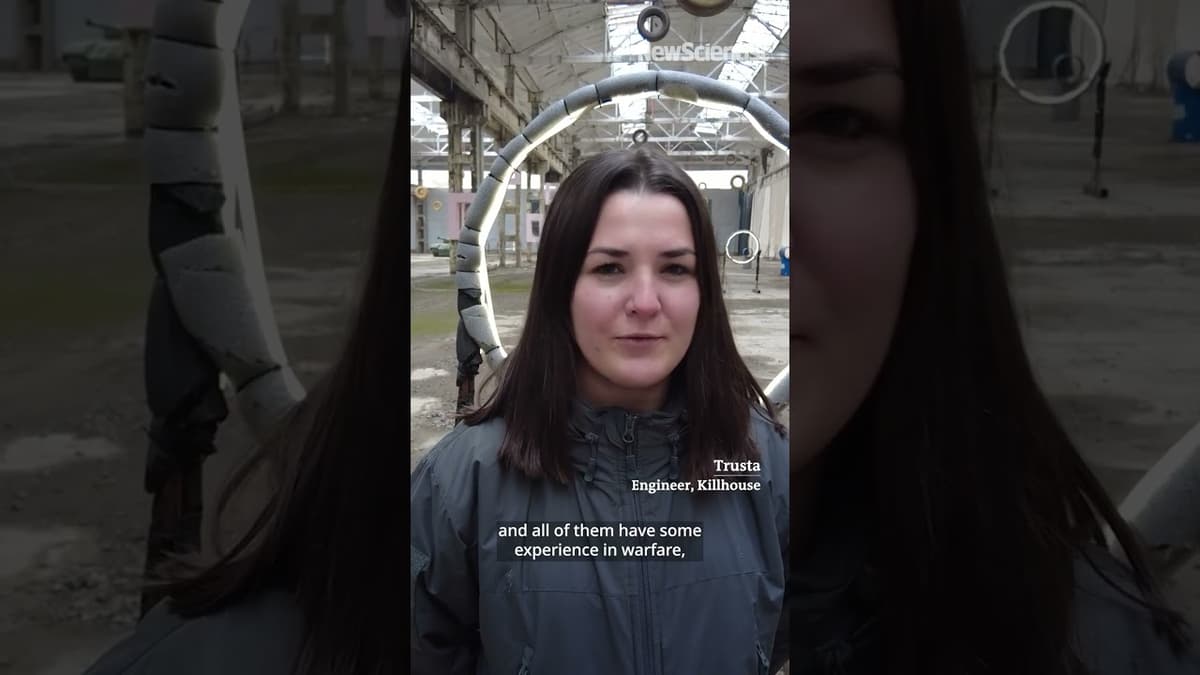
Inside Ukraine's Drone Schools
The video tours a Ukrainian air‑assault brigade’s “killhouse” where a dedicated drone school turns raw recruits into qualified UAV operators in as little as one to two weeks. Training begins on laptop simulators, progresses to obstacle‑filled flight ranges, and includes hands‑on...

Tech Foundation of WeRide and Bot.Auto - Tony Han & Xiaodi Hou
The MIT Mobility Forum session brought together Tony Han of WeRide and Xiaodi Hou of Bot.Auto to dissect the technology backbone of today’s autonomous‑vehicle push. Their conversation centered on four pillars—simulation and world models, human‑in‑the‑loop versus full autonomy, hybrid...

This New Underwater Drone Clings To Ships And Launches Drones
Lockheed Martin unveiled the Lamprey, a multi‑mission autonomous underwater vehicle (MMAV) designed to latch onto surface ships or submarines without any host modifications. Dubbed after the parasitic lamprey fish, the system can ride to a theater, recharge its batteries...
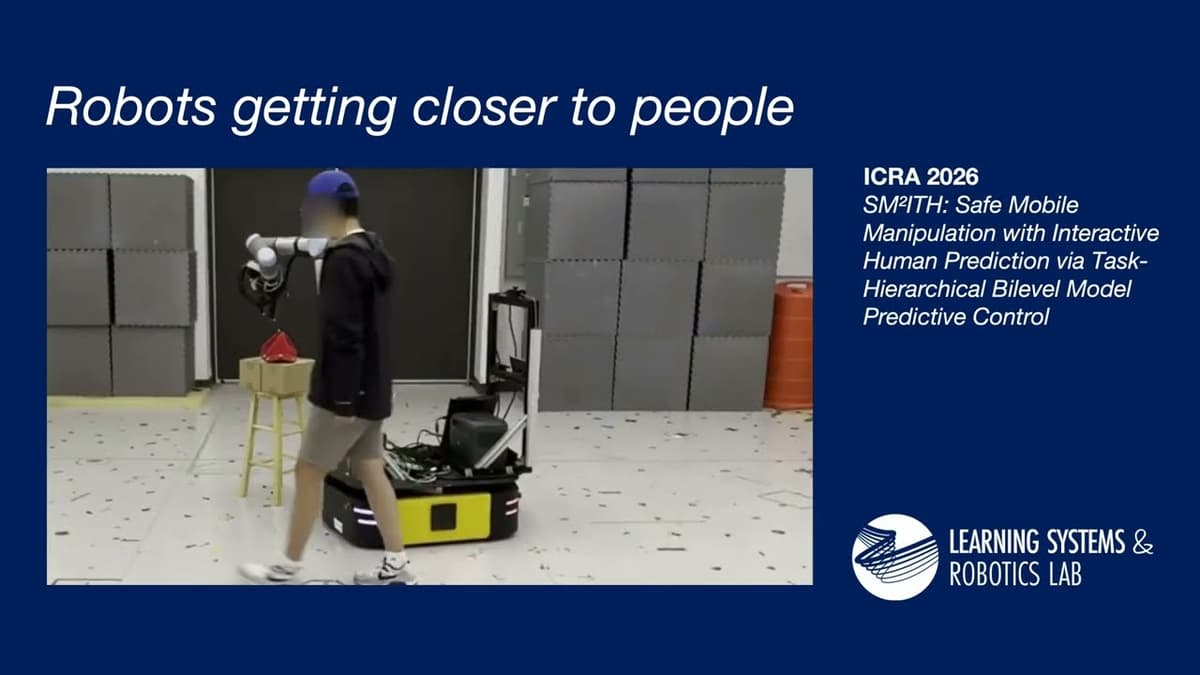
LSY @ ICRA 2026
The lab announced seven peer‑reviewed papers at ICRA 2026, spanning manipulation, crowd navigation, safety‑filtered diffusion policies, predictive model‑predictive control, large‑language‑model‑driven swarm planning, sensor scheduling, and cooperative MAV navigation. The work showcases novel algorithms that blend diffusion models with robotics, integrate...
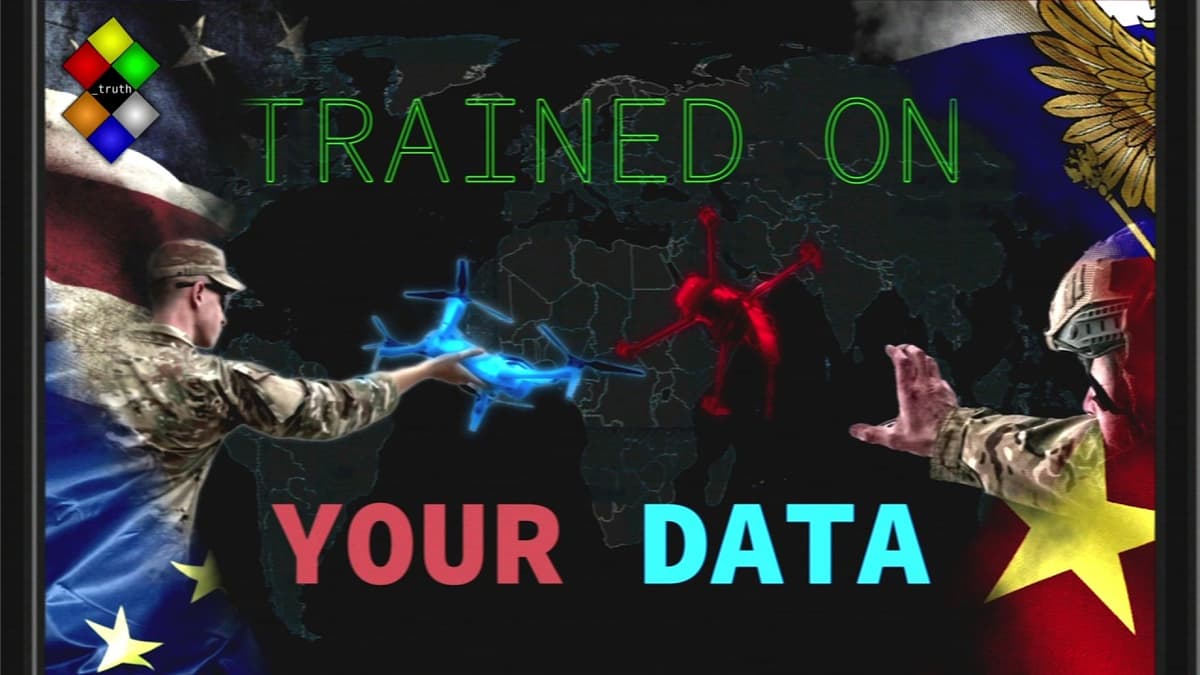
How AI Weapons Are Trained on Your Private Data
The video warns that the next generation of warfare will be powered not by nuclear arsenals but by autonomous weapons trained on the digital footprints of billions. It argues that private data harvested from social media, browsing habits and photos...
Next Generation 3D Cabin Tech - Seeing Machines CEO on Tech Leading Automotive and Robotics Future
Seeing Machines CEO says the company has a clear technological lead with a real-time 3D cabin reconstruction platform that enables scalable deployment across automotive customers and is gaining traction in new mobility programs. Early third-party conversations suggest demand for the...

RS186: Are Autonomous Trucks Outgrowing the Hub-to-Hub Model?
Wabby COO Leor Ron argues autonomous trucking is entering a new phase where an AI-first approach enables faster, far cheaper development and broad commercial deployment beyond legacy hub-to-hub models. He says regulators, OEMs and shippers are now receptive, and Wabby’s...
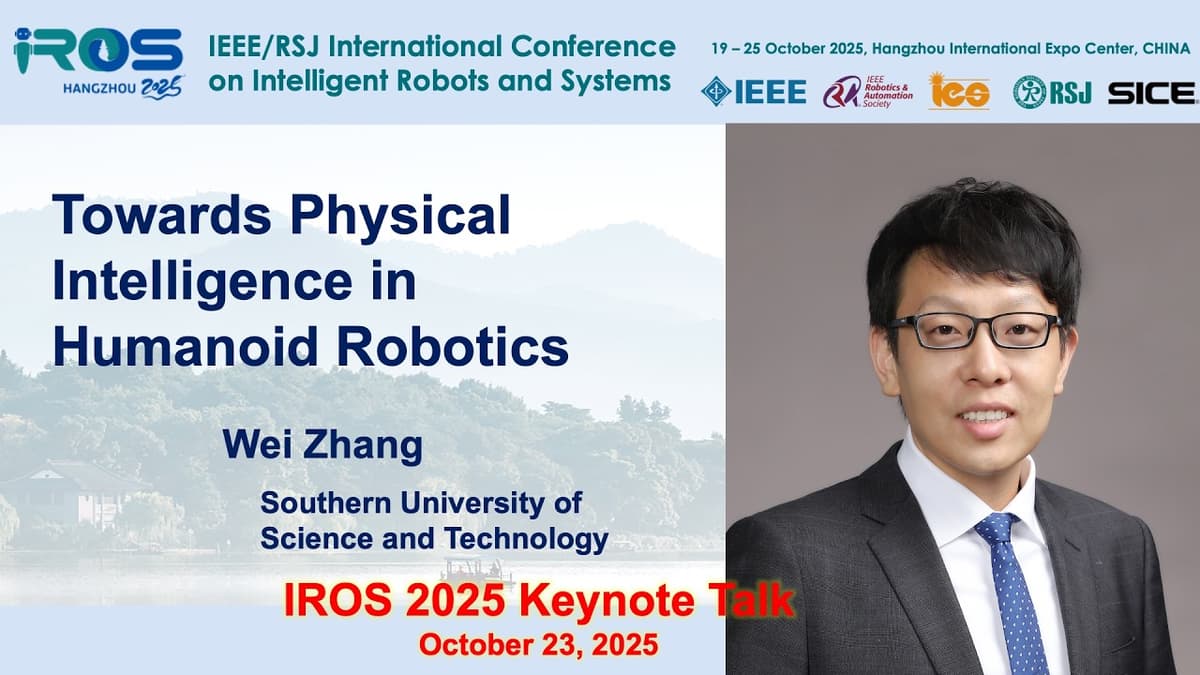
IROS 2025 Keynotes - Humanoid Robot Systems: Wei Zhang
Wei Zhang’s IROS 2025 keynote focused on the evolution of humanoid robot systems and introduced his company, Limax Dynamics, as a catalyst for practical, research‑grade platforms. Drawing on his background as a control theorist turned robotics entrepreneur, Zhang outlined the...
IROS 2025 Keynotes - Learning and Embodied Control: Abhinav Valada
Abhinav Valada’s IROS 2025 keynote outlines a roadmap toward open‑world autonomy for everyday robots, emphasizing that true utility requires systems that can learn continuously across heterogeneous environments. He frames the challenge with a data pyramid—ranging from scarce, high‑quality tele‑operated robot...

Waymo Growth Strategy Showdown – World Cup Finals 2026
Student finalists proposed a decentralized microhub strategy for Whimo to scale autonomous ride-hailing by anchoring fleets to predictable demand centers—airports, transit stations and campuses—to cut deadhead miles, boost utilization from roughly 9–20 rides per vehicle to hub-powered power-user behavior, and...

How Perseverance Learned to ‘Self-Locate’ on Mars
NASA’s Perseverance rover has gained the ability to determine its exact position on Mars without Earth‑based assistance, thanks to a new system called Mars Global Localization. The rover stitches together panoramic shots into a bird’s‑eye map, then an onboard algorithm rapidly...
IROS 2025 Keynotes - AI and Robot Learning: Xfeng Yan
In this keynote, Shifen Yan from UC Santa Barbara introduced a token‑level adaptive inference framework for transformer models, arguing that the uniform computational cost per token is inefficient for many robotics and language tasks. By inserting a lightweight router before...
IROS 2025 Keynotes - Field Robotics: Brendan Englot
Brendan Englot’s IROS 2025 keynote highlighted the latest advances in situational awareness and decision‑making for marine robots, spanning perception, exploration, and risk‑aware control. His Robust Field Autonomy Lab at Stevens focuses on equipping underwater platforms with sensors and algorithms that...
IROS 2025 Keynotes - Field Robotics: Jiancheng Yu
The keynote at IROS 2025 presented a multidisciplinary optimization framework for long‑range autonomous underwater vehicles (AUVs), aiming to overcome traditional design bottlenecks and deliver cost‑effective, high‑performance ocean observation platforms. The speaker, Jiancheng Yu of the Shenyang Institute of the Chinese Academy...
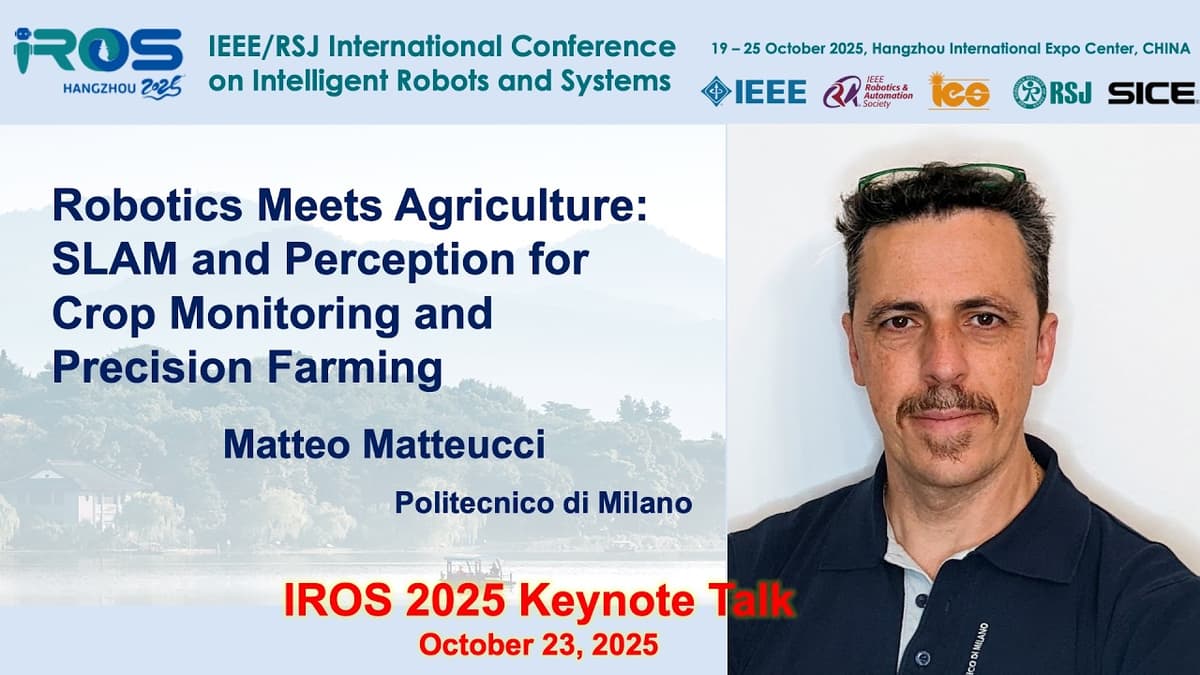
IROS 2025 Keynotes - Field Robotics: Matteo Matteucci
Matteucci’s IROS 2025 keynote frames agriculture’s fourth, digital revolution as a necessity to feed a projected two‑billion‑person increase by 2100. He links declining farm labor, rising food insecurity, and unsustainable fertilizer and water use to the urgent need for robotics,...

Fireside Chat with Chief of the Air Staff 2026
The Royal Aeronautical Society hosted a Fireside Chat with Chief of the Air Staff Air Chief Marshal Sir Harv Smyth at its London headquarters. Smyth delivered a forward‑looking assessment of the global security environment, highlighting hybrid threats, accelerating autonomy, artificial...
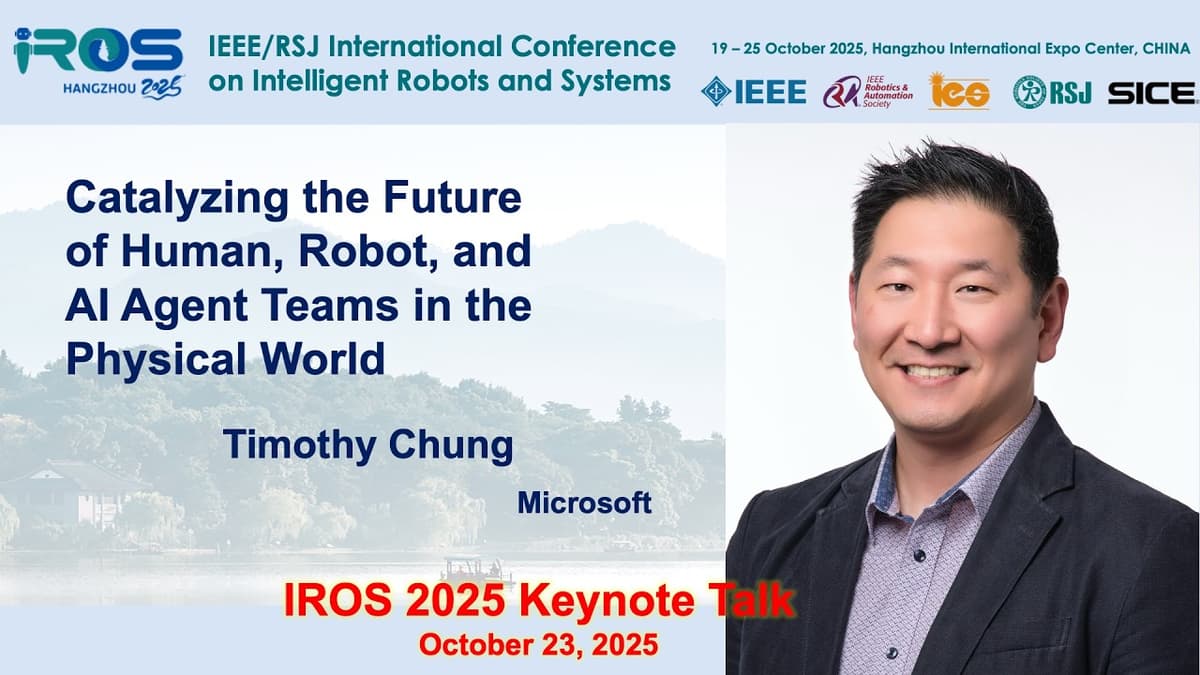
IROS 2025 Keynotes - Field Robotics: Timothy Chung
Timothy Chung’s IROS 2025 keynote outlined Microsoft’s strategic roadmap for field robotics, emphasizing a shift from isolated robot pilots to large‑scale, interoperable robot federations that operate across air, sea, ground and underwater domains. He framed this evolution on a two‑dimensional...

IROS 2025 Keynotes - Humanoid Robot Systems: Kei Okada
The keynote by Kei Okada traced the evolution of humanoid robotics from the early HRP2 platform to today’s foundation‑model‑driven systems, emphasizing that robots must coexist with humans in environments built for us. He argued that the defining trait of humanity—tool...
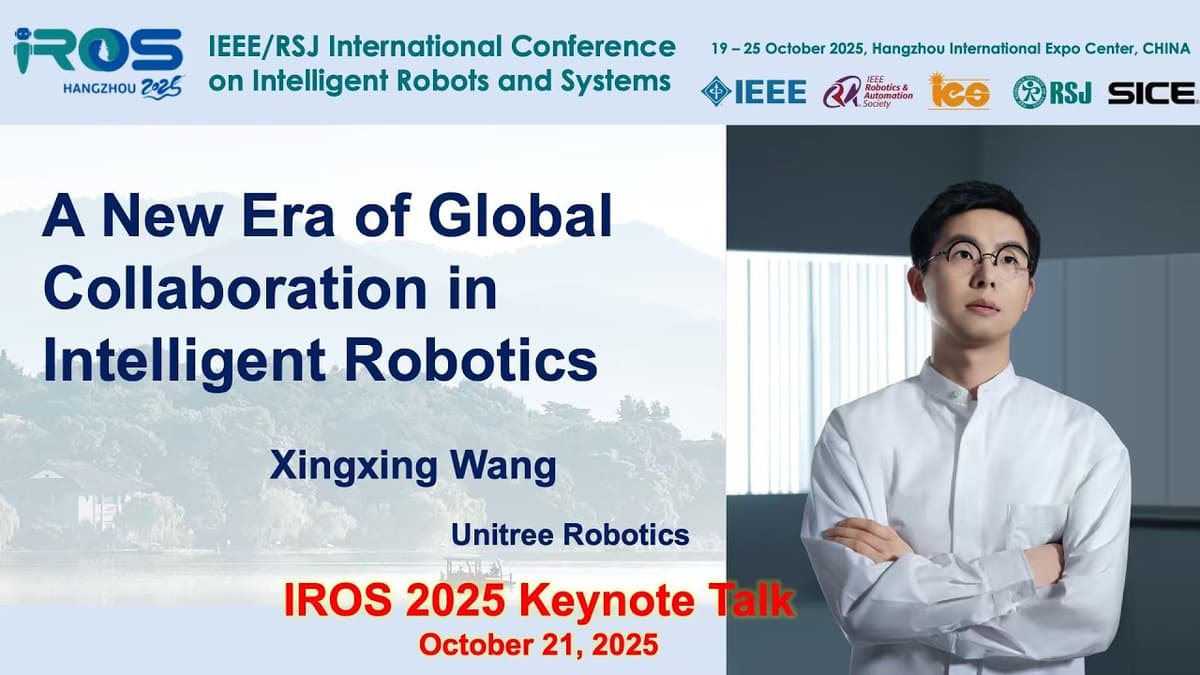
IROS 2025 Keynotes - Humanoid Robot Systems: Xingxing Wang
Xingxing Wang’s IROS 2025 keynote highlighted his firm’s rapid evolution from early Kodrader platforms to a diversified humanoid portfolio. Since its 2016 founding, the company unveiled the full‑size H1, then the compact 1.3‑meter G1 in 2023, and most recently the...

IROS 2025 Keynotes - Mechanisms and Controls: Eiichi Yoshida
The IROS 2025 keynote by Eiichi Yoshida examined how contact‑rich human motions can be harvested to advance humanoid robot mechanisms and control. Yoshida traced the evolution from a handful of humanoid platforms in 2022 to a burgeoning ecosystem of commercial...
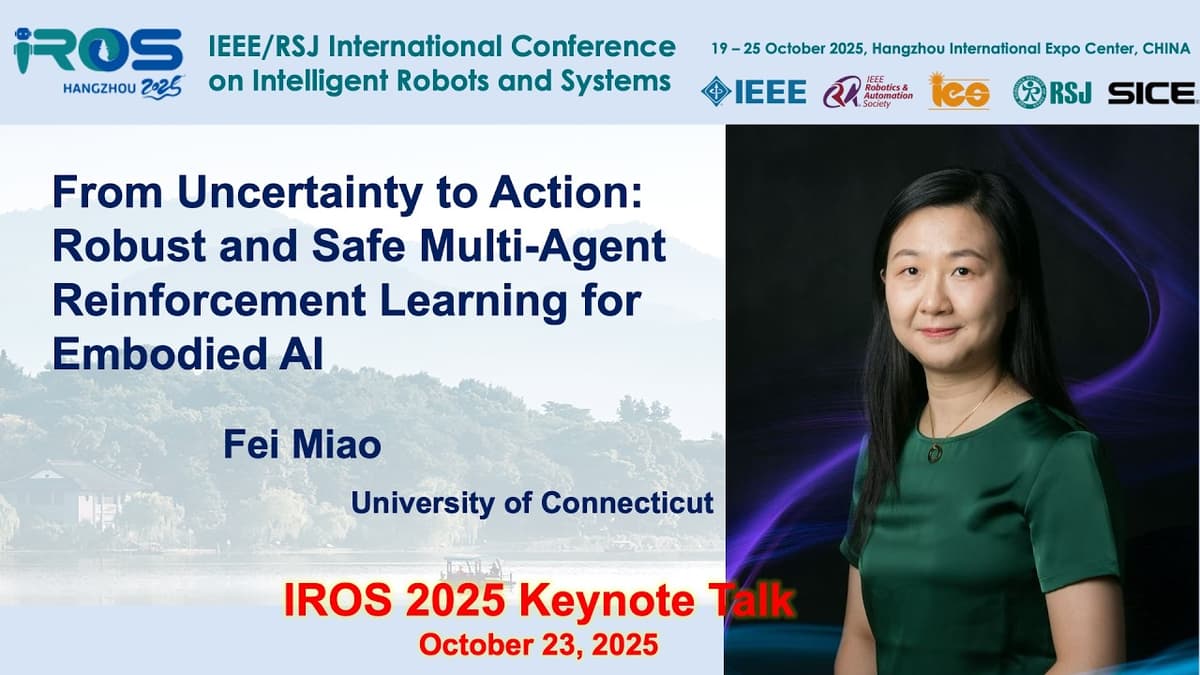
IROS 2025 Keynotes - Mechanisms and Controls: Fei Miao
The keynote by Fei Miao focused on advancing uncertainty understanding and safe, robust reinforcement learning for multi‑agent robotic systems, with autonomous driving as a primary example. Miao highlighted the gap between high‑performance perception models and their lack of calibrated uncertainty,...
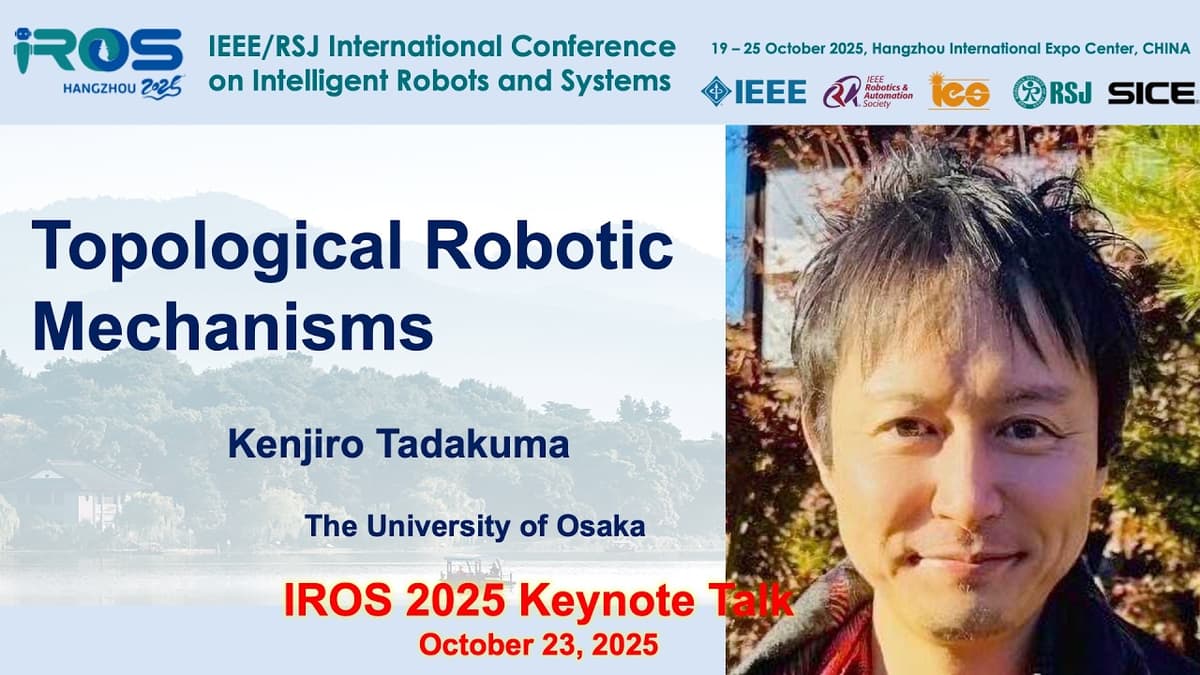
IROS 2025 Keynotes - Mechanisms and Controls: Kenjiro Tadakuma
Kenjiro Tadakuma’s IROS 2025 keynote centered on a sweeping portfolio of novel mechanisms and control concepts, ranging from omni‑directional locomotion modules to bio‑inspired soft actuators. He framed the discussion around the invention process, showcasing dozens of prototype models that illustrate both...
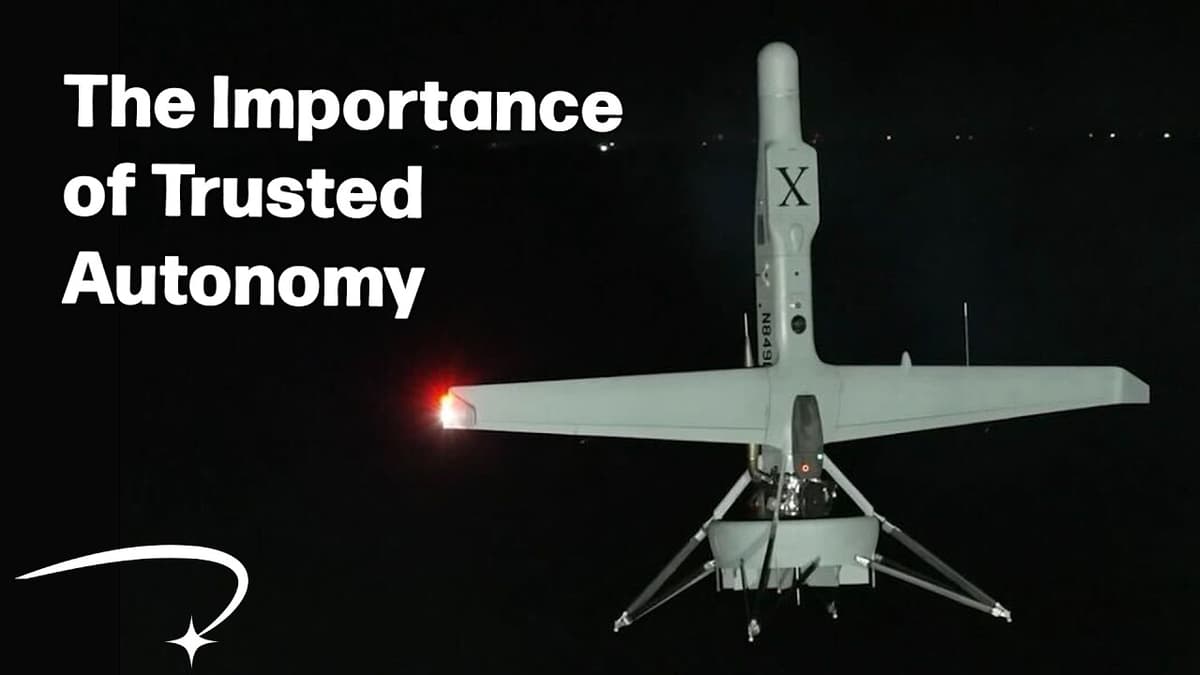
Operating Drones in Battlespaces Where GPS Can't Be Trusted
At the World Defense Show, Shield AI highlighted its AI‑driven unmanned aircraft designed for GPS‑denied battlefields, emphasizing trusted autonomy and sovereign control. The company unveiled its latest vertical‑takeoff‑and‑landing (VTOL) strike platform, the Expat, powered by a GE F‑110 engine that...