Legal Blogs and Articles
Legal Blogs and Articles
Legal Pulse
EMAIL DIGESTS
Daily
Every morning
Weekly
Tuesday recap
EMAIL DIGESTS
Daily
Every morning
Weekly
Tuesday recap

The Deal Lawyers newsletter’s January‑February 2026 issue has just gone to print and is available online for subscribers. Targeted at M&A attorneys, private equity professionals, and corporate counsel, the publication curates rapid‑fire developments that shape dealmaking across jurisdictions. Its reputation for timely analysis makes it a staple reference for firms that need to stay ahead of regulatory shifts and market trends. The print run reaches over 2,000 senior dealmakers, while the digital version integrates searchable archives for quick reference, aligning with filing deadlines for prompt client advice.

The U.S. Supreme Court ruled 6‑3 that President Trump exceeded his authority by imposing global tariffs under the International Emergency Economic Powers Act, effectively nullifying those duties. Trump immediately announced a new 10% worldwide tariff using a different statutory basis,...

Police in Liverpool will employ live facial‑recognition technology during the Everton versus Manchester United Premier League match. The deployment is presented as a tool to manage crowds while respecting attendees' rights. Advocacy group Big Brother Watch criticised the move, urging...

By 2026, up to 90 % of online content is expected to be synthetically generated, thrusting the legal profession into a crisis of evidentiary authenticity. Courts are grappling with deepfakes and AI‑hallucinated citations, forcing lawyers to prove not just that an...

General Counsel roles have expanded from pure legal advisers to strategic partners overseeing talent, data, spend, and broader governance, especially in volatile African markets. While AI promises efficiency, the article warns that it merely amplifies existing operating models—good or bad—so...

The FDA, backed by HHS, issued a stark warning to compounding pharmacies that market GLP‑1 products such as semaglutide, after Hims & Hers promoted a compounded Wegovy copy. A press release announced intent to restrict non‑approved GLP‑1 APIs and referred...

The Ontario Court of Appeal ruled that Ontario Energy Board staff letters can constitute binding legal determinations, not merely advisory opinions. The decision arose from a dispute over whether a new substation was an expansion or enhancement, prompting the parties...

In this episode of Andrew Revkin's "Sustain What" podcast, host Andrew Revkin discusses the EPA's controversial final rule rescinding the greenhouse‑gas endangerment finding, which underpins Clean Air Act regulation of emissions. He is joined by environmental attorney Sean Donohue, a...

The episode breaks down Avenger Flight Group LLC’s recent Chapter 11 filing, detailing its rapid expansion into a global network of flight simulators and the massive debt that financed that growth, including a $155 million term loan and various secured leases....
The episode examines Vanderbilt Minerals, LLC’s recent Chapter 11 sale filing, tracing its roots back to the 1916-founded R.T. Vanderbilt Company and its evolution from paper clay mining to industrial talc production. It highlights the long‑standing regulatory challenges with OSHA...

The article argues that stringent opioid prescribing guidelines, aggressive DEA oversight, and state medical board prosecutions have created a hidden cost to the U.S. health‑care system. These regulatory and prosecutorial practices restrict legitimate pain management, drive physicians toward defensive medicine,...
In this episode the host discusses his unconventional approach to Supreme Court opinions, focusing on a deep dive into the complex *Learning Resources* case, which produced seven separate opinions spanning over 170 pages. He explains how he edited the opinions—condensing...

The episode examines the rising trend of private litigation as a tool to hold audit firms accountable, sparked by concerns over potential SEC Chairman Paul Atkins' moves to weaken the PCAOB. Host Francine McKenna references her Substack post and discusses...
In this episode, the host reviews President Donald Trump's reaction to the Supreme Court's ruling that the International Emergency Economic Powers Act does not permit tariff impositions. Trump lambasts the justices he deems disloyal, praises Justices Thomas, Alito, and Kavanaugh...

The article outlines how legal professionals can harness generative AI by treating prompts like legal questions, emphasizing that vague inputs produce useless outputs. It introduces the 7 Ps Framework—persona, product, prompt, purpose, prime, privacy, and polish—as a systematic method for crafting...

The Winter 2026 eDiscovery Pricing Survey of 53 U.S.-centric participants reveals stable hourly rates for forensic collections—$250‑$350 for both onsite and remote work—while remote services show modest downward pressure and greater pricing model diversity. Per‑device pricing for desktops, laptops, and...

In a recent CLE session, a Texas lawyer highlighted how lawyers have progressed from no AI exposure to daily usage within three years. He urged attorneys to develop AI fluency by engaging with ChatGPT through spoken, hands‑free interactions while driving....

Optimizing a Governance, Risk, and Compliance (GRC) platform requires a holistic strategy that blends integration, user‑centric design, automation, and continuous improvement. Organizations should start with a thorough current‑state assessment and stakeholder feedback to pinpoint gaps. Seamless API‑driven connectivity, centralized data...
The episode dissects a recent Florida defamation case where New Moon Reptiles sued a Nevada resident for allegedly false social‑media claims that the company’s reptiles died due to unsafe shipping. The court denied the plaintiffs’ request for an ex parte...

The SEC has charged Texas‑based startup C‑Hear, Inc. and its former chief executive, Adena Harmon, with securities fraud over a $4.2 million private stock offering. Between 2019 and 2023, the company raised capital from at least 48 investors while allegedly misrepresenting...

The International Council for Commercial Arbitration (ICCA) has released Volume L, the 2025 edition of its Yearbook of Commercial Arbitration, marking the publication’s 50th anniversary. The volume, available in print and via Kluwer Arbitration, expands global coverage to over 20 jurisdictions,...
On February 6, 2026 the California Labor and Workforce Development Agency released a Notice of Proposed Rulemaking that would codify the first formal regulations for PAGA’s administrative procedures. The draft adds 34 sections covering notice specificity, a two‑tier filer‑designation system,...

The U.S. Supreme Court issued a 6‑3 decision striking down the bulk of President Trump’s global tariff regime, ruling the administration exceeded its statutory authority under the International Emergency Economic Powers Act. The ruling, framed around the major questions doctrine,...
Bloomberg’s February 2026 article outlines how compliance teams can build effective surveillance lexicon policies amid evolving AI and regulatory scrutiny. It defines lexicons, explains their precision and transparency, and highlights challenges such as language drift and false positives. The piece recommends...

A symposium on the digitalisation of justice will be held in Groningen on 29 May 2026, hosted by Dr. Benedikt Schmitz. The event features a keynote by Germany’s Justice Minister Benjamin Grimm and expert panels covering private international, civil, criminal, and administrative law. Emerging...
In this episode, Professor Jack Goldsmith discusses the Supreme Court's recent tariff decision, focusing on how the justices applied the Major Questions Doctrine (MQD) to limit presidential authority over broad statutory delegations. He highlights the significance of three conservative justices...

Texas Attorney General Ken Paxton sued Temu, alleging the discount marketplace operates as Chinese Communist spyware that harvests user data for the Chinese government. The lawsuit targets PDD Holdings, accusing it of deceptive marketing and seeking substantial civil penalties. It...

The Federal Motor Carrier Safety Administration unveiled three rulemakings and a sweeping fraud‑crackdown targeting ghost offices, sham CDL schools, and fraudulent electronic logging devices. Carriers and training providers must now maintain a physical office inspectable within 48 hours, and drivers...

Law firms are rapidly adopting a patchwork of AI applications, but the lack of a unified architecture is creating isolated data silos. These "AI silos" prevent seamless knowledge sharing across practice groups and hinder the firm’s ability to leverage collective...

The Supreme Court ruled in Learning Resources, Inc. v. Trump that the International Emergency Economic Powers Act (IEEPA) does not grant the President authority to impose tariffs. A six‑justice majority focused on the statutory text, finding no reference to duties,...

The Law Reform Commission of Ireland released a Consultation Paper on Non‑Court Adjudicative Bodies, unveiled at a Dublin event on February 20, 2026. The launch, chaired by Justice Bolger, featured remarks from Paul Daly, former Attorney General Frank Clarke, and former Chief...
In this episode, host Bainbridge critiques SEC Rule 14a-8, arguing it should be repealed or substantially reformed due to high costs, procedural flaws, and misuse, while proposing higher ownership thresholds and stricter materiality standards as alternatives. He then evaluates Joseph...

The Supreme Court struck down the broad tariffs imposed under the International Emergency Economic Powers Act, but left Section 232 duties untouched. Because most pharma tariffs were issued under Section 232, the ruling does not eliminate the targeted tariffs on drug imports....
Reveal has rolled out new functionalities for its Logikull platform, adding advanced contract analytics and automated compliance checks. HaystackID introduced AI Governance Services aimed at helping law firms monitor and control generative AI usage. Both announcements come amid heightened regulatory...
The Supreme Court struck down the Trump administration’s tariffs imposed under the International Emergency Economic Powers Act (IEEPA) in a 6‑3 decision, covering both reciprocal trade‑deficit tariffs and fentanyl‑related duties. Over half of the tariff revenue collected in recent years...
The episode dissects Justice Kagan's concurrence in the Supreme Court's recent tariff decision, highlighting how the International Emergency Economic Powers Act (IEEPA) lists nine verbs and eleven objects that combine into 99 distinct presidential powers, none of which include raising...

In a 6‑3 ruling, the Supreme Court held that President Trump lacked authority under the International Emergency Economic Power Act to impose sweeping tariffs, invalidating duties that had reached 145% on certain Chinese imports. The decision dismantles a cornerstone of...
In 2018 Mickey Barreto checked into the Wyndham New Yorker Hotel for a single night and invoked New York’s rent‑stabilization law to claim permanent‑tenant status. He filed a fraudulent deed that transferred the entire hotel to his self‑named nonprofit, then...
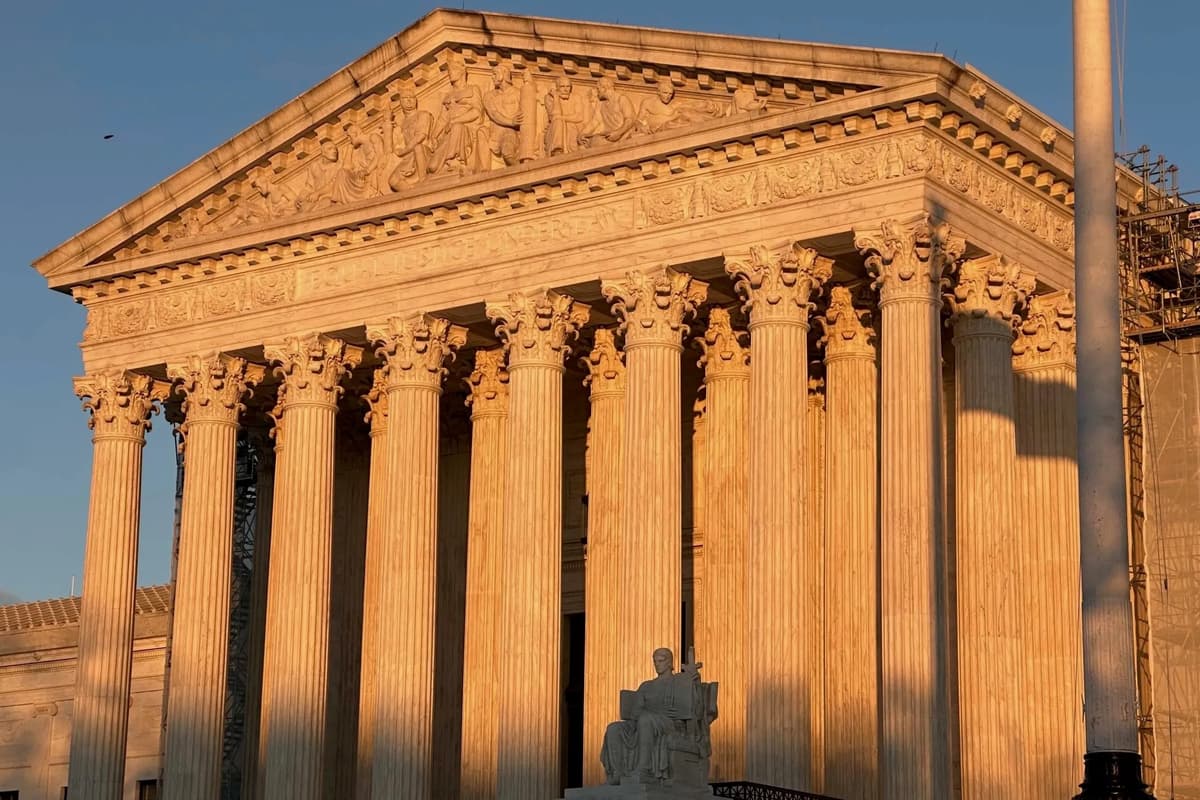
The Supreme Court, in a 6‑3 ruling, invalidated the sweeping tariffs imposed by former President Donald Trump, finding that the International Emergency Economic Powers Act (IEEPA) does not grant the president authority to levy tariffs. The justices applied the major...

The UK Supreme Court ruled on Feb. 13 that trans individuals may use bathrooms matching their gender identity in public venues but not in the workplace. Employers must therefore maintain mixed‑sex facilities while still offering single‑sex rooms, and the decision...

Florida lawmakers have passed legislation to rename Palm Beach International Airport after former President Donald Trump, clearing the Senate 25‑11 and the House 81‑30. The bill now awaits Governor Ron DeSantis' signature and subsequent FAA approval before becoming effective in...
The Supreme Court will hear *Pung v. Isabella County*, challenging the constitutionality of tax foreclosure sales. Michael Pung contends that the county’s auction sold his nephew’s property for $76,000, far below its $200,000 fair‑market value, violating the Fifth Amendment takings...

The latest "From Lawyer to Employer" podcast episode tackles arbitration clauses in employment contracts, featuring host and Emily McDonough Souza. It outlines arbitration’s speed, privacy, and legal focus while warning against treating it as a default solution. The discussion highlights...

The article argues that in‑house counsel must step out of the legal ivory tower and acquire direct sales experience to truly understand how revenue is generated. By taking a sales quota and selling themselves, lawyers gain empathy for the sales...

The European Commission is repositioning itself as a “Geopolitical Commission,” aiming to reclaim control over technology regulation. The strategy, outlined in Benjamin Farrand’s book *Geopolitical Union*, targets standards, micro‑chip access, online platform oversight, industrial data, and artificial intelligence. By blending...
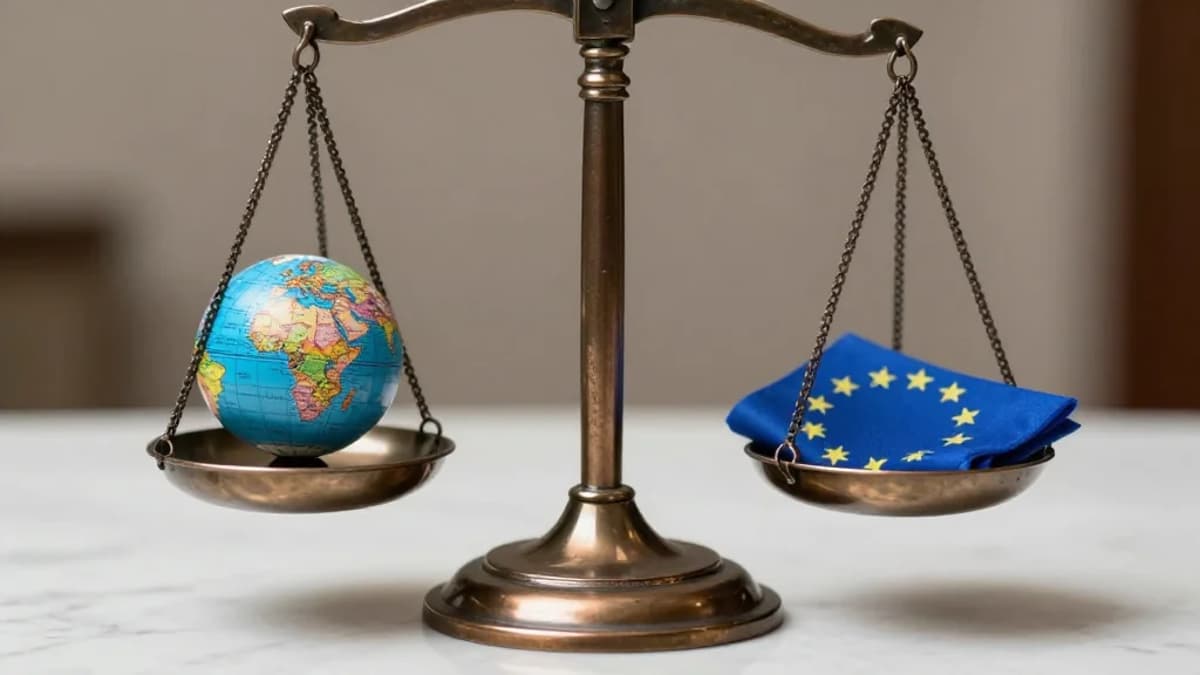
The EU Digital Services Act (DSA) imposes a special regulatory regime on very large online platforms (VLOPs) and very large online search engines (VLOSEs), mandating risk assessments, independent audits, data‑transparency and fines up to 6% of worldwide turnover. The European...

The American Trucking Associations (ATA) has asked the EPA to soften key provisions of the 2027 nitrogen‑oxide (NOx) emissions rule for heavy‑duty trucks, arguing that the required technologies are not yet proven in real‑world use. ATA’s letter cites ongoing freight...
Negotiations between banks and crypto leaders advanced during the White House’s third closed‑door meeting, but the core dispute over stablecoin yields remains unresolved. Industry representatives described the dialogue as constructive, emphasizing a need for consumer protection and U.S. competitiveness. The...

The First Circuit upheld nearly $43 million in disgorgement awards against five defendants in a penny‑stock pump‑and‑dump scheme. The court found internal records clearly demonstrated each participant’s share of the illicit profits. The case is being sent back to the District...

Changpeng Zhao, the founder of Binance, received a full presidential pardon and made his first U.S. visit since his 2024 release from a California federal prison. He attended a 500‑person crypto conference hosted by Trump‑backed World Liberty Financial at Mar‑a‑Lago,...


