
BIO Is Expanding Its Work to Defend IP
The Biotechnology Innovation Organization (BIO) is scaling its intellectual‑property advocacy by creating an IP Task Force and a new Economic Growth, Innovation, and Intellectual Property Committee to steer strategy. BIO is actively lobbying on Capitol Hill, filing amicus briefs, and submitting comments to the USTR to counter legislation like the ETHIC Act that could curb multiple patents. The group emphasizes that robust IP protections are essential for biotech innovation, investment, and U.S. national security. Internationally, BIO is highlighting unfair IP practices by China and other competitors.

Cardiometabolic Trials: Using Expertise to Turn Complexity Into Robust Results
Nucleus Network’s Minneapolis site has emerged as a benchmark for early‑phase cardiometabolic trials, leveraging AI‑driven recruitment, rigorous PI oversight, and advanced imaging to deliver decision‑grade data. In the Rivus RIV‑HU6‑203 study the team screened 506 candidates, randomised 80 participants and...

Mabwell Initiates P-III Trial for 9MW2821 in TNBC
Mabwell has launched a Phase III trial of its Nectin‑4‑targeting antibody‑drug conjugate 9MW2821 in patients with locally advanced or metastatic triple‑negative breast cancer (TNBC). The study pits 9MW2821 against the investigator’s choice of chemotherapy in patients who have already received taxane‑based...

FDA Declines to Approve AbbVie's Botox Follow-Up
The FDA sent a complete response letter to AbbVie, rejecting its filing for TrenibotE, a rapid‑acting, shorter‑duration botulinum toxin intended as a follow‑up to Botox. The agency’s concerns focus on manufacturing data rather than safety or efficacy, and AbbVie says...

FDA Clears First Genetic Hearing Loss Gene Therapy
Regeneron became the first company to receive FDA clearance for a gene therapy targeting congenital hearing loss, approving its OTOF‑focused product Otarmeni. The therapy, an AAV‑delivered one‑shot infusion, will be offered free to U.S. patients, a rare move given typical...

CatalYm Doses First Patient in Phase II/III VINCIT Trial
CatalYm has begun dosing the first patient in its Phase II/III VINCIT trial, evaluating the anti‑GDF‑15 antibody visugromab for cancer‑associated cachexia. The double‑blind, placebo‑controlled study plans to enroll about 518 participants with advanced solid tumours such as NSCLC and colorectal cancer....

Cumberland to Sell Drug Portfolio to Apotex for $100m
Cumberland Pharmaceuticals has agreed to sell its branded commercial drug portfolio to Canadian generic giant Apotex for $100 million in cash, subject to shareholder approval. The transaction lets Cumberland retain its pipeline assets, including the thromboxane antagonist ifetroban, and its majority...

Is Stem Cell Therapy About to Transform Medicine and Reverse Ageing?
Stem cell therapy is re‑emerging as a credible route to tissue regeneration and age‑reversal after a decade of failed anti‑ageing bets. Researchers are now demonstrating partial cellular reprogramming that restores youthful function without erasing cell identity. Early‑stage human trials from...

Diagonal Therapeutics’ Innovative Clustering Antibodies for Vascular Diseases
Diagonal Therapeutics is advancing a pioneering platform of clustering antibodies designed to restore vascular receptor signaling, targeting the root cause of genetic vasculopathies. Its lead candidate, DIAG723, has earned FDA Orphan Drug Designation for hereditary hemorrhagic telangiectasia (HHT) and shows...

Johnson & Johnson Reports Clinical Findings on Imaavy (Nipocalimab) for Generalized Myasthenia Gravis (gMG) at AAN 2026
Johnson & Johnson presented Phase III Vivacity‑MG3 data on its anti‑IgG antibody, Imaavy (nipocalimab), in generalized myasthenia gravis (gMG). In the 24‑week post‑hoc analysis, patients receiving Imaavy plus standard of care were about four times more likely to achieve sustained...

Regeneron Reports the US FDA Accelerated Approval of Otarmeni (Lunsotogene Parvec-Cwha) in Genetic Hearing Loss
Regeneron’s Otarmeni (lunsotogene parvec‑cwha) received FDA accelerated approval for treating severe to profound sensorineural hearing loss caused by biallelic OTOF gene variants. The therapy, provided free of charge in the U.S., was evaluated in a Phase I/II CHORD trial of...
Cipla Slips Despite FDA Nod for Generic Ventolin; Morgan Stanley Stays Cautious
Cipla Limited’s shares slipped 1.27% to about $15.5 after the company secured U.S. FDA approval for a generic version of GlaxoSmithKline’s Ventolin HFA, a product targeting the roughly $1.5 billion albuterol market. The approval is projected to generate $130 million in FY27...

What Trump’s Psychedelics Executive Order Means for Basic Neuroscience
President Donald Trump issued an executive order to accelerate clinical research on psychedelic drugs, allocating at least $50 million for state‑run programs and directing the FDA to speed up drug reviews. The order also tasks the attorney general with reviewing the...

Regulatory Review: Andrographis, Caffeine Warning, Biotics and More
Regulators across several markets are tightening rules for dietary supplements and natural health products. Australia’s TGA is consulting on removing Andrographis from its low‑risk ingredient list after anaphylaxis reports, while the EU continues to block probiotic health claims and has...

'Sterility Failures' Prompt FDA to Threaten Radiopharmaceutical Producer with Disciplinary Action
The FDA issued a warning letter to the University of California San Francisco Radiopharmaceutical Facility after sterility testing uncovered Bacillus contamination in a PET‑imaging agent batch. The agency found the facility’s explanation—that the bacteria entered the test tube during analysis—insufficient...

New Bioreactor Turns Stem Cells Into an Immune-Cell Factory, Producing 40 Million Human Macrophages per Week
Researchers at Hannover Medical School have unveiled a medium‑scale bioreactor that converts induced pluripotent stem cells into human macrophages at commercial‑grade volumes. The system can harvest up to 40 million immune cells per bioreactor each week for up to ten weeks,...
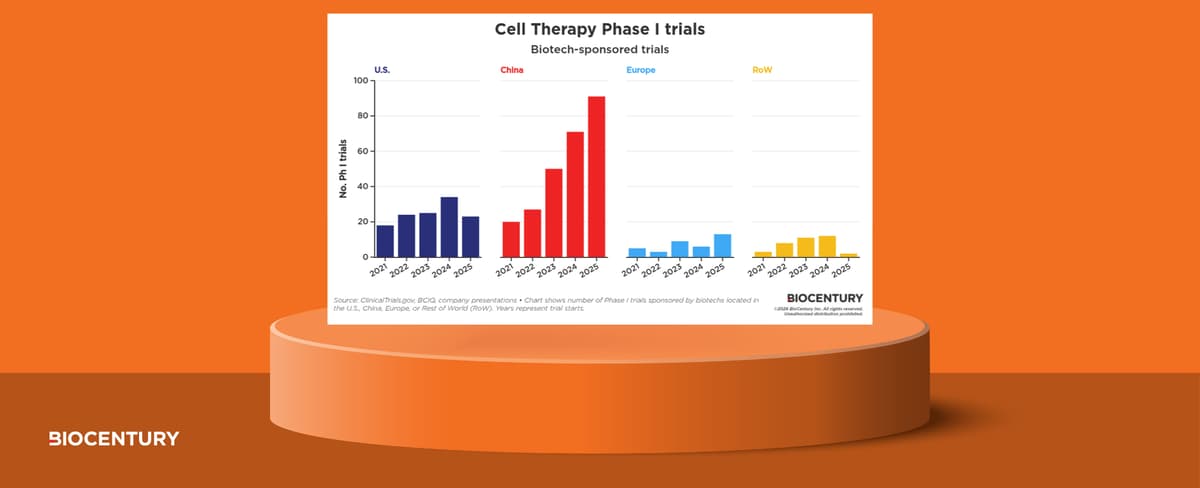
Cell Therapy Phase I Activity Accelerates on China Surge
BioCentury’s website now features a detailed Privacy Preference Center that categorizes cookies into strictly necessary, functional, marketing, advertising, and analytics groups. Users can toggle consent for each category, though disabling essential cookies may impair login and navigation. The policy clarifies...

These 'Good' Viruses Hold up a Booming Industry—AI Just Found a Faster Way to Track Them
Researchers at North Carolina State University combined electrochemical impedance spectroscopy with machine‑learning models to quantify viral vectors, eliminating the need for costly ELISA tagging. Six AI models accurately measured virus titers across five orders of magnitude, even with pH‑induced noise....
![[Comment] Alzheimer's Disease Immunotherapy and the Amyloid Hypothesis: When Aggregation Obscures Interpretation](https://hixhlmpcokxhartfkpyi.supabase.co/storage/v1/object/public/images/thumbnails/614bb5987569a37ee2c14e1338f7df10.webp)
[Comment] Alzheimer's Disease Immunotherapy and the Amyloid Hypothesis: When Aggregation Obscures Interpretation
A Cochrane review released on April 16, 2026 pooled data from 17 randomized trials of amyloid‑beta‑targeting monoclonal antibodies, encompassing more than 20,000 participants with mild cognitive impairment or mild dementia due to Alzheimer’s disease. The analysis found little to no...

Acting Attorney General Issues New DEA Order Reclassifying Some Marijuana Products as Schedule III Controlled Substances, Available by Prescription
Acting Attorney General Todd Blanche issued a final order on April 23, 2026 that reclassifies FDA‑approved cannabis medicines and state‑licensed medical marijuana products from Schedule I to Schedule III, making them available by prescription. The order requires state‑licensed dispensaries to register with...

For Researchers, Trump's Easing Restrictions on Marijuana Signals a Budding Shift
The Department of Justice reclassified marijuana distributed through state medical programs from Schedule I to Schedule III, easing DEA registration for researchers. The change applies to FDA‑approved and state‑licensed medical cannabis, allowing more straightforward clinical trials while still requiring DEA and FDA...

FLAG-Based Regimen Yields Robust Results in Acute Myeloid Leukemia Subtype
A Phase 2 trial at MD Anderson evaluated FLAG‑based chemotherapy combined with either gemtuzumab ozogamicin (FLAG‑GO) or idarubicin (FLAG‑IDA) in 219 newly diagnosed core‑binding factor AML patients. The FLAG‑GO arm delivered an 80% five‑year overall survival rate and a 67% relapse‑free survival...

ESCMID Global 2026: Zelicapavir Demonstrates Benefits for High-Risk Adults with RSV
At ESCMID Global 2026, Enanta Pharmaceuticals presented Phase IIb data for zelicapavir, an oral once‑daily N‑protein inhibitor, in high‑risk adults with RSV. The double‑blind study of 186 participants missed the primary endpoint but demonstrated faster symptom resolution—up to 7 days quicker in...

New Scoring Tool Reveals How Radiation Reprograms the Pancreatic Tumor Microenvironment
A novel scoring system developed by researchers quantifies how ionizing radiation reshapes the pancreatic tumor microenvironment. By integrating spatial transcriptomics, collagen imaging, and immune cell profiling, the tool identifies three distinct radiation‑induced phenotypes that correlate with patient survival and response...

Regeneron Will Offer Rare Disease Therapy Free As Part Of TrumpRx Deal
Regeneron announced it will provide its newly approved gene therapy for a rare pediatric hearing loss at no cost to U.S. patients under the TrumpRx program. The therapy, cleared by the FDA earlier this year, treats an X‑linked condition affecting...

Specialty Pharmacy's Critical Role as Advanced Therapies Move Into the Community: Fran Gregory, PharmD, MBA
Advanced therapies are set to expand dramatically, rising from 61 approved products today to roughly 180 by 2030. The growth includes cell and gene therapies, bispecific antibodies, and next‑generation monoclonal antibodies, many targeting high‑volume diseases such as cardiovascular and metabolic...

First Bispecific-ADC Combo Shows Strong Results in R/R Mantle Cell Lymphoma
A phase‑2 study published in Blood shows that combining the bispecific antibody mosunetuzumab with the antibody‑drug conjugate polatuzumab vedotin yields an 88.1% overall response rate in relapsed or refractory mantle‑cell lymphoma (MCL). The regimen produced a 78.6% complete response rate,...

AI Model Designs New Antibiotic for Staph Infections After Exploring 46 Billion Compounds
Researchers at McMaster University unveiled SyntheMol‑RL, a generative AI model that explored up to 46 billion virtual compounds and designed a novel, water‑soluble antibiotic named synthecin. The AI‑crafted drug demonstrated strong efficacy against drug‑resistant Staphylococcus aureus in mouse wound models when...

Pan-RAS Inhibitor ADCs Emerge at AACR 2026
At the 2026 American Association for Cancer Research meeting, four biotech companies unveiled antibody‑drug conjugates that deliver pan‑RAS inhibitors directly to tumor cells. Pan‑RAS inhibition has recently delivered unprecedented survival improvements in pancreatic and other RAS‑mutant cancers, but its clinical...

Digital Health Technologies (DHTs) for Drug Development
The FDA has issued a Request for Information and Comments on the use of Digital Health Technologies (DHTs) in drug and biologic development, with a comment deadline of June 1, 2026. Under PDUFA VII, the agency will publish a DHT framework, establish a...

The FDA Gives the Green Light to the First Gene Therapy for Deafness
The FDA has approved the first gene therapy designed to restore hearing in patients born with the rare OTOF‑related form of deafness. Developed by Regeneron, the treatment delivers a functional OTOF gene via adeno‑associated virus directly into the inner ear....

Pharma Meets AI Conference 2026: Key Barriers to Scaling AI in Drug Development
At the Pharma Meets AI conference in Barcelona, industry leaders warned that trust and governance are the biggest obstacles to scaling artificial intelligence in drug development. While AI is delivering gains in prediction, personalization and productivity, concerns over data quality,...

SELUTION DeNovo: Sirolimus DCB Safe and Effective in ACS Patients
A subanalysis of the SELUTION DeNovo trial presented at SCAI 2026 shows that the sirolimus‑eluting Selution drug‑coated balloon (DCB) is non‑inferior to drug‑eluting stents (DES) in acute coronary syndrome (ACS) patients, with 1‑year target vessel failure (TVF) rates of 5.3%...

Enabling In Vivo Lentiviral Therapies: Manufacturing Strategies to Improve Purity, Scalability, and Clinical Readiness
SK pharmteco’s CTO Tatiana Nanda and Director Mardhani Aparajithan discussed the shift of lentiviral vectors from ex‑vivo tools to in‑vivo therapeutic platforms. They highlighted manufacturing hurdles such as the need for substantially higher vector doses, stricter impurity thresholds, and the...

Lunsotogene Parvec Becomes First FDA-Approved Gene Therapy for OTOF-Related Hearing Loss
Regeneron’s lunsotogene parvec‑cwha (Otarmeni) received accelerated FDA approval as the first gene therapy for OTOF‑related hearing loss. The single‑dose AAV vector is indicated for patients with severe‑to‑profound sensorineural loss who have confirmed biallelic OTOF variants and no prior cochlear implant....

LeonaBio to Host Virtual Key Opinion Leader Event Highlighting Potential of Lasofoxifene in Treatment-Resistant ER+/HER2-, ESR1-Mutated Metastatic Breast Cancer
LeonaBio announced a virtual Key Opinion Leader webcast on April 29, 2026 to discuss lasofoxifene, its novel selective estrogen receptor modulator, for treatment‑resistant ER+/HER2‑, ESR1‑mutated metastatic breast cancer. The company expects to complete enrollment in the Phase 3 ELAINE‑3 trial, which pairs...

Validating Your Business Idea with Punit Mehra
Punit Mehra, co‑founder of ALP AI, explains how biotech’s high‑stakes environment forces a startup playbook that prioritizes early validation over rapid iteration. The company uses AI to flag drug‑development risk before costly late‑stage trials, fitting its solution into existing risk‑budget...

Early ALPHA3 Data Could Signal Shift to Frontline Use of CAR T in LBCL
Allogene Therapeutics reported that its off‑the‑shelf CAR‑T product cemacabtagene ansegedleucel (cema‑cel) achieved 58.3% minimal residual disease (MRD) negativity at day 45 versus 16.7% with observation in the interim futility analysis of the phase 2 ALPHA3 trial. The study enrolled LBCL patients who...

BBC Inside Science
Researchers have launched a phase 3 clinical trial to evaluate an mRNA vaccine targeting H5N1, the highly lethal avian influenza strain. The virus, endemic in birds, rarely infects humans but carries a high case‑fatality rate, prompting fears of a mutating...

Freeze-Dried Platelets Combat TBI Brain Swelling and Bleeding
Researchers at UCSF have shown that Thrombosomes, a freeze‑dried platelet‑derived product, dramatically reduces bleeding and cerebral edema in a mouse model of traumatic brain injury (TBI). The biologic, originally created for battlefield hemorrhage, can be stored at room temperature for...

Trump Administration Reclassifies some Medical Marijuana Products as Less Dangerous
The Justice Department, via Acting Attorney General Todd Blanche, issued an order moving FDA‑approved and state‑licensed medical marijuana products from Schedule I to Schedule III. The change reclassifies these cannabinoids as having a moderate to low potential for dependence, aligning them more...

CRISPR Base Editing Repairs Hard-to-Treat Cystic Fibrosis Mutation in Cell Models
A new study published in Science Translational Medicine demonstrates that an adenine base editor (SpRY‑ABE9) can correct the hard‑to‑treat CFTR 1717‑1G>A splicing mutation in cell models. Researchers delivered optimized mRNA and sgRNA, achieving up to 30% editing in kidney and...

TRIDENT: Triple Antihypertensive Pill Cuts Recurrent Stroke in ICH
The TRIDENT trial showed that a single low‑dose triple‑antihypertensive pill (telmisartan, amlodipine, indapamide) added to standard care reduced recurrent stroke in patients with prior intracerebral hemorrhage from 7.4% to 4.6% (HR 0.61). Mean systolic blood pressure during follow‑up was 127 mm Hg in...

Cardiometabolic Intervention: Evaluation of PCSK9 Inhibitors as the Successor to the GLP-1 Phenomenon
The 2026 analysis pits GLP‑1 receptor agonists against PCSK9 inhibitors, showing that the latter now deliver comparable or superior reductions in major adverse cardiovascular events and are expanding into oral formulations. Clinical trials such as VESALIUS‑CV demonstrate primary‑prevention benefits for...

ESCMID Global 2026: Adibelivir Emerges as Potential Disease-Modifying Therapy for HSV
Innovative Molecules presented Phase I/Ib data on adibelivir (IM‑250), a novel helicase‑primase inhibitor, at ESCMID Global 2026. The drug demonstrated nanomolar potency against clinical and acyclovir‑resistant HSV‑1/2 isolates and showed a favorable safety profile up to 200 mg with no dose‑limiting toxicities....

The Skinny on Skinny Labels: The Active Inducement Problem That Patent Practitioners Should Know
The U.S. Supreme Court will hear Hikma Pharmaceuticals v. Amarin Pharma, a case that tests whether a generic maker can be liable for induced patent infringement despite using the FDA’s skinny‑label pathway. The dispute centers on Hikma’s generic icosapent ethyl, which omitted...
Key Takeaways: How Regulatory Exclusivity, PTA, PTE, and Double Patenting Shape Pharmaceutical Lifecycle Value
The recent Sterne Kessler webinar dissected how FDA regulatory exclusivities, patent‑term adjustment (PTA), patent‑term extension (PTE) and obviousness‑type double patenting (ODP) intersect to shape a drug’s lifecycle value. Regulators can grant exclusivity periods that outlast patent terms, while PTA can add...

The BioPharm Brief: CAR-T Advances, Pediatric Biologic Approval, and Oral GLP-1 Progress
A2 Biotherapeutics will unveil early data on its A2B694 CAR‑T therapy, which targets HLA‑A*02 loss of heterozygosity in solid tumors, at ASCO 2026. The FDA approved dupilumab for children ages 2‑11 with chronic spontaneous urticaria, marking the first biologic for this pediatric...

Substance Use Disorder Biotech Tempero to Close After Earlier 'Serious' Safety Event
Tempero Bio, a biotech focused on novel treatments for substance‑use disorders, announced it will wind down operations following a serious adverse event in its late‑stage clinical trial. The company had raised more than $200 million to advance a kappa‑opioid receptor antagonist...

Novartis' Radioligand Therapy Lutathera Could Soon Face Generic Competition
Novartis’s Lutathera, the first FDA‑approved radioligand therapy for neuroendocrine tumors, recorded $1.5 billion in 2023 sales and dominates a market projected to exceed $3 billion by 2028. A generic version filed by Sandoz aims for a 2025 launch, marking the first non‑brand...