
February Patches for Azure DevOps Server
Microsoft released February 2026 patches for its self‑hosted Azure DevOps Server suite, covering the core product and the 2022.2, 2020.1.2, and 2019.1.2 releases. Each patch is available via direct download links and includes detailed release notes. The company urges all customers to upgrade to the latest, most secure version to maintain platform stability. A simple command‑line check (.exe CheckInstall) lets administrators verify successful installation.
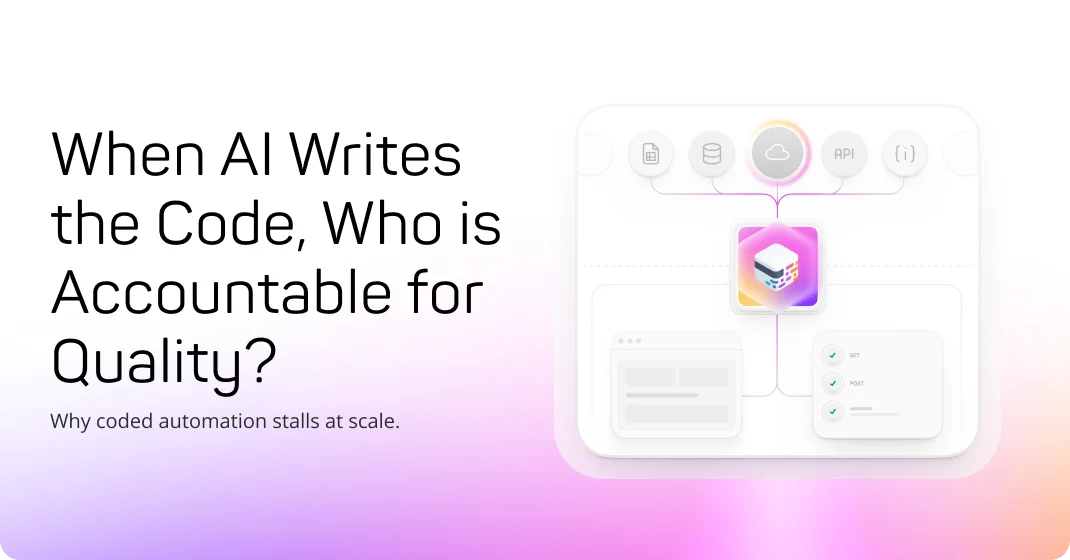
When AI Writes Code, Who's Accountable for Quality? | Mabl
AI coding assistants such as Claude Code and Copilot now generate features and tests in minutes, dramatically boosting engineering velocity. However, when test outcomes become the sole decision signal for autonomous agents, organizations face hidden risks like logic drift, excessive manual...

Kong Launches Context Mesh
Kong introduced Context Mesh, a new component of its AI Connectivity platform that automatically discovers enterprise APIs, converts them into Model Context Protocol (MCP) toolkits, and deploys those tools through the AI Gateway with built‑in governance. The service leverages existing...

GitLab CEO on Why AI Isn’t Helping Enterprise Ship Code Faster
GitLab CEO Bill Staples says AI coding assistants haven’t accelerated enterprise software delivery because developers spend only 10‑20% of their day writing code. The remaining 80‑90% involves reviews, pipeline runs, security and compliance checks that remain untouched by AI. GitLab’s...
Rootly | Alerting as Code: How Mistral AI Uses Terraform as the Source of Truth
Mistral AI has re‑engineered its alerting pipeline by treating monitoring definitions as code, using Terraform as the single source of truth. The approach automatically generates synthetic checks for every model capability, tags them for ownership, and enforces deterministic routing. By...

Simplyblock Provides Postgres Git-Style Branching
Simplyblock has launched Vela, a self‑hostable platform that provides instant, Git‑style branching for PostgreSQL databases without copying data. The solution leverages copy‑on‑write on local NVMe storage and deep Kubernetes integration to deliver high‑performance, low‑latency environments. Vela targets AI workloads that...

Size Analysis Is Generally Available in Sentry
Sentry has rolled out Size Analysis to every user following its May 2025 acquisition of Emerge Tools. The feature plugs into CI pipelines, automatically uploading each build and providing diff‑based size reports with actionable insights. Developers can set thresholds that fail...

From Messy to Modular: Rebuilding Filters in React
Harness rebuilt its execution‑listing filters with a modular React component built on the Context API. The new system replaces a hidden side‑panel legacy UI that lost state on refresh with a discoverable, type‑safe framework. It centralizes filter state in a...

What CNCF Project Velocity in 2025 Reveals About Cloud Native’s Future
The CNCF’s 2025 Project Velocity report shows that cloud‑native projects are still measured by real signals such as commit frequency, contributor growth, and deployment patterns. Kubernetes retains its dominant position, while Backstage’s contributions have more than doubled and OpenTelemetry sees...

Sneak Preview: Peak Performance: Handling Traffic Spikes for Global Live Sports Streams
On February 25, Matt Stagg will moderate a Streaming Media Connect panel titled “Peak Performance: Handling Traffic Spikes for Global Live Sports Streams.” The discussion brings together senior engineers from TATA Communications, BT Group, and DAZN to dissect how leading...
.png)
Port’s View as Feature Lets Org Admins See the Product Through Any User’s Permissions to Reproduce Issues, Validate RBAC, and...
Port introduced a highly requested “View as” feature that lets organization administrators instantly experience the platform with any user’s effective permissions. The tool enables rapid reproduction of permission errors, validation of RBAC changes, and secure troubleshooting without needing screenshots or...

Linkerd Protocol Detection
Linkerd’s lightweight service mesh automatically detects the protocol of incoming connections by inspecting the first bytes, enabling features such as HTTP metrics, retries, and load‑balancing without manual annotations. The detection logic recognises HTTP/1.x, HTTP/2, gRPC, TLS and falls back to...
The Claude Skills I Actually Use for DevOps
Claude Code's skill system transforms generic AI assistance into senior‑engineer‑level DevOps guidance. By encoding best‑practice patterns—Pulumi ESC, component resources, monitoring, security, debugging—skills let Claude generate reliable infrastructure code while preserving context budget. Compared with Model Context Protocol servers, skills load...

Git-Driven Environments: Why Treating Infra as Code Unlocks Consistent Builds Every Time
Git‑driven environments treat infrastructure as code, storing full stack definitions in version‑controlled repositories. This eliminates environment drift by making every branch a deployable, production‑aligned preview environment. Changes to services, routes, or runtime versions are reviewed through pull requests, providing an...

Sixteen Claude AI Agents Working Together Created a New C Compiler
Anthropic researcher Nicholas Carlini released a GitHub project where 16 instances of Claude Opus 4.6 worked together to write a Rust‑based C compiler from scratch. Over two weeks and roughly $20,000 in API costs, the agents produced a 100,000‑line compiler that...

Rootly | Behind the Mind of a Future Thinking Reliability Expert
Prolific’s senior delivery lead Hannah Hammonds overhauled the company’s incident management by migrating from incident.io to Rootly, a platform offering highly configurable workflows and AI‑assisted SRE capabilities. The new system automates root‑cause analysis, integrates tightly with Slack, and provides audit‑ready...