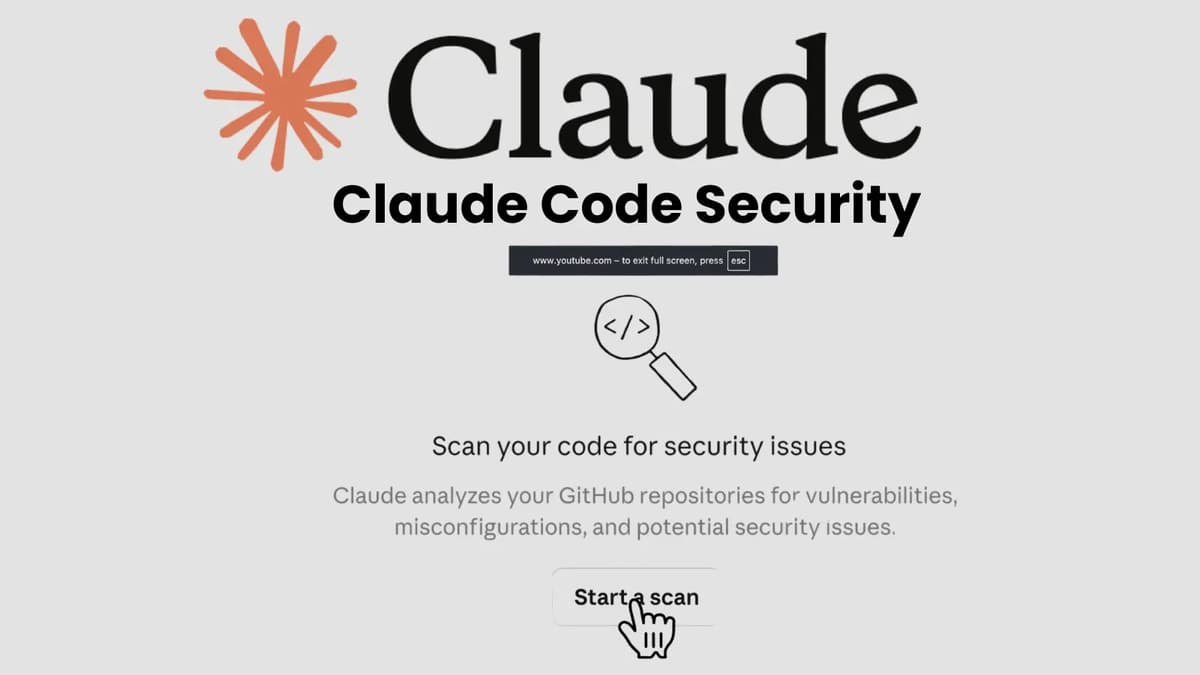
Anthropic Debuts Claude Code Security – AI Now Scan Vulnerabilities in Your Entire Codebase
Anthropic launched Claude Code Security, an AI‑driven tool that scans entire codebases for vulnerabilities and suggests patches. Powered by Claude Opus 4.6, it uses frontier reasoning to map data flows and identify complex bugs that traditional SAST tools miss. Internal tests uncovered over 500 previously unknown high‑severity flaws in popular open‑source projects. The announcement sent shares of major cybersecurity vendors down 8‑9% and sparked concerns about the future of legacy vulnerability‑management solutions.
Anthropic Updates Claude Code with Desktop Features that Automate More of the Dev Workflow
Anthropic has launched new desktop features for Claude Code, enabling the AI to spin up development servers, display running web apps, auto‑detect and fix errors, and perform code reviews directly in the diff view. For GitHub projects, Claude now monitors...
How to Write a Test Summary Report: Template and Real Examples
Agile teams rely on rapid test cycles, yet without a consolidated record, test outcomes can lose context between sprints. A test summary report captures objectives, coverage, defect status, environment details, and exit‑criteria compliance for a given cycle or release. The...

KubeCon + CloudNativeCon Europe 2026 Co-Located Event Deep Dive: Agentics Day: MCP + Agents
Agentics Day at KubeCon+CloudNativeCon Europe 2026 spotlights the Model Connectivity Protocol (MCP) and AI agents, moving them from experimentation to production. The half‑day, community‑driven event features over ten talks on real‑world deployments, governance, and security. It targets platform, SRE, infrastructure...

Ensuring Release Confidence in Fast-Moving DevOps Teams - Xray Blog
Fast‑moving DevOps teams struggle to maintain release confidence as deployment frequency rises. Xray Enterprise delivers a single source of truth inside Jira, unifying test plans, executions, and reporting. By embedding continuous validation into CI/CD pipelines, it provides real‑time traceability from...

Amazon Q Developer for AI Infrastructure: Architecting Automated ML Pipelines
Amazon Q Developer, a generative‑AI assistant, now automates the end‑to‑end provisioning of machine‑learning infrastructure on AWS. By interfacing with the Cloud Control API, SageMaker, and CDK, it creates IaC for GPU clusters, VPC‑only pipelines, and serverless inference stacks. The tool...

Cost Control for Kubernetes: Monitor, Right-Size, Govern
Christian Dussol, engineering manager at a financial firm, warns that Kubernetes deployments can generate surprising cloud bills when resources are over‑provisioned. Moving a production cluster to Azure revealed hidden costs in storage, networking, and telemetry, highlighting that Kubernetes itself does...
There’s Always Something: Secrets Detection at Engagement Scale with Titus
Praetorian released Titus, an open‑source secret scanner built in Go that runs as a CLI, library, Burp Suite, or Chrome extension. It inherits Nosey Parker’s 450+ detection rules and adds binary file extraction and a validation framework that confirms whether...

Redwood Software Expands Automation Observability with Redwood Insights Premium and SAP Cloud ALM Integration
Redwood Software has broadened RunMyJobs observability by launching Redwood Insights Premium and adding deep integrations with SAP Cloud ALM, Dynatrace, Splunk, New Relic and AppDynamics. The premium tier introduces a no‑code dashboard builder and 15‑month historical data retention, delivering role‑specific,...

Why End-to-End Testing Fails in Microservice Architectures
End‑to‑end (E2E) testing, once seen as a universal safety net, struggles in microservice architectures due to inherent distribution and dynamism. The article outlines eight failure points, including flaky tests from many moving parts, non‑deterministic asynchronous behavior, environment drift, and unclear...

Future-Proofing Virtual Desktops: What IT Leaders Need to Plan for Now
IT leaders are re‑evaluating desktop strategies as demand becomes erratic, security standards tighten, and AI reshapes workloads. Future‑proofing requires elastic provisioning, centralized Zero‑Trust controls, and continuous automation rather than periodic overhauls. The article argues that operational efficiency and flexible platforms...

The Modern Desktop Reset: Why UK IT Leaders Are Rethinking End-User Computing
UK IT leaders are abandoning traditional on‑premises desktops and legacy VDI in favor of Desktop‑as‑a‑Service (DaaS) to meet evolving security, cost and hybrid‑work demands. DaaS, especially Microsoft’s Azure Virtual Desktop and Windows 365, offers scalable, cloud‑native environments that align spend with...

Why the Era of Relying on Dozens of “Purpose-Built” Databases Is Finally Coming to an End
Enterprises are shifting from fragmented, purpose‑built databases to unified operational data platforms that prioritize memory‑first architectures and AI‑ready features. The new platforms deliver sub‑millisecond response times, reduce infrastructure complexity, and cut total cost of ownership by up to 60%. By...

Scaling a Financial Reconciliation Pipeline With Serverless
The team built an event‑driven reconciliation pipeline on AWS using Step Functions, Lambda, and DynamoDB. At low volumes it performed well, but processing million‑transaction daily batches exposed two bottlenecks: Lambda’s 15‑minute timeout and hot DynamoDB partition keys. They resolved these...

Minions – Stripe's Coding Agents Part 2
Stripe’s minions are unattended LLM‑driven coding agents that now generate over 1,300 pull requests each week, all created without human‑written code. The system runs on Stripe’s pre‑warmed devboxes—standardized EC2 instances that spin up in about ten seconds—providing isolated, parallel environments...

The Rise of Context-Aware Platforms in Cloud-Native Engineering
Cloud‑native engineering’s reliance on decoupled containers and Kubernetes has delivered scale but fractured operational context, creating a “Crisis of the Broken Context.” Vendors now advocate a shift from pure automation to context‑aware platforms that can reason about code, infrastructure, and...

Strategic Product Leadership Elevates Platform Reliability for Industry Leaders
Shankar Raj, a veteran of Fidelity, Deloitte, LTI Mindtree and doTERRA, redefines enterprise platform reliability as a living, adaptive product rather than a finite project. His AI‑native framework treats failure signals as data, cutting incident recovery times by up to 30 %...

4 Best API Testing Tools for Enterprise Teams
Enterprise teams are under pressure to deliver secure, high‑performance APIs while meeting strict compliance and rapid release schedules. The article evaluates four leading API testing platforms—SmartBear ReadyAPI, Postman, Bruno, and Katalon—highlighting their functional, security, performance, and governance capabilities. Each tool...

NVIDIA Releases Dynamo v0.9.0: A Massive Infrastructure Overhaul Featuring FlashIndexer, Multi-Modal Support, and Removed NATS and ETCD
NVIDIA unveiled Dynamo v0.9.0, a major overhaul of its distributed inference platform. The update eliminates NATS and ETCD, swapping them for a ZeroMQ‑based Event Plane and native Kubernetes discovery, cutting operational overhead. It adds full multi‑modal support with an Encode/Prefill/Decode split,...

I Found the Best Linux Server Distros for Your Home Lab
ZDNet outlines four Linux distributions—Ubuntu Server, Debian, Rocky Linux and Fedora Server—as the top choices for home‑lab environments. The guide contrasts bare‑metal versus virtual‑machine deployments and highlights each distro’s strengths, from Ubuntu’s ease of use to Fedora’s container‑centric tooling. All...
Red Hat OpenShift 4.21 Brings Kubernetes to Oracle Database Appliance
Red Hat OpenShift 4.21 now officially supports Oracle Database Appliance, extending enterprise Kubernetes to Oracle’s engineered on‑prem system. The integration lets organizations run containerized workloads directly on ODA, combining Red Hat’s orchestration with Oracle’s optimized database hardware. By unifying the application and...

GitLab Extends Omnibus Package Signing Key Expiration to 2028
GitLab announced that the GPG key used to sign its Omnibus packages will now expire on February 16, 2028, extending the previous 2026 deadline. The key, which authenticates package integrity across CI pipelines, remains separate from repository metadata signing keys...

Automating Unix Security Across Hybrid Clouds
The article introduces a “Patching as Code” framework that automates Unix security updates across hybrid‑cloud environments by containerizing the patching toolchain and driving it through a CI/CD pipeline. A CSV‑based schedule stored in Git triggers a Python controller that launches...

Moderne Expands Agent Tools Platform with Python Support
Moderne announced Python language support on its Agent Tools platform, integrating the language into the OpenRewrite Lossless Semantic Tree. The addition extends deterministic, recipe‑driven automation—previously limited to Java and JavaScript/TypeScript—to Python codebases. Enterprises can now coordinate large‑scale runtime upgrades, API...
Saving Banks From Technical Debt: How Atruvia Built Secure, Self-Service Infrastructure
Atruvia, the backbone of over 900 German cooperative banks, tackled massive technical debt by adopting HashiCorp Terraform and Vault. The shift to infrastructure‑as‑code slashed cluster provisioning from three months to two hours and cut network setup from weeks to minutes....

Mastering Serverless Data Pipelines: AWS Step Functions Best Practices for 2026
AWS Step Functions has become the backbone of serverless data pipelines, offering two workflow models—Standard for long‑running, exactly‑once jobs and Express for high‑frequency, short‑lived tasks. The article outlines best‑practice patterns such as the Claim Check for large payloads, using intrinsic...
Simultaneous Multi-Cloud Deployment to AWS and GCP with CircleCI
A recent AWS outage highlighted the fragility of single‑cloud architectures, prompting firms to adopt multi‑cloud strategies. The article walks readers through building a unified CircleCI pipeline that simultaneously deploys a Node.js app to AWS ECS Fargate and Google Cloud Run....
Adronite Secures $5M Series A to Scale AI Code Platform
Adronite announced a $5 million Series A round led by Gatemore Capital Management, appointing Gatemore’s Liad Meidar as board chair. The funding will accelerate development of its AI‑powered platform that scans entire software codebases across more than 20 languages, delivering deterministic, explainable...

How Medplum Secured Their Healthcare Platform with Docker Hardened Images (DHI)
Medplum, an open‑source headless EHR serving over 20 million patients, migrated its production containers to Docker Hardened Images (DHI) with just 54 lines of code changes across five files. The switch replaced custom hardening scripts with Docker’s secure‑by‑default base images, eliminating...

Bank of Ireland UK Fined for Late Security System Implementation
The UK arm of Bank of Ireland was fined £3.78 million by the Payments Systems Regulator for a 14‑month delay in deploying the Confirmation of Payee (CoP) system. The lapse left 1.14 million new payees and roughly £7 million in payments without fraud‑prevention...

Neom Partners with DataVolt on $5bn Hyperscale Datacentre Project for Digital Infrastructure
Neom has signed a landmark $5 billion agreement with Saudi‑based DataVolt to build the Kingdom’s first green‑AI hyperscale data centre in Oxagon. The facility will operate at net‑zero, powered entirely by renewable energy and equipped with advanced cooling to support generative...

Dave Page: Building Ask Ellie: A RAG Chatbot Powered by pgEdge
pgEdge introduced Ask Ellie, an AI‑powered documentation chatbot built directly on PostgreSQL using the company’s open‑source extensions. The system follows a Retrieval‑Augmented Generation (RAG) pattern: Docloader ingests docs, Vectorizer creates vector embeddings, and the RAG Server retrieves relevant chunks and...

From Acceleration to Exposure: Why AI Demands Mature AppSec
AI‑driven development is dramatically speeding code creation, reviews and releases, but application security (AppSec) has not kept pace. Autonomous AI actions now make decisions on dependencies, configurations and remediation, turning isolated flaws into system‑wide risks. When AppSec foundations are immature,...

GlassFish 8 Java Server Boosts Data Access, Concurrency
The Eclipse Foundation announced the final release of GlassFish 8, the reference implementation for Jakarta EE 11. The server now includes Jakarta Data repositories, allowing developers to work with JPA and NoSQL entities through a unified repository pattern. It also...
![[Tutorial] Building a Visual Document Retrieval Pipeline with ColPali and Late Interaction Scoring](/cdn-cgi/image/width=1200,quality=75,format=auto,fit=cover/https://www.marktechpost.com/wp-content/uploads/2026/02/blog-banner23-1-16-1024x731.png)
[Tutorial] Building a Visual Document Retrieval Pipeline with ColPali and Late Interaction Scoring
The tutorial demonstrates how to build a visual document retrieval pipeline using the open‑source ColPali model. It walks through creating a stable Python environment, rendering PDF pages as images, and generating multi‑vector embeddings for each page. Late‑interaction scoring matches natural‑language...

React Native SDK 8.0.0 Is Here
Sentry has launched React Native SDK 8.0.0, its first major release since September 2025. The update introduces native‑layer app start error capture, upgrades core native dependencies, and raises minimum OS and tooling versions. Migration is straightforward via the provided guide,...

Track Vulnerability Remediation with the Updated GitLab Security Dashboard
GitLab’s updated Security Dashboard, now in the 18.9 release, adds advanced filters and visualizations that let teams track vulnerability trends, remediation velocity, and risk scores across projects and groups. The dashboard calculates risk using vulnerability age, EPSS, and KEV data,...

Multi-CDN: A Critical Decision for a Resilient Architecture
Recent high‑profile cloud outages have exposed the risks of relying on a single CDN, prompting enterprises to adopt multi‑CDN architectures for resilience and performance. By distributing traffic across multiple providers, companies can automatically reroute around regional failures, maintain SLA compliance,...
Agentic AI, Enterprise Control: Self-Hosted Duo Agent Platform and BYOM
GitLab 18.9 launches a self‑hosted Duo Agent Platform for online cloud license customers, enabling AI‑driven automation while keeping models on‑premise or in approved clouds. The new offering uses a usage‑based billing model powered by GitLab Credits, delivering transparent per‑request metering...

Production-Ready: Red Hat’s Blueprint for 2026
Red Hat’s 2026 blueprint redefines the company from a software vendor to a strategic partner that delivers end‑to‑end, open‑source platforms for virtualization, containers and artificial intelligence. The announcement highlights RHEL 10, OpenShift, OpenShift AI, vLLM, Granite 4, Guardian and Ansible as a unified stack...

Open Source Liquibase MongoDB Native Executor by Harness
Leveraging its Database DevOps platform, Harness has released an open‑source native MongoDB executor for Liquibase Community Edition. The executor allows teams to run MongoDB scripts, generate changelogs, and embed migrations into CI/CD pipelines without purchasing commercial extensions. Accompanying the tool...

New Agent Framework Matches Human-Engineered AI Systems — and Adds Zero Inference Cost to Deploy
Researchers at UC Santa Barbara introduced Group‑Evolving Agents (GEA), a framework that evolves entire groups of AI agents instead of single individuals. By sharing a collective experience archive and using a reflection module, GEA combines innovations across agents, leading to...
Arista Hints at In-the-Works Telemetry Tools to Manage AI Fabrics
Arista Networks announced extensions to its telemetry stack aimed at AI‑driven environments, adding host‑level data such as RDMA counters, NIC buffering, and flow‑control metrics to its CloudVision platform. The new capabilities will merge in‑network and host telemetry into a single,...
Spirent Luma Brings Agentic AI to Network Testing, Slashes Triage Time
Spirent Communications, now part of Keysight, launched Luma, an agentic AI platform that automates network test case generation, root‑cause analysis, and knowledge retrieval. Built on a domain‑specific knowledge graph, deterministic rule engine and a suite of 10‑12 specialized AI agents,...

FAA Launches Competition to Modernize Aging IT Portfolio
The Federal Aviation Administration announced a challenge‑based acquisition to modernize its sprawling, aging IT portfolio of roughly 200 applications and 3,000 databases. Vendors must demonstrate cloud‑native migration strategies, AI‑driven code analysis, and security automation across a four‑phase competition ending with...

When Kubernetes Forgets: The 90-Second Evidence Gap
A recent experiment demonstrates that Kubernetes can recover from an OOMKill in under five seconds, erasing the diagnostic evidence before an on‑call engineer can investigate. The default event retention and container‑log policies cause the OOM event and related state to...

Building and Testing in One Flow: BrowserStack Meets Cursor
BrowserStack announced a new plugin for the AI‑native editor Cursor, embedding its testing cloud, test‑management tools, and AI agents directly into the IDE. The integration lets developers generate test cases from requirement documents with a single prompt, launch real‑device sessions...
Safeguarding IoT & Edge Data Pipelines: QA Best Practices
The migration of data processing from centralized servers to edge devices is reshaping QA strategies for IoT pipelines. Unstable networks, fragmented device fleets, and expanded attack surfaces demand testing that goes beyond functional checks. Specialized IoT testing services now employ...

Snowflake’s New Coding Agent Is in a Category of Its Own, Says Head of Product
Snowflake unveiled Cortex Code, an AI‑driven coding assistant embedded in its data platform, at the Build conference in London. The tool can generate, explain, and optimize SQL and Python code, handle data‑engineering and analytics tasks, and is context‑aware of schemas, governance...

94% of Developers Eye Vendor Switch Amid AI Race
Nylas' 2026 State of Agentic AI report, based on a survey of over 1,000 developers and product leaders, reveals that 94% would consider switching AI vendors to obtain stronger, scalable, and compliant agentic capabilities. Currently, 67% are already building or...