
Cliff Asness on Diversification: The Real Risk Investors Miss
Cliff Asness and AQR argue that a recent positive stock‑bond correlation is not a cure for diversification problems. The report warns investors against swapping bonds for assets that merely track equities, such as private credit, leveraged equity products, or Bitcoin. It stresses that many portfolios were already equity‑heavy before the correlation shift, so the core issue remains unchanged. As a remedy, Asness recommends true diversifiers like market‑neutral and trend‑following strategies that behave differently from broad stocks.

Maywood Acquisition Corp. 2 (MYXXU) Prices $100M IPO
Maywood Acquisition Corp. 2 priced its $100 million initial public offering and will begin trading on Nasdaq under the ticker MYXXU on April 12, 2026. The SPAC’s sponsor, chaired by Zikang Wu, has assembled a board that includes Zixun Jin, Hao Tian and Chao Yang....
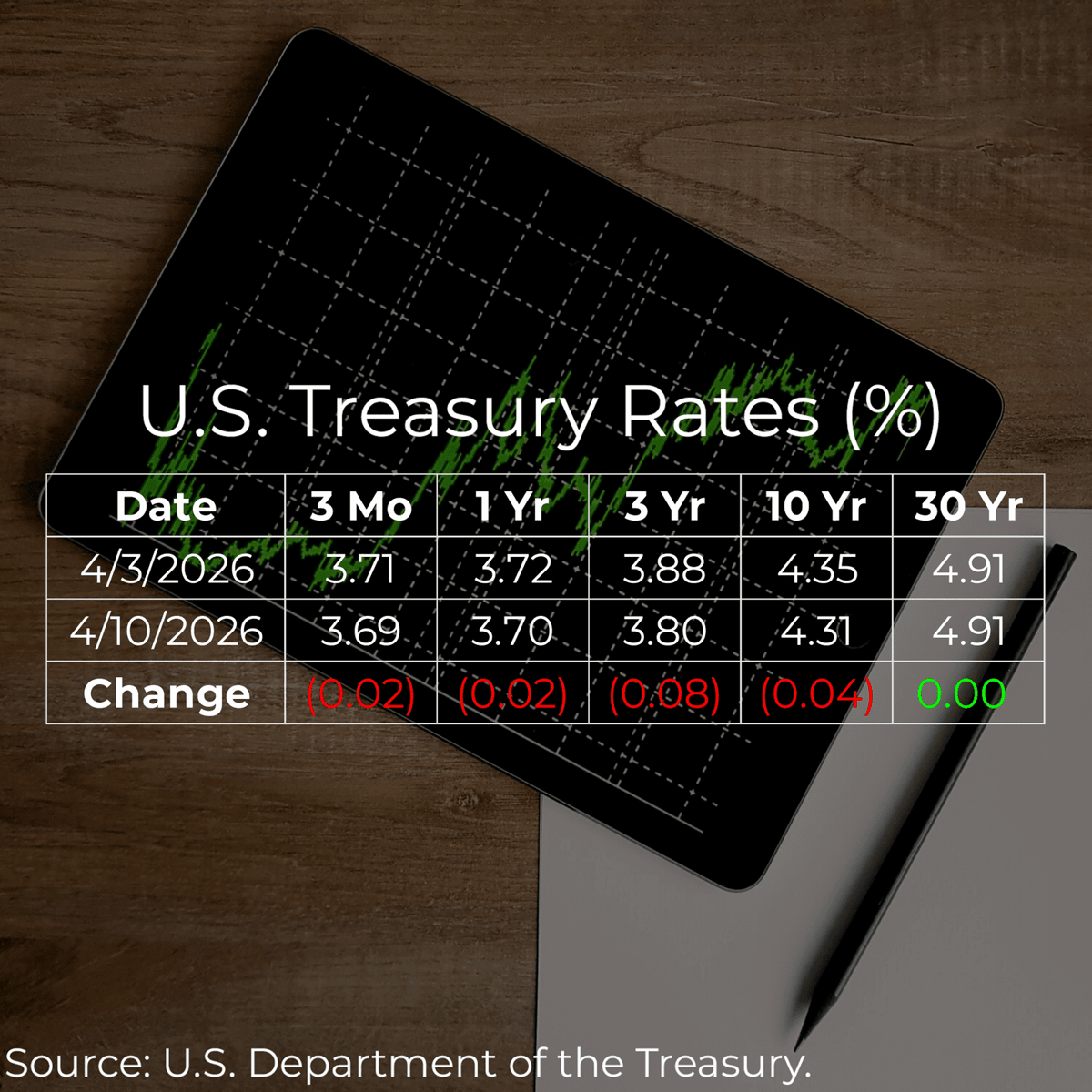
U.S. Treasury Rates Weekly Update for April 10, 2026
U.S. Treasury yields softened across most maturities for the week ending April 10, 2026, with the benchmark 10‑year rate slipping 0.04 percentage points to 4.31%. The 3‑year note posted a yield of 3.80%, while the 30‑year Treasury held steady at...

PadSplit Secures ORIX Financing; A Federal Court Upholds America’s Most Controversial Coliving Ban; 4.1 Million Australians Turn to Coliving, and...
PadSplit announced a new debt financing facility from ORIX USA’s Growth Capital, signaling institutional confidence in affordable shared‑housing infrastructure. A federal appeals court upheld Shawnee, Kansas’s ordinance that limits more than three unrelated adults from sharing a dwelling, raising zoning...

New SPACs: Irenic Acquisition Corp. (IACQU), Alpex Acquisition Corporation File for IPOs
Irenic Acquisition Corp. (ticker IACQU) and Alpex Acquisition Corp. have each filed Form S‑1 to launch new special purpose acquisition companies (SPACs). Irenic aims to raise roughly $200 million to pursue targets in technology and clean‑energy sectors, while Alpex seeks a...

The Paramount Question Isn’t Paramount
Paramount Skydance Corp. agreed to acquire Warner Bros. Discovery for roughly $110 billion in cash, valuing the target at $31 per share. The deal has drawn political and regulatory attention, yet antitrust concerns appear muted because the combined entity faces strong...

Asset Allocation for Alternatives: Digital Assets
Digital assets are moving from niche holdings into mainstream institutional portfolios, driven by better market infrastructure and the rise of index‑based products. The report outlines how crypto exposure, often paired with gold and the US dollar, can improve risk‑adjusted returns...

Is Your Company Prepared to Prevent Business Fraud, or Is It Set to Be the Next Victim?
The article catalogs fourteen common business fraud schemes—from Business Email Compromise and deep‑fake voice scams to asset misappropriation and payroll fraud—highlighting how attackers exploit executive authority, technology, and weak internal controls. It notes that asset misappropriation alone accounts for roughly...

District Buyer Map: North East ISD (TX)
North East Independent School District (TX) is a bond‑heavy district where capital funding is fully unlocked even as operating budgets tighten. The district’s capital pipeline is already financed, with infrastructure projects moving forward and security and compliance upgrades accelerating. Meanwhile,...

The IPO Buzz: Obesity-Focused Kailera Therapeutics Sets $500 Million IPO
Kailera Therapeutics, an obesity‑focused biotech developing a weekly GLP‑1 injection and a daily oral pill, filed an S‑1/A to raise $500 million. The company will offer 33.33 million shares at $14‑$16 each, which would place its market value near $1.8 billion if priced...

The IPO Window Reopens for Small Caps
The U.S. IPO market rebounded in 2025 with 371 listings, a 40% jump from 2024, marking the third year of recovery. A pipeline of heavyweight private firms—including Anthropic, OpenAI, SpaceX and Canva—promises continued issuance into 2026. Small‑cap stocks are benefiting...

Somnigroup International to Acquire Leggett & Platt in a $2.5 Billion All-Stock Deal
Somnigroup International announced an all‑stock acquisition of Leggett & Platt valued at $2.5 billion. Leggett shareholders will receive 0.1455 SGI shares per share, equivalent to $11.36 and a 13.69% premium. The transaction, priced at 6.64 × EBITDA, will give Leggett owners roughly 9%...

Mirepa Invests in Ghanaian Food Company
Mirepa Investment Advisors has closed a strategic investment in Ghanaian food producer Uniik Foods through its Mirepa Capital SME Fund I. The capital will fund modernisation of Uniik’s production lines, boost manufacturing capacity, and enhance distribution networks for its shelf‑stable...
The Great Debate: Private Capital Isn’t One Asset Class – or Is It?
At SAVCA’s 2026 Private Equity in Southern Africa Conference, industry leaders debated whether private capital in South Africa should be treated as a single, generalist asset class or broken into distinct allocations such as private equity, infrastructure, credit and venture....

Peer Group Governance
Peer groups, once a niche tool for executive‑pay benchmarking, now shape corporate governance across the S&P 1500. The new study shows 93% of these firms use peer lists, typically 14‑17 firms, and that governance reforms at peers strongly predict similar moves...

Shifting Sentiments Around Long-Vesting RSUs
Semler Brossy notes a growing debate over long‑vesting RSUs as an alternative to performance share units (PSUs) amid macro‑economic volatility. ISS’s 2026 guidelines now classify time‑based equity with at least three‑year vesting and a five‑year total horizon as performance‑based, opening...

Safe-Haven Liquidation Paradox: Margin-Call Transmission Architecture
The article explains a recurring paradox where safe‑haven assets, especially gold, fall during peak risk periods because margin‑call liquidations prioritize the most liquid holdings. A case study on April 13 2026 shows that a Hormuz Strait blockade drove oil prices up 7%,...

Iran War May Widen 10-Year Yield’s Market Premium Vs. Fair Value
The US 10‑year Treasury yield remains above the Capital Spectator’s fair‑value estimate of roughly 4.0%, closing at 4.34% after a brief rise to 4.50% in late March. A market premium that spiked over a percentage point during the 2022‑23 inflation...

What 10,000 Paying Subscribers Already Know
Michael’s newsletter has attracted over 10,000 monthly paying subscribers, many of whom are financial advisors, portfolio managers, and institutional allocators. The paid version delivers a proprietary intermarket signal framework, including a weekly dashboard of four ratios, sector rotation analysis, a...

Called Early, Paid in Full
Eagle Point Income Company’s Series C term preferred was called on April 3, 2026, exactly on its first‑call date. Investors who bought at $25.09 earned seven monthly distributions totaling about $1.17 per share, offsetting the $0.09 price loss when the...

The Daily Feather — Ingmar, Not Ingrid
The University of Michigan’s preliminary April consumer‑sentiment survey recorded an all‑time low, with 98% of interviews completed before the April 7 cease‑fire announcement. Analysts caution that the final results, due in two weeks, could show a rebound if geopolitical tensions ease....

The Compliance Blind Spots Hiding Inside Financial Data
Compliance programs often boast robust policies, yet many overlook the granular details hidden in transaction‑level data. Steve Markle of Itemize argues that fraud now embeds itself in invoices, vendor records, and expense reports, slipping past traditional controls. Without deep analysis...

AI Insurance Exists. Getting It Is the Hard Part.
Businesses are confronting a fragmented regulatory landscape and rising litigation risk, prompting a growing demand for AI‑specific insurance. While some insurers are adding outright AI exclusions, others offer tailored policies, algorithmic riders, or silent coverage within existing cyber and professional...
Standard Bank Continues to Back Optasia with $330m Syndicated Refinancing
Standard Bank, Africa’s largest lender by assets, acted as joint lead arranger and underwriter for a $330 million syndicated refinancing of Optasia, the continent’s leading AI‑driven fintech. The package includes a $180 million term loan and $150 million of bank guarantees, expanding the...

Calero Unveils ConnectIQ Orchestration Engine for Enterprise
Calero has launched ConnectIQ, an orchestration and automation engine that turns technology expense insights into immediate actions across telecom, mobility, SaaS and market data management. The platform uses an event‑driven architecture to detect issues the moment they arise and trigger...

Carve-Outs: Practical Tips for Improving Deal Certainty
The latest AURELIUS Carve‑Out Survey shows roughly 80% of executives anticipate a rise in non‑core divestitures in 2026, with 73% citing refocusing on core operations as the primary driver. Trade‑related uncertainties now affect 72% of respondents, while deleveraging has fallen...

Domes Resorts Becomes Majority Shareholder in Casa Collective
Domes Resorts has agreed with Goldman Sachs to acquire a majority stake in Casa Collective, the operator of 13 boutique hotels. The deal will add four new properties, expanding the portfolio to 17 locations. Casa Collective’s brands include the adults‑only...

BCW on the Block as WPP Weighs Exit From PR
WPP is reportedly preparing to sell its Burson Cohn & Wolfe (BCW) unit after a recent divestiture of a majority stake in FGS Global for roughly £1.3 bn ($1.65 bn). The move follows a 6% drop in PR revenue in WPP’s latest...

InsuranceERM Releases Podcast with Generali's CFO Cristiano Borean
InsuranceERM launched an In‑Depth podcast episode featuring Generali Group CFO Cristiano Borean, recorded shortly after the insurer’s annual results. Borean discusses how the CFO role is becoming increasingly strategic, driving growth, transformation and risk management. The conversation highlights AI’s potential...

Delek Logistics Partners (DKL) Secures $1.3 Billion Credit Facility
Delek Logistics Partners (DKL) announced a $1.3 billion revolving credit facility led by Truist Bank, extending to March 2031 and featuring an accordion clause for additional borrowing. The new facility will refinance existing debt and fund acquisitions, capital expenditures, and general corporate...

Global Partners (GLP) Expands Credit Facility by $300 Million
On March 13, 2026 Global Partners LP exercised a $300 million accordion feature under its existing credit facility, extending its working‑capital commitments for up to 364 days. The company also received lender approval to shift $200 million from its aggregate revolver to...

Martin Midstream Partners (MMLP) Amends Credit Facility
Martin Midstream Partners L.P. amended its credit agreement on March 31, 2026, trimming the revolving loan facility from $130 million to $115 million and tightening covenants. The new terms raise the minimum interest‑coverage ratio to 1.65× for 2026 and 1.75× for 2027, and cap...
Mach Natural Resources (MNR) Closes 9 Million Unit Secondary Offering
Mach Natural Resources LP (NYSE:MNR) completed a secondary public unit offering of 9 million common units on April 8, 2026, underwritten by Morgan Stanley. The sale was a pure secondary transaction, meaning existing unitholders received all proceeds and the company raised no new...

Genesis Energy (GEL) Secures $900 Million Credit Facility
Genesis Energy (GEL) secured a $900 million senior secured revolving credit facility on March 4, 2026, with an optional expansion to $1.3 billion and a maturity in March 2031. The new facility replaces the company’s prior agreement, extending its debt tenor and providing a flexible...

The False Decline Tax
The payments ecosystem is losing more legitimate merchant revenue to false declines than it is to fraud, with $50.7 billion in false‑decline losses in 2022 versus $33.4 billion in global card‑fraud losses in 2024. Visa’s 2026 Acquirer Monitoring Program tightened fraud‑tolerance thresholds,...

The SEC–CFTC “Historic” Crypto Harmonization: A Defining Inflection Point for Institutional Digital Asset Adoption:
U.S. regulators the SEC and CFTC have signed a formal Memorandum of Understanding to coordinate oversight of cryptocurrency markets. The MoU establishes information sharing, joint enforcement and clearer jurisdictional boundaries, offering the first unified regulatory posture for digital assets. For...

Intel Brings Fab 34 Back: The Repurchase of the Apollo Stake Marks a Change of Course in Ireland
Intel announced on April 1, 2026 that it will repurchase Apollo’s 49 percent stake in its Fab 34 joint venture in Leixlip, Ireland, for an estimated $14.2 billion. The transaction will be funded with existing cash and roughly $6.5 billion of new debt. Fab 34, a high‑volume...

Howard Marks Warns Private Credit Faces a Crucial Test for Investors
Howard Marks warns that private credit is entering a critical scrutiny phase as rapid asset growth has compressed yields, narrowed spreads, and attracted a flood of new managers. He cautions investors in listed asset managers and lenders to assess whether...

Mortgage REIT And BDC Ratings - Edition 133
The Mortgage REIT and BDC Ratings newsletter released Edition 133 on March 22, 2026, continuing its weekly series that tracks credit rating changes across mortgage‑backed REITs and business development companies. The post lists the five most recent editions (130‑133) with...

Why the Future of GRC Is a Command Center, Not a Collection of Modules
The governance, risk and compliance (GRC) market has outgrown its traditional collection‑of‑modules approach, leaving many enterprises with fragmented tools despite broader portfolios. Vendors have added risk, policy, audit, cyber and resilience solutions, but shared logins and interfaces have not delivered...

How Modern Finance Teams Are Using Agentic AI to Simplify Planning
Finance teams are turning to agentic AI to overhaul financial planning, moving from manual spreadsheets to continuous, real‑time forecasting. A KPMG study shows 71% of organizations already use AI in finance, and agents now handle scenario modeling, data integration, and...

USPS Plans to Raise Stamp Prices to 82 Cents in July and Suspend Retirement Fund Contributions to Avoid Running Out...
The U.S. Postal Service has asked the Postal Regulatory Commission to raise the price of a First‑Class Forever stamp from 78 cents to 82 cents on July 12, while other market‑dominant products will see roughly a 4.8% increase. The move...

From the Microsoft Dynamics 365 Business Central Blogs: Quality Management; Self-Billed Invoices; E-Invoice Draft Page
Microsoft announced three major updates to Dynamics 365 Business Central. Version 28 introduces a native quality management module, ending the need for separate add‑ons in manufacturing implementations. The 2026 Release Wave 1 adds full self‑billed invoice capability to the purchasing workflow. A...

From the Microsoft Dynamics 365 Finance and Supply Chain Management: Elastic Compute; Deferred Revenue; License Usage Summary Reports; Turn Compliance...
Microsoft Dynamics 365 Finance and Supply Chain Management introduces elastic compute, moving from fixed‑size tiers to a shared, auto‑scaling architecture that adds AOS instances as demand spikes. The platform now supports multi‑currency deferred revenue, addressing prior gaps in revenue recognition for...

CoT: Peek Into Future Through Futures, How Hedge Funds Are Positioned
Hedge funds (non‑commercial speculators) have deepened their bearish bets on long‑duration Treasuries, pushing net short positions in 10‑year note futures to 823.6 k contracts—a 5% weekly rise—and expanding 30‑year shorts to 59 k, up 86% week‑over‑week. In commodities, they remain net long...
The Deal That Changed the Credit Story Overnight
The January 26 2026 high‑yield bond now offers yields above 8.5% and a spread of 436 bps, a stark contrast to its earlier “ugly junk” label. Over the past three months, investors who bought at the mispriced level have earned roughly 7.8% total...

Deep Dive WeRide: Business Model, Unit Economics, Fleet Data, Financials and More
WeRide, one of China’s leading autonomous‑vehicle firms, now operates five distinct AV products in 12 countries and holds driverless permits in eight. The company’s revenue model blends asset‑light robotaxi services with higher‑margin robobuses and robosweepers, differentiating its China and international...

US Government Sold $620 Billion of Treasury Securities This Week. 10-Year Yield Ends at 4.31%, 30-Year Yield at 4.91%
The U.S. Treasury auctioned $620 billion of securities this week, including $480 billion of short‑term bills and $140 billion of 3‑year, 10‑year and 30‑year notes and bonds. The 10‑year note cleared at a 4.282 % yield and settled at 4.32 % in the secondary market,...

Priced Equity Rounds: A Founder's Complete Guide to Series Seed, Series A, and Beyond
A priced equity round converts SAFEs and notes into actual preferred shares at a negotiated pre‑money valuation, establishing the company’s capital structure from Series Seed through IPO. The term sheet outlines four critical levers—valuation and option‑pool sizing, liquidation preferences, board...

Cash Flow Strategies for Entrepreneurs to Stay on Track
Entrepreneurs often mistake profitability for cash health, but cash flow timing can cripple operations even when sales are strong. The article outlines a suite of tactics—budgeting and forecasting, building a 3‑6‑month cash reserve, tightening receivables and payables, and parking surplus...