
Italy's Software Fiscalization Shift: Lower Hardware Costs, Higher Compliance Complexity
Italy is rolling out a software‑based fiscalization system that will replace traditional fiscal printers with a certified, distributed architecture. The change promises lower upfront hardware costs, reduced maintenance, and fewer local service dependencies for retailers. However, the model shifts compliance control to software, requiring new PEM (point‑of‑sale) and PEL (central) components, digital certificates, hash‑chain integrity, and robust audit‑readiness processes. Retailers, POS vendors, and fiscal solution providers must redesign their architectures and certification strategies to avoid costly compliance gaps during rollout or tax audits.

The End of Gas Pain? Oregon Launches Nation’s First Road-User Charge
Oregon is moving its experimental OReGO road‑user charge from a voluntary pilot to a mandatory program that will begin on July 1 2027, initially targeting electric and hybrid vehicles. The per‑mile fee is set at just over two cents, linked to the...

AI Is Changing Who Wins Research Grants
A Northwestern Innovation Institute study examined confidential grant proposals from two universities alongside all NIH and NSF awards from 2021‑2025, revealing a sharp rise in AI‑assisted writing after 2023. At the NIH, proposals with higher AI involvement secured more funding...

Dutch Govt Looks at Relaxing Rules for Mobile Antenna Sites
The Dutch government is reviewing its regulations to make it easier for mobile operators to install antennas in new locations, especially in densely populated cities. State Secretary Willemijn Aerdts presented the proposal to parliament, citing a Monet industry report that...
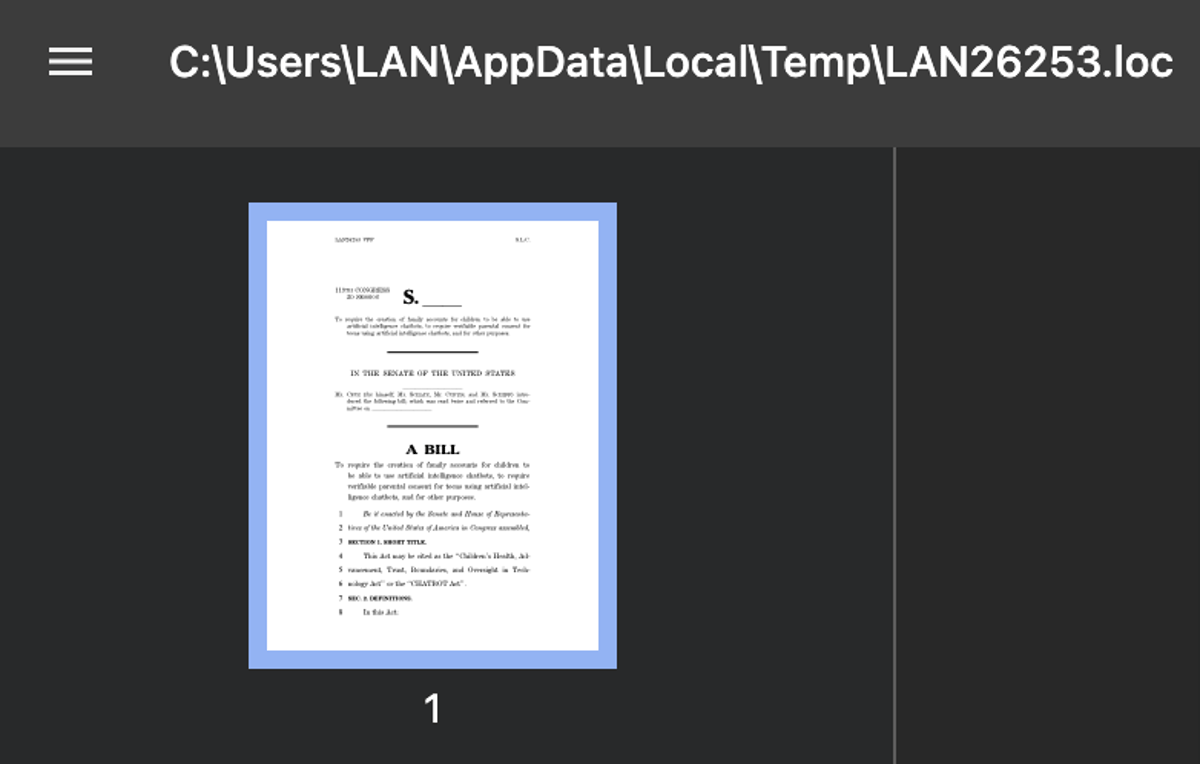
CHATBOT Act Introduced in Senate
The U.S. Senate Commerce Committee introduced the Children’s Health, Advancement, Trust, Boundaries, and Oversight in Technology (CHATBOT) Act, aiming to shift control of AI chatbot use from tech firms to parents. The bill mandates family accounts, parental consent, and bans...

The "Kill" Switch
Congress’ 2021 infrastructure law mandates that new vehicles embed technology to detect impaired driving, turning cars into data‑collecting platforms. The system combines cabin cameras, steering sensors and emerging breath or skin‑based alcohol detectors, initially marketed as safety features but increasingly...

Godshill Residents Left in Lurch as New Forest Gigabit Contract Adjusted
Godshill, a village in the New Forest, has been removed from the UK Government’s Project Gigabit contract, leaving 159 homes without a guaranteed full‑fibre connection. The original timeline promised service by the end of 2026 from Wessex Internet, but the...

Papers Please! MPs Back Mass Online Digital ID Checkpoints
British MPs have incorporated new powers into the Children and Schools Wellbeing Bill that would enable mass online digital ID checkpoints for age verification. The Open Rights Group warns that expanding age‑identification across platforms could force millions to surrender personal...

JT/DL: Justice AI Regs; FBI Gets Encrypted Texts
The latest JT/DL newsletter highlights a surge in AI oversight for criminal justice, with Brookings urging state regulation and Florida launching a criminal probe into OpenAI after its chatbot was linked to a campus shooting. A new Colorado bill targets...

The DEEP, OVHcloud and Clever Cloud Consortium Is Selected for the Sovereign Cloud for European Institutions
The European Commission has chosen a consortium of DEEP (POST Luxembourg), OVHcloud and Clever Cloud to deliver sovereign cloud services to EU institutions. The six‑year contract is capped at €180 million (approximately $196 million). The partnership combines OVHcloud’s high‑capacity OPCP infrastructure, Clever...

1st US Town to Deploy Defibrillator Drones for Cardiac Events | Gizmodo
Clemmons, North Carolina, became the first U.S. municipality to deploy drones that deliver automated external defibrillators (AEDs) during live 911 calls. The program, a collaboration between Duke Health and the Forsyth County Sheriff’s Office, launches a drone as soon as...

The Legal Tech Giants Powering ICE, Part 1 — How Thomson Reuters and LexisNexis Helped Support America’s Immigration Surveillance Machine
Legal‑tech powerhouses Thomson Reuters and LexisNexis have sold ICE extensive data‑aggregation tools, CLEAR and Accurint, under contracts totaling roughly $51.6 million. Between 2003 and 2024 the Department of Homeland Security paid over $333 million to these firms for surveillance‑grade databases that compile...

The Storage “Tax” On Petabyte Surveillance Systems
European infrastructure operators are confronting a "storage tax" as cloud fees surge alongside petabyte‑scale 8K video streams and AI‑driven analytics. Disk Archive Corporation’s ALTO on‑premise archive promises cold‑storage cost levels with sub‑minute access, sidestepping volatile egress charges. Deep native integration...

Scaleway Selected by the European Commission to Deliver a Sovereign Public Cloud & AI Platform to EU Institutions
Scaleway has been chosen as one of four providers for the European Commission’s Cloud III Dynamic Purchasing System, a €180 million (≈ $196 million) procurement that will supply sovereign cloud and AI services to EU institutions for up to six years. The selection follows...

The Push for Permitting Reform
Congress is reviewing H.R. 2289, the American Broadband Deployment Act of 2025, which would overhaul permitting for wireless and wired infrastructure. The bill imposes a 60‑to‑150‑day "shot clock" for state and local authorities to approve or deny permits, automatically granting...

AI-Enhanced Deliberative Democracy and the Future of the Collective Will
Manon Revel and Théophile Pénigaud examine AI‑enhanced deliberative democracy, outlining computational frameworks that aim to aggregate collective preferences more accurately than traditional opinion polls. They argue that preferences are shaped by context, making AI a potential discovery tool for uncovering...

Finally, Access: How Article 40 DSA Changes Platform Research in Practice
The EU’s Digital Services Act now grants independent researchers a legal right to access data from Very Large Online Platforms (VLOPs) and Search Engines serving at least 45 million EU users. Article 40 creates two routes: public‑data access beyond voluntary tools (40‑12)...

Signals From the Frontier of Digital Statecraft: Rethinking Governance in the Age of AI
Last week Cambridge’s Jesus College hosted the inaugural Digital Statecraft Fellows, bringing together policymakers, technologists, scholars, and practitioners to confront the question of governing in the age of AI. The convening, anchored by the Digital Statecraft Manifesto, moved beyond digitising...

The Legal Tech Giants Powering ICE, Part 1 — How Thomson Reuters and LexisNexis Helped Support America’s Immigration Surveillance Machine
Thomson Reuters and LexisNexis, the two dominant legal‑research platforms, have entered multi‑year contracts with U.S. Immigration and Customs Enforcement (ICE) to supply immigration case data and real‑time detainee records. The agreements, valued in the millions, enable ICE to automate risk‑scoring...

Oman TRA Plans 69 Field Visits to Check Telecoms Quality
Oman’s Telecommunications Regulatory Authority (TRA) unveiled its 2026 field‑survey plan, scheduling 69 on‑site visits to assess telecom service quality nationwide. The inspections will span multiple governorates and focus on high‑traffic locations such as town centres, major roads, malls and event...

As Aerospace Companies Pursue AI, FAA Lags
The Federal Aviation Administration’s aging processes and staffing cuts are slowing aircraft certification as aerospace firms race to embed artificial intelligence in design and development. Boeing, Airbus, GE and emerging eVTOL players rely on AI to accelerate product cycles, yet...

US Government Ramps up Mass Surveillance with Help of AI Tech, Data Brokers, Your Apps and Devices
The U.S. government is dramatically expanding its mass‑surveillance capabilities by pairing $165 billion in annual DHS funding with AI‑driven analytics and private‑sector contracts. Agencies such as ICE have secured roughly $86 billion, while the FBI openly purchases bulk location data from commercial...

AI’s Potential to Increase IRS Audits Raises Expectations and Fears
The IRS is piloting Palantir’s Selection and Analytic Platform (SNAP), an AI‑driven tool designed to sift through more than 100 legacy systems and identify high‑value audit and collection targets. The agency spent roughly $1.8 million on the contract, hoping to replace...

Daily Mail – AI Facial Recognition Wrongly Flags a Software Engineer and Midwife as Criminals
British software engineer Alvi Choudhury and pregnant midwife Rennea Nelson were both arrested after live facial‑recognition systems mistakenly identified them as criminals. Choudhury was taken from his Southampton home for a crime committed in Milton Keynes, while Nelson was detained in...

America’s Data Crisis: Saving Trusted Facts Is Essential to Democracy
A coalition of researchers, technologists, and civic leaders is urging a coordinated national program to safeguard the United States' most critical public datasets. The proposal outlines a ten‑step, AI‑enabled framework that begins with scanning the federal data ecosystem to catalog...

Participatory Modelling and Simulation to Improve AI-Based Public Social Services
The new open‑access volume presents a suite of agent‑based simulations that examine AI’s role in welfare‑related public services across nine countries. It emphasizes participatory modelling to ensure AI systems are context‑specific, adaptive, and aligned with diverse societal values. Case studies...

My Best Idea: Decision Markets
On April 25 1996 the author posted the first description of “decision markets,” a hybrid of prediction markets and decision theory that prices outcomes conditional on specific choices. The idea builds on two long‑standing concepts: markets’ ability to aggregate dispersed information and...

California Coastal Community Must Reject CBP's AI-Powered Surveillance Tower
Customs and Border Protection has applied to the city of San Clemente to place an Anduril Industries Autonomous Surveillance Tower, known as the Sentry, on a cliff 1.5 miles inland. The AI‑powered system combines video, radar and computer‑vision to monitor...

Big Ferries Are Becoming Battery-First Systems
Large vehicle‑carrying ferries over 100 m are beginning to run on batteries, with an operating fleet of just 20 vessels—about 2‑3% of the estimated 700‑900 global large‑ferry stock. The current fleet is hybrid‑heavy; only three ships (15% of the battery‑propulsion group)...

Bill Shielding CT Residents From Data Brokers and Surveillance Passes Senate
The Connecticut Senate approved Senate Bill 4, passing 31‑4, to give residents new powers over personal data. The bill lets consumers request deletion of information held by data brokers and bans the sale of precise geolocation data. It also requires...

Digital Location Data Heads Back to the Supreme Court
On April 27, the U.S. Supreme Court will hear Chatrie v. United States, a challenge to police access to app‑generated geofence location data. The case asks whether a warrant is required to obtain anonymized lists of devices in a specific...

From Surveillance State to Kill Machine: Has the Line Already Been Crossed?
The Pentagon’s FY 2027 request includes a $54.6 billion boost for the Defense Autonomous Warfare Group, a 24,000 % increase aimed at building AI‑driven lethal systems for U.S. Special Operations. Simultaneously, ICE has signed $60 million contracts with Palantir to deploy ImmigrationOS and the...

Nigerian Telecoms Identity Risk Management System Launches
On April 24, the Nigerian Communications Commission and the Central Bank of Nigeria unveiled a joint Telecoms Identity Risk Management System (TIRMS) portal. The platform gives banks and other financial institutions real‑time visibility to monitor and flag suspicious telephone numbers...

IRS Tries to Bring Amended Returns Into the 21st Century
The IRS has opened electronic filing for Form 1040‑X and deployed AI tools that instantly cross‑check amended returns against existing data, dramatically cutting the initial review time. Despite the technology boost, a human still must manually adjust the taxpayer’s account,...

G2 Speech Achieves Self-Certified Supplier Status on NHS England AVT Registry
G2 Speech has been accepted as a self‑certified supplier on the NHS England Ambient Voice Technology (AVT) Registry. The designation confirms that its SpeechAmbient platform meets NHS safety, data‑security and performance standards. By joining the registry, G2 Speech can more...

Weekly Roundup: April 17-23, 2026
Harvard Law School’s Forum weekly roundup (April 17‑23, 2026) covered a spectrum of governance issues, from SEC Commissioner Hester Peirce’s warning about the Consolidated Audit Trail’s multi‑billion‑dollar cost and privacy risks to ISS’s legal challenge against Indiana’s proxy‑filing statute. The collection also...

Mozambique Launches National Roaming Pilot to Improve Coverage
Mozambique’s communications regulator, INCM, has launched a pilot national roaming scheme that allows subscribers of Tmcel, Vodacom and Movitel to access each other’s network infrastructure. The program targets the country’s persistent “shadow zones,” where existing operators provide little or no...

KDDI Selected for Japan Government Project to Test Satellite-Connected Drones
KDDI has been chosen by Japan’s Ministry of Internal Affairs and Communications for a fiscal‑2026 digital transformation initiative that will pilot satellite‑direct communication to control drones in regions lacking mobile coverage. The program, part of the government’s regional DX promotion...

NTT Tests AI-Based Inspection of Railway Viaducts
Japan’s NTT e‑Drone Technology completed a proof‑of‑concept trial of its AI‑driven inspection service for railway viaducts, in collaboration with Tokyu Construction. The e‑Drone AI platform processes high‑resolution images of concrete structures to automatically identify cracks, delamination, exposed rebar, water leakage...

New E-Mobility Study Actually Reveals Need For Safer Streets, Not E-Bike Crackdowns
A new analysis of roughly 900 emergency‑room visits at Bellevue Hospital from 2018 to 2023 shows that injuries involving electric bikes, scooters and pedestrians are driven primarily by motor‑vehicle collisions, not by the devices themselves. ER visits rose through 2022...

Congressman Wants AI Out of Kids’ Toys After Chatbots Got Weird with Children
Congressman Blake Moore (R‑UT) introduced legislation to prohibit artificial‑intelligence features in children’s toys after a series of unsettling chatbot interactions with minors. While OpenAI, Google, Anthropic, xAI and Perplexity all restrict unsupervised use by users under 13, they license the...

New Jersey Admits Defeat on Offshore Wind (at Least for Now)
New Jersey’s Board of Public Utilities has terminated its 2021 transmission agreement with PJM Interconnection, effectively halting the Larrabee Pre‑Built Infrastructure intended to move offshore wind power onto the state grid. The decision follows the collapse of key offshore projects,...

The Palantir Problem
Palantir Technologies unveiled a 22‑point manifesto derived from co‑founder Alex Karp’s book, positioning the firm as a political actor rather than a neutral data‑analytics provider. The document frames Silicon Valley as morally indebted to the United States and dismisses consumer‑product...

UK Launches Inquiry Into Security Risks of Chinese-Made 3D Printing Equipment
Britain’s Defence Secretary has launched an investigation into the British Army’s use of Chinese‑manufactured Bambu Lab 3D printers, which were deployed during a training exercise in Kenya. The inquiry focuses on potential security risks stemming from the printers’ default cloud...

America’s Cyber Strategy Has a Budget Problem
The Trump administration’s FY2027 budget proposes a $707 million cut to the Cybersecurity and Infrastructure Security Agency (CISA), shrinking its budget to just over $2 billion—well below the $2.6 billion Congress had earmarked. The proposal also trims the Office of the National Cyber...

MPs Call for Publication of Secret Documents that Outline Chronic Risks From UK’s Dependence on Big Tech
Cross‑party MPs and the Open Rights Group have urged the UK government to publish classified documents that outline chronic risks from the nation’s dependence on foreign digital platforms, especially US‑based Big Tech and AI providers. The request follows an Open...

Auditing AI
Auditing AI, a new MIT Press book by Christian Sandvig and co‑authors, outlines a practical framework for evaluating artificial‑intelligence systems. It defines what an AI audit entails, why it’s essential, and the components of a best‑practice audit. The authors illustrate...

Is AI Actually Useful for Intelligence Analysis?
At the AI+ Intelligence Summit, former CIA officials Wayne McCool and Bruce Frost examined how artificial‑intelligence tools are currently deployed within the intelligence community, highlighting faster data triage and pattern detection. They also outlined the technology’s shortcomings, such as bias, data‑quality...

GB News – Man Hauled to Court After Facial Recognition Mistook Him for Someone Else
A 59‑year‑old roofer in London was arrested after a live facial‑recognition system mistakenly identified him as the suspect who stole roughly £300 (about $380) of IKEA furniture. He spent 24 hours in custody and was brought before a magistrate before...

“Without Haste, but Without Pause”: How Uruguay’s Parliament Is Approaching AI
Uruguay’s Chamber of Deputies, led by Speaker Rodrigo Goñi Reyes, is pursuing a dual strategy of AI adoption and regulation framed as an “enabling condition.” The parliament is internally deploying AI for legislative drafting, transcription, and impact‑evaluation, while awaiting sector‑specific...