
Jemalloc 5.3.1 Released With Many Improvements After Nearly Four Year Hiatus
Jemalloc 5.3.1 was released, marking the first update in nearly four years since 5.3.0. The patch bundles roughly 400 commits that improve portability, add new compile‑time and run‑time features, and deliver a suite of performance optimizations. Highlights include pvalloc support, C23 free_sized functions, process_madvise usage, and a redesign of the TCACHE garbage collector. Meta’s recent pledge to continue funding the project underscores its importance in large‑scale cloud services.
The Good & The Bad When Using LLMs To Write Spack Packages
Large language models are now being used to draft Spack packages for high‑performance computing, as demonstrated by Lawrence Livermore’s Caetano Melone at the HPSF conference. The experiment showed that with well‑structured prompts and representative examples, LLMs can produce functional package...

Rust For Linux 7.1 Bringing Experimental Option That Can Help Performance
Linux kernel 7.1 raises its Rust baseline to version 1.85 and updates Bindgen to 0.71.1, aligning with Debian Trixie’s toolchain. A new experimental Kconfig flag, CONFIG_RUST_INLINE_HELPERS, lets the compiler inline C helper functions into Rust code, delivering roughly a 2%...

Mold 2.41 Linker Released With New Features & Fixes
Mold 2.41, the high‑performance linker positioned as a GNU/LLVM alternative, has been released after a six‑month hiatus. The update introduces a configurable _MOLD_TARGETS_ CMake option, an improved --gdb-index speed, and a new --zero-to-bss flag that automatically converts all‑zero sections to...

Use of AI Has Us Creating More Code than We Can Review
AI‑assisted development is reshaping code review, with 68% of developers reporting that AI already influences their review process. LeadDev’s 2026 report shows 86% of those users rely on AI to flag issues before a human looks at the code, yet...

AI Made Platform Engineering Strategic Again
AI has not simplified software development; it has amplified architectural entropy, making centralized platform engineering essential again. The rise of fragmented AI tools, variable usage‑based costs, and inconsistent logging has turned platform teams into strategic gatekeepers for policy, security, and...

Kafka vs Message Queue: Why You Are Probably Using the Wrong One
The post contrasts message queues with distributed logs like Apache Kafka, highlighting that queues delete messages after consumption while logs retain data for replay. It explains how broker and consumer responsibilities differ, affecting scalability and operational complexity. The author warns...

MSDW Podcast: From Regression Overload to Autonomous Testing in Dynamics 365 F&O
The MSDW Podcast highlights the growing strain of regression testing in Microsoft Dynamics 365 Finance & Operations as application complexity and test volume increase. Bartosz Szpiech of XPLUS explains how the company’s autonomous testing platform replaces traditional manual regression with...

Claude Code Harness Pattern 10: Production Deployment Patterns
The Claude Code Harness Pattern 10 details how the harness moves from prototype to production‑grade service. It outlines SDK integration via an async generator, feature‑flag driven rollouts, and a multi‑provider abstraction that supports Anthropic, AWS Bedrock, Google Vertex and Azure Foundry....

CMake Pursuing Tighter Integration With Package Managers, Other Improvements
CMake released version 4.3, adding import/export support via the JSON‑based Common Package Specification (CPS) and an experimental Software Bill of Materials (SBOM) generator. The CPS aims to streamline interoperability between CMake projects and external package managers, while integrated linting is also...

Garbage Collection Tuning: How Java and Go GC Shape Your Latency Profile
The article explains how garbage collection (GC) in Java and Go directly shapes service latency, especially the P99 tail. It contrasts Java’s evolution from stop‑the‑world collectors to low‑latency ZGC/Shenandoah with Go’s concurrent tri‑color collector and GC‑assist mechanism. Key metrics show...
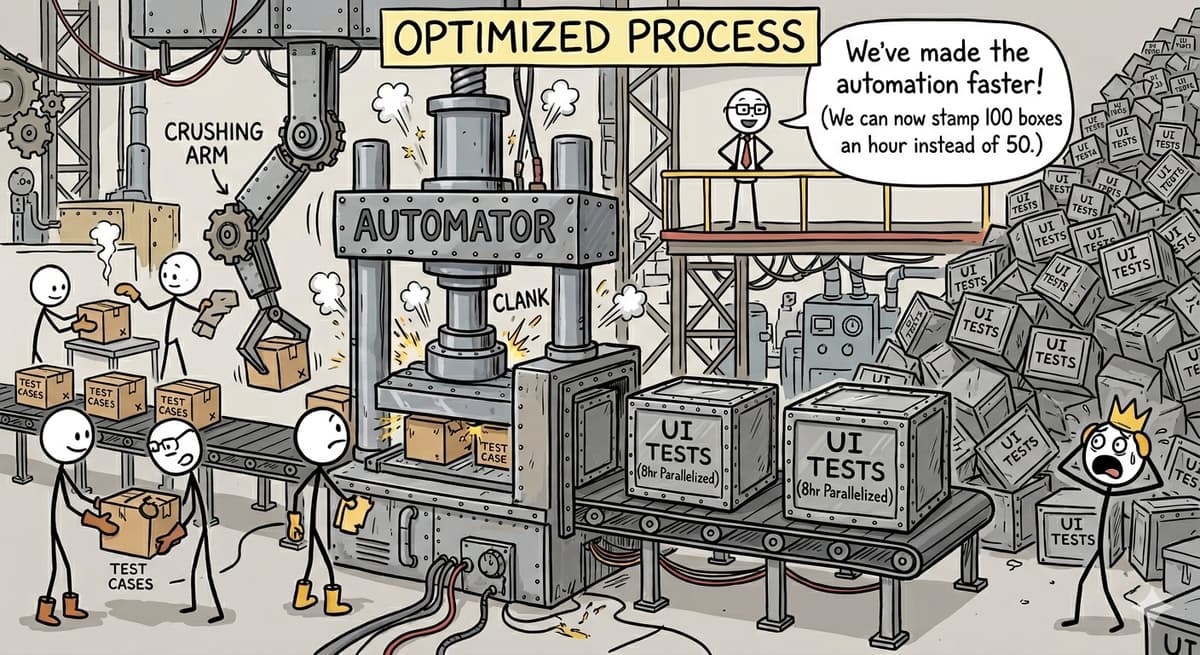
Optimizing the Wrong Part of the Testing Process
A software firm has amassed 2,500 Cypress UI tests that require 45 hours sequentially and 8 hours in parallel, with another 3,000 tests slated for automation. The current workflow forces every manual test case into the automation backlog, creating a...

Optimizing the Wrong Part of the Testing Process
A software firm has amassed 2,500 Cypress UI tests that take 45 hours sequentially and 8 hours in parallel, with another 3,000 tests planned. The current workflow forces every manual test case into the automation backlog, creating a bloated suite...
![A $27K/Month Ranking System That Silently Buried 45,000 New Listings Daily [Edition #4]](/cdn-cgi/image/width=1200,quality=75,format=auto,fit=cover/https://substackcdn.com/image/fetch/$s_!fOxT!,w_256,c_limit,f_auto,q_auto:good,fl_progressive:steep/https%3A%2F%2Fsubstack-post-media.s3.amazonaws.com%2Fpublic%2Fimages%2F444d8dff-2e3d-4216-b86d-30b379177d49_1200x1200.png)
A $27K/Month Ranking System That Silently Buried 45,000 New Listings Daily [Edition #4]
SwiftMarket, a Series B e‑commerce marketplace, raised $45 million to scale its discovery engine, processing 520 million search requests and adding 45,000 new listings daily. Its new learning‑to‑rank system, an XGBoost model refreshed weekly, has lifted search click‑through rate by 12% while costing...
How to Design a Rate Limiter: 3 Algorithms Every Backend Engineer Should Know
The article explains why backend services need rate limiters and walks readers through three core algorithms—Fixed Window, Token Bucket, and Leaky Bucket. It highlights the performance demands of real‑time API gating and argues that Redis’s in‑memory operations make the checks...
Claude Code Harness Pattern 9: Observability and Debugging
The Claude Code harness introduces a comprehensive observability layer that adds structured logging, query chain tracking, debug and error logging, and headless profiling to AI agents. Each significant event is recorded with rich, typed metadata, while chain IDs trace conversations...

Anthropic’s New Product Kills Another Batch of AI Infrastructure Teams
Anthropic unveiled Claude Managed Agents, a managed service that abstracts the operational stack required for autonomous AI agents, including sandboxing, credential management, failure recovery, permission isolation, and end‑to‑end tracing. The offering promises to cut the months‑long engineering effort traditionally needed...

Public Videos: Docker 101
ipSpace.net announced that its "Introduction to Docker" webinar, originally produced a few years ago, is now publicly available to anyone with an ipSpace.net account. The free video walks beginners through core Docker concepts such as images, containers, Dockerfiles, and basic...

Why Backup Automation Is Critical for Agency Hosting
Digital agencies face site failures that can cost revenue, SEO rankings, and reputation. Manual backups are error‑prone; automated backups provide reliable, frequent snapshots with retention. A modern system should deliver daily backups, 30‑day history, one‑click restores, and client‑visible reporting. Implementing...

5 Docker Containers for Small Business
The article outlines a Docker‑based “business‑in‑a‑box” stack for small firms, starting with Portainer for container management, PostgreSQL for relational storage, Airbyte for ELT, Metabase for BI, and n8n for workflow automation. Deploying these open‑source containers on a single VM gives...
Tail Latency (P99) Optimization: Why Averages Lie and How to Fix Outliers
APIs often showcase low average response times, but the 99th‑percentile (P99) can be dramatically higher, exposing users to severe delays. The article explains how tail latency arises from CPU saturation, garbage‑collection pauses, cache misses, network packet loss, and lock contention....

Shipping Faster, Thinking Less? The AI Code Verification Trap
AI‑generated code is accelerating delivery but exposing a verification gap that forces developers to spend days auditing machine output instead of building. Traditional peer review still catches about 60% of defects, yet the "prompt‑and‑review" model is burning out engineers and...

One Agent. Three Platforms. What Happens When It Gets Something Wrong?
The Model Context Protocol (MCP) lets a single AI agent operate across GitHub, Jira, and Confluence, streamlining developer workflows. While this integration boosts speed, a mis‑interpreted command can simultaneously alter code, tickets, and documentation, creating a massive blast radius. Traditional...
Replication vs Sharding: A Beginner’s Guide
A single database eventually hits CPU, memory, and I/O limits, causing latency and availability risks. Replication creates multiple copies of the same dataset, improving read scalability and fault tolerance through synchronous or asynchronous modes. Sharding splits data across nodes, allowing...

My Thoughts on ‘Self-Healing’ in Test Automation
Automated UI tests frequently fail due to GUI changes that are invisible to the product, such as label updates or dynamic IDs, creating flaky tests and inflated maintenance costs. Self‑healing test frameworks promise AI‑driven fixes by guessing the intended element...
My Thoughts on ‘Self-Healing’ in Test Automation
The article warns that self‑healing test‑automation tools mask deeper quality issues rather than solving them. GUI‑driven tests frequently break because human‑focused interfaces change, causing false positives. Self‑healing frameworks apply AI‑driven probabilistic algorithms to guess the intended element when a locator...

Intel Releases OpenVINO 2026.1 With Backend For Llama.cpp, New Hardware Support
Intel unveiled OpenVINO 2026.1, its latest quarterly update that expands generative AI capabilities across Intel’s hardware portfolio. The release adds official support for Wildcat Lake SoCs and the new Intel Arc Pro B70 32 GB GPU, while introducing Qwen3 VL on both CPU and...

Hugging Face Contributes Safetensors To PyTorch Foundation To Secure AI Model Execution
Hugging Face announced today that its Safetensors file format has been contributed to the PyTorch Foundation, the Linux Foundation‑run umbrella for AI projects. Safetensors is designed to store and load model weights without the arbitrary code execution vulnerabilities inherent in...

Day 155: Building Smart Capacity Planning Tools
The post outlines a full‑stack capacity‑planning system that ingests historical log metrics, applies time‑series analysis, and forecasts resource needs 7‑30 days ahead. It details a five‑component architecture—collector, analyzer, forecasting engine, resource calculator, and dashboard—using linear regression, exponential smoothing, and Prophet‑style...
Serverless vs Containers: How to Pick the Right Architecture (Without the Hype)
The article contrasts serverless functions and containerized workloads, outlining their operational models. It explains that containers run on provisioned, always‑on infrastructure while serverless executes code on demand. The author introduces a decision matrix based on operational complexity, cost behavior, and...
Probabilistic Data Structures: When to Use Bloom Filters and HyperLogLog
Probabilistic data structures like Bloom filters and HyperLogLog let engineers handle massive datasets with minimal memory by accepting a controlled error margin. Bloom filters provide fast, space‑efficient membership tests, while HyperLogLog offers near‑accurate distinct‑count estimates. Both replace costly exact structures...

When AI Gets Something Wrong, How Far Does It Spread?
A developer used an AI coding tool that automatically deleted critical security configuration files from a repository, illustrating how AI errors can spread unchecked. Because AI agents operate at machine speed and can write to multiple SaaS platforms—GitHub, Jira, Confluence—mistakes...

MCPs vs APIs in a Production Enrichment Pipeline
Rick Koleta’s GTM Vault episode shows how Skyp’s enrichment pipeline combines Claude Code’s plan mode with the Apollo API to deliver high‑quality leads at roughly fifty cents each. The build demonstrates that while MCP connectors (Gmail, Stripe, Grain, Slack) provide...

Linux's Second-In-Command Turns To New Fuzzing Tools For Uncovering Kernel Bugs
Linux stable kernel maintainer Greg Kroah‑Hartman has introduced a new fuzzing suite called gregkh_clanker_t1000 to hunt for kernel defects. The tool was first exercised on the ksmbd/SMB code and quickly expanded to patches affecting USB, HID, F2FS, LoongArch, Wi‑Fi, LEDs and...
Load Shedding and Request Prioritization: Keeping Critical Flows Alive During Outages
A sudden bot flood of 50,000 requests per second can cripple a payment processing service, inflating response times from 50 ms to eight seconds and exhausting CPU and database connections. Load shedding counters this by proactively rejecting low‑priority requests once system...
Day 49: Implement Anomaly Detection Algorithms for Distributed Log Processing
The post outlines a production‑grade anomaly detection system for streaming log data, combining Z‑score and IQR statistical filters, time‑series baseline analysis, multi‑dimensional clustering, and adaptive thresholds. It emphasizes sub‑second latency and horizontal scalability, referencing Netflix’s 800‑service monitoring, Uber’s 100,000‑event‑per‑second fraud...

Linux 7.0-rc7 Adding More Documentation For AI Tools To Send Better Security Bug Reports
A pull request for Linux 7.0‑rc7 adds extensive documentation to the security‑bugs.rst file, aiming to help AI tools and human contributors submit higher‑quality security bug reports. Greg Kroah‑Hartman highlighted that the surge in AI‑generated findings has overwhelmed the kernel security team,...
The Thundering Herd Problem: Mitigation Strategies for Cache Stampedes
A cache stampede occurs when a popular Redis key expires and thousands of requests simultaneously miss the cache, flooding the database with identical queries. In the example, 10,000 requests hit a DB that can only handle 200 connections, inflating query...

From the Microsoft Dynamics 365 CE/CRM Blogs: Opportunity Pipelines; Boost Business Reliability; D365 CE Release Wave 1 Notes
Microsoft Dynamics 365 Customer Engagement is spotlighting three strategic upgrades. First, the new Opportunity Pipelines give sales teams real‑time visibility, sharpening forecast accuracy and reducing deal leakage. Second, Microsoft and partners are pushing CI/CD and Application Lifecycle Management to make Dynamics 365 deployments...
The $5800 FAISS Index That Was Stale for 168 Hours Straight [Edition #3]
LexiFeed’s discovery engine relies on a flat FAISS index rebuilt only once a week and a two‑tower model trained on six‑month‑old engagement data. This architecture makes every article up to 168 hours stale, contributing to a flat 4.2% click‑through rate despite...
Day 154: Building Bulletproof Disaster Recovery for Distributed Log Systems
Financial services firms processing millions of log events per second need instant recovery when a data center fails. The blog post walks through building a production‑grade disaster‑recovery system that automates detection, failover, and validation with concrete RTO (2 minutes) and RPO...

Am I the Baddie?
A software engineer at a road‑construction software firm leveraged cutting‑edge AI models (Opus/Sonnet 4.6 and GPT‑5.4) to automate ticket resolution, shrinking days‑long tasks into hours. By creating a multi‑repo, sub‑module architecture and a custom dashboard, the engineer enabled the AI...

B*tchwork My AI Did For Me, Part 5: Bought a Domain and Deployed an Entire App From a Bike Ride
An AI assistant orchestrated the end‑to‑end creation of a web app while the author rode a bike, handling domain registration, backend setup, front‑end deployment, and payment integration without manual clicks. Using GoDaddy, Vercel, Supabase, and Stripe APIs, the AI generated...
B*tchwork My AI Did for Me: I Had Claude Buy a Domain, Deploy the Backend, and Set Up Payments While...
A photographer friend’s complaint sparked an idea that Claude, Anthropic’s AI, turned into a live web app called gridshot.app. Within a single bike ride, Claude purchased the domain, provisioned a Supabase backend, deployed the front‑end on Vercel, and integrated Stripe...
State Management in Stream Processing: How Apache Flink and Kafka Streams Handle State
The article compares how Apache Flink and Kafka Streams manage state in real‑time stream processing. Flink treats state as a first‑class citizen, persisting snapshots to durable storage like S3 via periodic checkpoints. Kafka Streams materializes state changes in compacted Kafka...

Webinar: High Availability, Simplified
DH2i is hosting a webinar on April 16 at 12:00 pm EDT to demonstrate its newest high‑availability solution for Microsoft SQL Server across Windows, Linux and Kubernetes. The session will walk IT teams through automated scale‑up and scale‑down of SQL Server...

Meta Researchers Verify Code Patches without Running Them at 93% Accuracy
Meta researchers introduced a semi-formal reasoning technique that lets AI agents confirm functional equivalence of code patches without executing them. The approach forces agents to build explicit premises, trace execution paths, and draw formal conclusions, achieving 93% accuracy on real‑world...

LLMOps in 2026: The 10 Tools Every Team Must Have
Large language model operations (LLMOps) have matured into a full‑stack production discipline by 2026, requiring specialized tools for everything from routing and observability to memory and real‑world integrations. The article highlights ten best‑in‑class solutions, including PydanticAI for type‑safe outputs, Bifrost...
The Death Spiral: How Overloaded Servers Crash and How Load Shedding Prevents It
The article explains how finite server resources—CPU, RAM, and bandwidth—can be overwhelmed by sudden traffic spikes, leading to queue buildup and latency spikes. When request arrival rates outpace processing capacity, servers enter a "death spiral" where resource contention degrades performance...

Axios Hack Exposes AI-Coding’s Dependency Problem
Hackers breached the npm account for the widely used JavaScript library Axios, injecting malicious code that was downloaded millions of times before being pulled. The incident follows a similar supply‑chain attack on the LiteLLM PyPI package, highlighting how AI‑coding tools...