From Atomic Chaos to Custom Materials
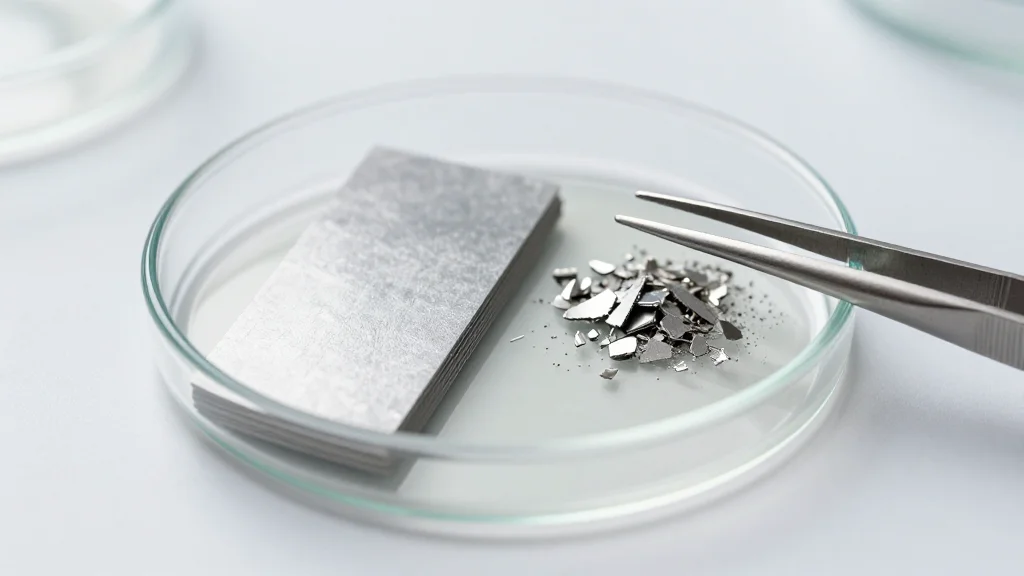
Scientists at Argonne National Laboratory have expanded the MXene precursor library by synthesizing 40 new MAX phases, nearly doubling the known chemical space. Their experiments show that atomic ordering persists with up to six different metals, but collapses into disorder when seven or more are mixed, highlighting entropy’s role in stabilizing complex compositions. By mapping how composition, structure, and surface chemistry interrelate, the team provides a design roadmap for MXenes across energy storage, catalysis, EMI shielding, and other high‑tech sectors. The findings pave the way for AI‑driven discovery and larger‑scale production.

AI Paired with Tiny Optical Device Corrects Distorted Light for Sharper Imaging
University of California‑San Diego engineers have combined an AI‑designed metasurface with a deep‑learning analysis system to detect and correct optical distortions from a single image. The tiny device—about 1 cm by 0.5 mm—uses nanofabricated titanium‑dioxide pillars and can operate across multiple wavelengths...

Nanoparticles Inspired by Lung Fluid Improve Therapies Targeting Respiratory System
Researchers at CIC biomaGUNE have created pulmonary surfactant nanoparticles that encapsulate antifibrotic drugs and can be delivered by inhalation. Using a microfluidic synthesis platform, the particles achieve uniform size, high drug loading and 90% retention in mouse lungs, dramatically lowering...

Teaching AI to Design Optical Surfaces Using Real-World Imperfections
Researchers at Singapore’s SUTD and collaborators in China have unveiled ExpForm, a transformer‑based deep‑learning framework trained directly on experimental spectra of optical Fourier surfaces. By ingesting over 25,000 angle‑resolved measurements, the model predicts forward and inverse optical responses with 99.79%...