LogicMonitor Collaborates with IBM and Red Hat to Support Autonomous Data Centers?
LogicMonitor announced a partnership with IBM and Red Hat to embed IBM watsonx and the Red Hat Ansible Automation Platform into its Edwin AI agent. The integration lets Edwin AI automatically generate or trigger Ansible playbooks when anomalies are detected, enabling self‑healing across hybrid and multi‑cloud environments. By combining AI‑driven observability with generative automation, the solution aims to prevent incidents, reduce manual remediation, and free IT teams for higher‑value work.

Announcing AWS CDK Mixins: Composable Abstractions for AWS Resources
AWS announced CDK Mixins, a new composable abstraction layer for the Cloud Development Kit that lets developers attach reusable capabilities to any construct—L1, L2, or custom—without rewriting libraries. Mixins decouple features from concrete implementations, enabling day‑one access to new AWS...
What Kubectl Debug Doesn’t Tell You: The Silent Evidence Gap
Kubernetes’ API design for ephemeral containers deliberately omits a persistent termination record, so a kubectl debug session’s exit code, duration, and target container disappear once the pod is updated. The `EphemeralContainerStatus` lacks a `lastState` field, unlike regular containers, causing vital...

Gabriele Bartolini: CloudNativePG and Crunchy PGO: An Honest, Opinionated Comparison
The article pits CloudNativePG against Crunchy PGO, two leading open‑source PostgreSQL operators for Kubernetes, and argues that CloudNativePG’s design—embedding high‑availability logic directly in the operator and using minimal images—offers a stronger, more Kubernetes‑native foundation. It contrasts architectural choices, upgrade mechanisms, backup...

Beyond BYOK: Why Governance Matters for AI Agents
GitHub announced that its Copilot CLI now supports bring‑your‑own‑key (BYOK) and fully offline models, letting developers route requests to private providers or run models locally. In contrast, GitLab’s Duo CLI is built on the Duo Agent Platform and provides headless,...

Introducing the TrafficExtension API
Istio 1.30 launches the TrafficExtension API, consolidating WasmPlugin and Lua-based extensibility into a single resource. The new API lets users embed inline Lua scripts or pull WebAssembly modules from OCI registries for sidecars, gateways, and waypoint proxies. It introduces unified...

Jump Crypto’s ‘Firedancer’ Is Taking a Slow and Steady Approach to Its Long-Awaited Solana Infrastructure Rollout
Jump Crypto’s Firedancer validator client has quietly gone live on the Solana mainnet, processing tens of millions of transactions. The rollout is deliberately incremental, avoiding a mass public launch until comprehensive security audits are complete. Firedancer is positioned as a...

Why Pass/Fail CI Pipelines Are Insufficient for Enterprise Release Decisions
Modern CI/CD pipelines give fast feedback, but pass/fail signals are insufficient for enterprise releases. In large, regulated systems, a green pipeline only shows tests ran, not that releasing is safe. Binary outcomes hide risk when failures differ in business impact....

Kubernetes v1.36: New Metric for Route Sync in the Cloud Controller Manager
Kubernetes v1.36 adds an alpha counter metric `route_controller_route_sync_total` to the Cloud Controller Manager (CCM) route controller, tracking each route synchronization with the cloud provider. The metric supports the `CloudControllerManagerWatchBasedRoutesReconciliation` feature gate introduced in v1.35, which switches the controller from a...
Platform Engineering Labs Introduces Kubernetes Support
Platform Engineering Labs announced that its open‑source IaC platform, formae, now includes native Helm integration and full Kubernetes support, covering vanilla clusters as well as managed services like Amazon EKS and Azure AKS. The update also introduces a Public Hub...

Vibesies Launches AI-Native Hosting Platform Built Around Vibe Coding
Archieboy Holdings launched Vibesies, an AI‑native hosting platform that equips each tenant with a sandboxed Linux container pre‑loaded with Claude Code and OpenAI Codex. The service lets users direct an AI agent in plain English to build, deploy, and maintain...

Microsoft to Automatically Roll Back Faulty Windows Drivers
Microsoft announced Cloud‑Initiated Driver Recovery, a Windows Update feature that automatically rolls back drivers flagged for quality issues. The system lets Microsoft trigger a rollback to a known‑good version without requiring OEMs or users to intervene. Testing runs from May...

The Inference Bottleneck: Architecting Kubernetes Autoscaling for Production LLMs
Generative AI workloads are moving into production, but Kubernetes’ native Horizontal Pod Autoscaler (HPA) cannot reliably scale large‑language‑model (LLM) inference services. Because inference engines pre‑allocate GPU memory for the KV cache, memory‑based HPA thresholds fire immediately, mistaking optimal utilization for...

How AI Is Transforming Software Development
AI‑driven coding agents have moved from autocomplete helpers to autonomous developers that can read tickets, generate multi‑file changes, run tests, and submit pull requests. Adoption is soaring—84% of developers use or plan AI tools, and half employ them daily—compressing six‑month...
Red Hat Expands OpenShift Application Development Environment
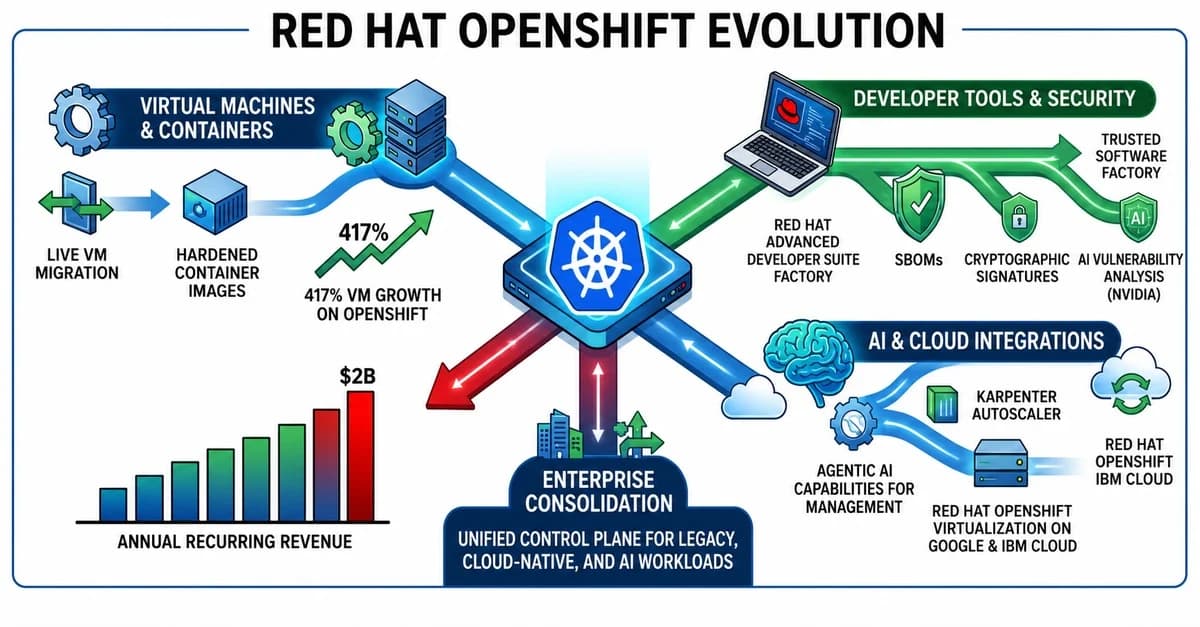
Red Hat announced a suite of OpenShift upgrades, adding live VM migration, hardened container images, and AI‑driven vulnerability analysis. The company previewed an Advanced Developer Suite with a Trusted Software Factory, SBOMs, and cryptographic signatures for secure CI/CD pipelines. Red Hat Desktop...

Claude Code's '/Goals' Separates the Agent that Works From the One that Decides It's Done
Anthropic introduced Claude Code’s /goals feature, which separates the code‑generation model from an independent evaluator that checks whether a defined goal is truly met. The evaluator, typically the lightweight Haiku model, reviews each step and only allows the agent to stop...

TestRail Is Now in the Azure DevOps Marketplace
TestRail has launched a certified app in the Azure DevOps Marketplace, enabling one‑click installation for cloud‑based Azure DevOps. The app brings bidirectional test management capabilities—including requirements traceability, defect tracking, and a live coverage panel—directly into ADO work items. It extends...

Exadel Launches Exadel Colleague, an Autonomous AI Delivery Peer Built to Solve Problems AI Coding Tools Leave Behind
Exadel unveiled Exadel Colleague, an autonomous AI delivery peer that works inside existing engineering workflows. Unlike traditional AI coding assistants, the platform accepts tickets, plans work, writes tests, builds code, and submits validated pull requests without human intervention between assignments....

Red Hat Summit 2026: AI, Virtualization, Ansible Updates Signal Partner Opportunity
Red Hat’s 2026 Summit in Atlanta unveiled AI 3.4 with deeper Nvidia integration, the upcoming Ansible Automation Platform 2.7, and a push for OpenShift Virtualization that now generates over $600 billion in annual recurring revenue. The company highlighted a “virtualization cost crisis” and positioned...
When AI Agents Become Contributors: How KubeStellar Reached 81% PR Acceptance
In late 2023 the author built the KubeStellar Console, a multi‑cluster Kubernetes dashboard, using two AI coding agents alongside Go, React, and Helm. Initial weeks saw rapid code generation, but unchecked agent actions broke builds and caused cascading failures, prompting...
CloudBolt Furthers Its Cloud Management Platform, Diversifying Hybrid Cloud and Virtualization Strategies
CloudBolt Software unveiled the latest version of its CloudBolt CMP, adding AI‑ready operations via MCP, fine‑grained RBAC, and expanded multi‑cloud support. The release emphasizes governed agent interactions, contextual user experiences, and day‑two lifecycle management across VMware alternatives, public, private and...

Browser Run: Now Running on Cloudflare Containers, It’s Faster and More Scalable
Cloudflare has rebuilt its Browser Run platform on Cloudflare Containers, boosting capacity and speed. The new architecture allows 60 browsers to launch per minute and up to 120 concurrent sessions—four times the prior limit—and cuts Quick Action response times by...
Building a Cloud Native Platform From the Ground up with Kairos, K0rdent, and Bindy
RBC Capital Markets built a cloud‑native platform that unifies node, cluster, and DNS lifecycle management using Kairos, k0rdent, and bindy. Immutable Kairos images eliminate node drift, while k0rdent (leveraging CAPI and k0s) declaratively provisions and upgrades 50+ clusters across hybrid...

Gabriele Bartolini: CNPG Recipe 24 - Migrating From Crunchy PGO to PostgreSQL 18 with CloudNativePG
Gabriele Bartolini’s CNPG Recipe 24 details how to migrate a PostgreSQL 17 cluster managed by Crunchy PGO v6 to PostgreSQL 18 using CloudNativePG. Two approaches are covered: an offline, fully declarative pg_dump import and an online logical‑replication method that enables near‑zero‑downtime cutover. The guide provides...

Deploying Docker AI Agents on OCI and OKE
Oracle’s OCI and managed Kubernetes service OKE now support Docker‑based AI agents as production‑grade workloads. The guide details a full stack—from hardened container images and OCI Vault secret injection to virtual‑node serverless compute and OCI Generative AI’s GPU‑free LLM inference....

5 Ways to Fix Misleading Vulnerability Severities with Policy
GitLab introduced vulnerability management severity override policies that let teams automatically adjust CVSS scores based on context such as CVE ID, CWE, file path, or exploitation intelligence. The policies can set, increase, or decrease severity levels on each default‑branch pipeline,...
Everpure’s Portworx Makes Data Management Native to Red Hat OpenShift
Everpure unveiled Portworx Plugin 2.2 for Red Hat OpenShift, embedding storage, data protection and disaster‑recovery directly into the OpenShift console. The release bundles Portworx Enterprise 3.6, Plugin 2.2 and Backup 2.11, and adds edge‑focused capabilities that encrypt and protect data on 2‑5 node clusters. Integrated...

Red Hat Is Betting on AgentOps to Close the Gap Between AI Experiments and Production
Red Hat unveiled AI 3.4 at its Summit, introducing a Model‑as‑a‑Service layer and a new AgentOps suite to move AI agents from experiment to production. The update adds distributed inference with vLLM and llm‑d, speculative decoding that can double response speed,...

Red Hat Opens Ansible to AI Agents, Within Limits
Red Hat announced the general availability of its Model Context Protocol (MCP) server, letting external AI agents interact with the Ansible Automation Platform. The company also introduced a technology‑preview orchestrator that forces AI‑generated actions through pre‑approved, deterministic playbooks. Support now...

Red Hat Establishes Ansible Automation Platform as the Trusted Execution Layer for IT Operations in an Agentic Era
Red Hat unveiled Ansible Automation Platform 2.7, adding a technology‑preview automation orchestrator, Model Context Protocol server, and AI‑aware features that blend deterministic, event‑driven, and AI‑driven workflows. The update introduces a “bring‑your‑own‑knowledge” assistant, a universal AI bridge, and a performance dashboard...

Honeycomb Introduces Agent Observability Features to Keep an Eye on Production
Honeycomb, the full‑stack observability startup, unveiled a suite of AI‑agent monitoring tools—including Agent Timeline, Canvas Agent, Canvas Skills, and auto‑investigations. The features give engineers a real‑time, single‑pane view of large language model calls, tool invocations, and decision paths without requiring...

I Asked Three AI Models to Fix the Same Broken Code. One Outperformed the Rest
A tech writer tested three leading AI models—ChatGPT (GPT 5.5), Google Gemini 3.1 Pro Preview, and Anthropic Claude Sonnet 4.6—by asking each to fix a deliberately broken Python script that moves image files. All three corrected the basic syntax errors and missing imports, but...

Red Hat Adds Support for Agentic AI Development
Red Hat unveiled a suite of agentic AI development tools at its Summit, including the generally available Red Hat Desktop with sandboxed AI agent testing, an enhanced Advanced Developer Suite, dedicated AI skill bundles, and the free rolling‑release Fedora Hummingbird...

Resolve and Deduplicate Email Alerts
Incident.io introduced advanced email parsing that lets a “resolved” email automatically close the originating alert and eliminates duplicate notifications by extracting a unique key from the subject or body. The platform also refreshed the team overview page, adding clearer views...
A Decade of Governance: Cloud Custodian at 10 and Its Role in the Agentic AI Era
Cloud Custodian, an open‑source, stateless policy engine, celebrates its 10‑year anniversary as a CNCF incubating project. The tool now serves as a foundational cost‑optimization and security layer for the emerging agentic AI era, where autonomous agents provision GPU fleets, model‑serving...

Christophe Pettus: All Your GUCs in a Row: Autovacuum_worker_slots
PostgreSQL 18 introduces a split configuration for autovacuum workers by adding the autovacuum_worker_slots parameter, which reserves shared‑memory slots at server startup. The existing autovacuum_max_workers becomes SIGHUP‑reloadable, allowing DBAs to raise or lower active workers on a running instance as long...

Red Hat AI Inference Brings Llm-D to Any Managed Kubernetes, Starting with CoreWeave and Microsoft Azure
Red Hat announced that its AI Inference platform now runs on any managed Kubernetes service, with validated blueprints for CoreWeave Kubernetes Service and Azure Kubernetes Service. The offering extends the vLLM‑based server with the llm‑d distributed inference orchestrator, delivering up...

Supercharging Local AI Development with RHEL on NVIDIA DGX Spark
Red Hat announced a development preview of Red Hat Enterprise Linux 10 running on NVIDIA’s DGX Spark workstation. The DGX Spark, built on the Grace Blackwell GPU architecture, offers up to 1 petaflop of compute and 128 GB of unified memory, enabling developers to train and test...

OpenShift: Consistent Integration for the Hybrid Enterprise
Red Hat OpenShift has become the leading hybrid cloud platform, now surpassing $2 billion in annual recurring revenue. The company highlighted large‑scale migrations such as EUROCONTROL’s 25‑year legacy replacement and Telenet Business’s consolidation of VMs and containers, while reporting a 417% rise...

Red Hat Desktop Brings Kubernetes-Aligned Development to the Desktop
Red Hat announced Red Hat Desktop, an enterprise‑backed version of Podman Desktop that brings cloud‑native, container‑based development to developers' laptops. The offering includes extensions for local OpenShift clusters, bootable image creation, AI model labs, and hardened container images, plus a new Kaiden...

The MCP Catalog Is Here: Discover, Deploy, and Connect on Red Hat OpenShift AI
Red Hat OpenShift AI 3.4 introduces the MCP catalog, a developer‑preview marketplace of pre‑validated Model Context Protocol (MCP) servers. The catalog lets users discover, deploy, and manage MCP servers directly on OpenShift with an automated lifecycle operator and a secure...

Strengthening Security and Consistency in the Cloud with Red Hat and HashiCorp
Red Hat and HashiCorp have deepened their partnership by embedding HashiCorp Vault and Terraform into Red Hat Ansible Automation Platform, and by introducing OIDC‑based authentication in the upcoming 2.7 release. The new capability lets Ansible act as an OpenID Connect...

LinearB Named a Leader in the 2026 Gartner® Magic Quadrant™ for Developer Productivity Insight Platforms
LinearB has been named a Leader in Gartner’s 2026 Magic Quadrant for Developer Productivity Insight Platforms. The analyst firm estimates the DPIP market at roughly $400 million and growing at over 40% annually. LinearB’s platform combines AI‑driven metrics, a natural‑language interface,...

Kubernetes in Production: Where Platform Decisions Break Down
Running Kubernetes in production demands far more than the core orchestration layer. Organizations must add networking, ingress, CI/CD, observability, and security tooling, which often become separate, hard‑to‑integrate components. The article contrasts vendor‑managed distributions that accelerate initial rollout with internally built...

Lendi Group Runs First Project Through "Agentic SDLC"
Lendi Group, a home‑lending fintech, completed its first project using an agentic software development lifecycle (SDLC) powered by Atlassian’s Teamwork Graph. The new process captures meeting audio with Loom, auto‑generates PRDs in Confluence, and employs AI agents to create Jira...

Red Hat Embraces MCP to Enable AI Agents to Automate IT Operations
Red Hat is previewing Model Context Protocol (MCP) servers embedded in Red Hat Enterprise Linux (RHEL), the Satellite management framework, and the Lightspeed automation platform, allowing AI agents to invoke these services via natural‑language workflows. The company also announced container‑based...

Debian 14 Cracks Down on Unreproducible Packages
Midway through Debian 14 "Forky" development, the release team announced a mandatory reproducible‑build policy. New migration software now blocks any package that cannot be rebuilt byte‑for‑byte, and flags regressions in existing testing packages. The move aligns Debian with the broader...

The Serverless Illusion: When “Pay for What You Use” Becomes Expensive
The article debunks the myth that serverless "pay‑for‑what‑you‑use" is always cheaper. It shows how hidden line items—API Gateway, NAT gateways, CloudWatch logs, and provisioned concurrency—can drive costs far beyond the Lambda compute price. A startup with 2.6 billion monthly invocations spent...

Telenet Taps Red Hat for Private Cloud Infrastructure
Telenet Business, the managed‑service arm of Belgium’s Telenet, has partnered with Red Hat to build a sovereign private‑cloud using Red Hat OpenShift. The solution consolidates virtual machines and container workloads on bare‑metal across two regional data centres, providing a single management layer...

Docker Isn’t Just About Containers Anymore
Docker, long known for popularizing containers, is repositioning itself as an AI‑infrastructure platform. The company launched Docker Model Runner to pull and run large language models locally via an OpenAI‑compatible API, introduced MCP Gateway to centralize AI tool configuration and...