
Fast, Collaborative Founders Drive 120% YoY Growth
After 9+ years of working with DTC brands, the majority of the ones that stay with us longer than 6 months all have these things in common: • they respond within 24 hours, every time • the founder is in the room, not hiding behind a marketing manager • they say "let's test it" instead of "we've always done it this way" • feedback goes two ways, not just one • they treat it like a partnership, not a vendor relationship • they move fast when something needs to change • they care more about actual business performance than being right You’ll scale 120% YoY with us (on average) if you adapt quickly, communicate, and trust the process.

Analytics + Marketing Ops Drive Accelerated Growth
RT @VisionEdgeMktg 📊 Analytics + marketing operations = growth acceleration. Measure everything. Here's your toolkit: https://t.co/erhl8XtQN3 #Analytics #MarketingOps #DataDriven
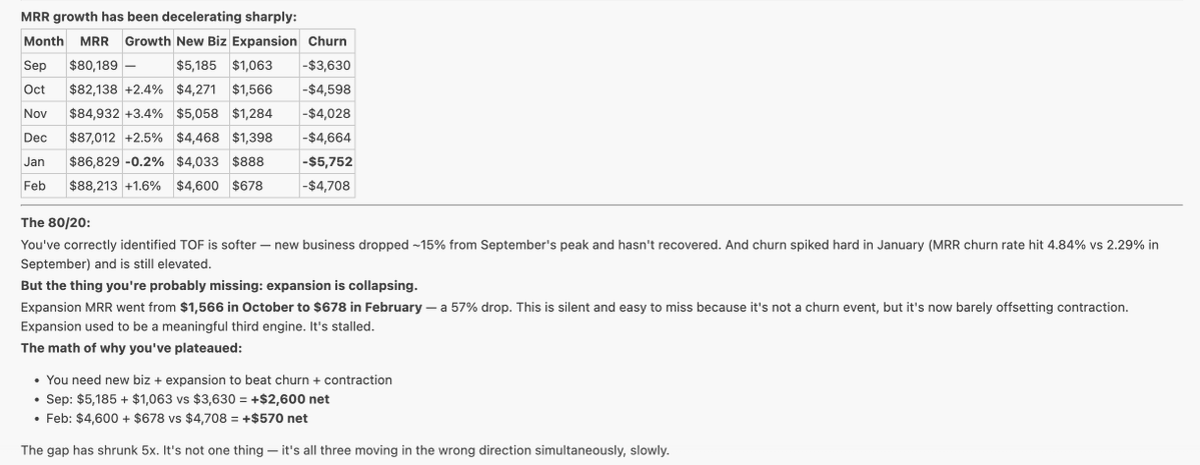
Investigating Senja's Stalled Revenue Growth with AI
Why is Senja's revenue growth stalling? I've shipped my own MCP server for @ChartMogul and connected it to Claude Code to find out Cannot wait to start acting on this data https://t.co/hsq519MDck

Refresh Tiny Touchpoints to Revive B2B Campaigns
As a B2B marketer, have you ever hit campaign fatigue? That moment when performance keeps dipping, you’ve tried everything, and nothing seems to work. It happens to the best of us, especially if we lean on the same channels over...

Meta's AI Analyst Can't Grasp Business Fundamentals, Risks Spend
Meta just dropped a $2B AI agent inside your Ads Manager. Everyone's asking if they should test it. • It pulls reports • Does audience research • Analyzes campaign data But it can’t: • Create campaigns • Change bids • Touch your budget It's an analyst sitting...

B2B Buyers Favor Rep‑Free Experience, Rethink GTM
Learning systems developers - how are you shifting your #B2B #GTM strategy to meet potential buyers where they are? #LMS #software #productstrategy #marketing #sales #selling

Aggressive 2026 Territory Plan: Deep Research, Quick Wins
Received my territory for 2026 (in mid Jan) and boy am I pumped up. Here’s a glimpse into my book. -6 Tier 1’s -8 Tier 2’s -16 Tier 3’s And 5 strategic customers with whitespace potential. Glimpse into my Tier 1 strategy for 2026: -Google...

Revenue Orchestration Redefined: Conga‑PROS Insights Unveiled
Revenue Orchestration Redefined: Insights from the Conga + PROS Era at Connect 2026 #congaconnect https://t.co/4bEbn8fnog

Turn Competitors' Bad Reviews Into Your Growth Blueprint
Your competitors hide your growth plan in their reviews. Study their 1-star feedback on Google, Amazon, and social media to spot gaps in service, pricing, and delivery. Survey their lost customers and ask why they chose or rejected them. You’ll see clear...

Stop Over‑Segmenting: One Persona Beats Six Empty Versions
If you’ve created 6 different buyer personas - it’s time to be honest with yourself. Are you really going to create 6 different versions of your content? A version for each one? You could. It is possible. But I would...

Stop Overpaying Agencies: Cut 60% TOF Spend
The number of 7 & 8 figure brands that we audit whose agencies are running clicks / leadgen and very very TOF metrics is mind boggling to me. Yes these events “can” have their place as a % of your budget...

Prepare a Validation Matrix for Every Prospect Objection
Founders: Build your narrative validation matrix: Prospect says: You need: 'Interesting' → Market data 'Proven?' → Case studies 'ROI?' → Calculator 'Why you?' → Comparisons 'Why now?' ...

Color‑Code Your Calendar: Fill It With Money‑Making Activities
I told an SDR two weeks ago to triple their cold calling blocks. They looked at me like I was crazy. I said... " Listen.. that's like telling Steph Curry to only shoot 3s in the first quarter.. He's the best...

Targeting Everyone Kills Founders; Narrow Focus Drives Demand
Most founders fail because they target everyone. When you narrow your market, you attract buyers who see your value and stop wasting time on bad leads. Focus on one niche, speak to one problem, and align your offer to one clear outcome. Test,...

Meta's New Ads Breakdowns Overstate True Performance
Meta rolled out two new breakdowns in Ads Manager, and I strongly suggest taking them with a grain of salt. More data does not always mean more truth. They give you a cleaner look at new vs. returning customer splits,...

Scale Beyond $1M: Test, Evolve, Listen, Adapt
Worst ways to scale past $1M/month: - Protecting the winning formula instead of evolving it - Launching brand-new creative directions without testing them first - Ignoring what your customers are actually telling you - Refusing to test new offers, promotions, or products - Being so...

AI Empowers Solo Entrepreneurs to Build End‑to‑End Businesses
We are seeing the rise of the full stack entrepreneur. AI is expanding the scope of what an individual entrepreneur can do. She can have the idea. She can test it using a virtual customer panel constructed with LLMs. She...

Great AI Won’t Save Poor Customer Journeys
Today's reminder that, even in the age of AI, marketing still matters. In my exuberance over the launch of ChatGPT 5.4 yesterday, I hit a usage limit. But instead of using this as an upsell opportunity, I got the below...

Ambarella Onboards ISV Partners in Weeks
.@Ambarella_Inc: "We moved ISV's software over in a matter of weeks" The company onboarded new ISV partners extremely quickly, as it evolves its go-to-market strategy to an ecosystem approach. Catch the full episode on the EE Times channel at https://t.co/NbBpWDeyi1...

Category Fame Outperforms Household Fame in B2B
Why “Category Fame” Beats Household Fame in B2B Marketing - B2B Marketing Blog | Webbiquity - https://t.co/Xac64vxxFo Research from @LinkedIn

Build Resilient Growth with Processes and Long-Term Planning
RT @VisionEdgeMktg 🛡️ Future-proof your growth with two key components: processes & plans. Track what's happening. Plan long ahead. When disruption hits, you'll be ready. https://t.co/Zpjd6B3t19 #Growth #Strategy #Planning
AI Marketing Is Reactive; Brands Need Proactive Awareness
There is still a big brand marketing gap in the industry and the massive push to use AI isn't solving it. Most of what's being done to attract business with AI right now is reactive marketing - showing up in...
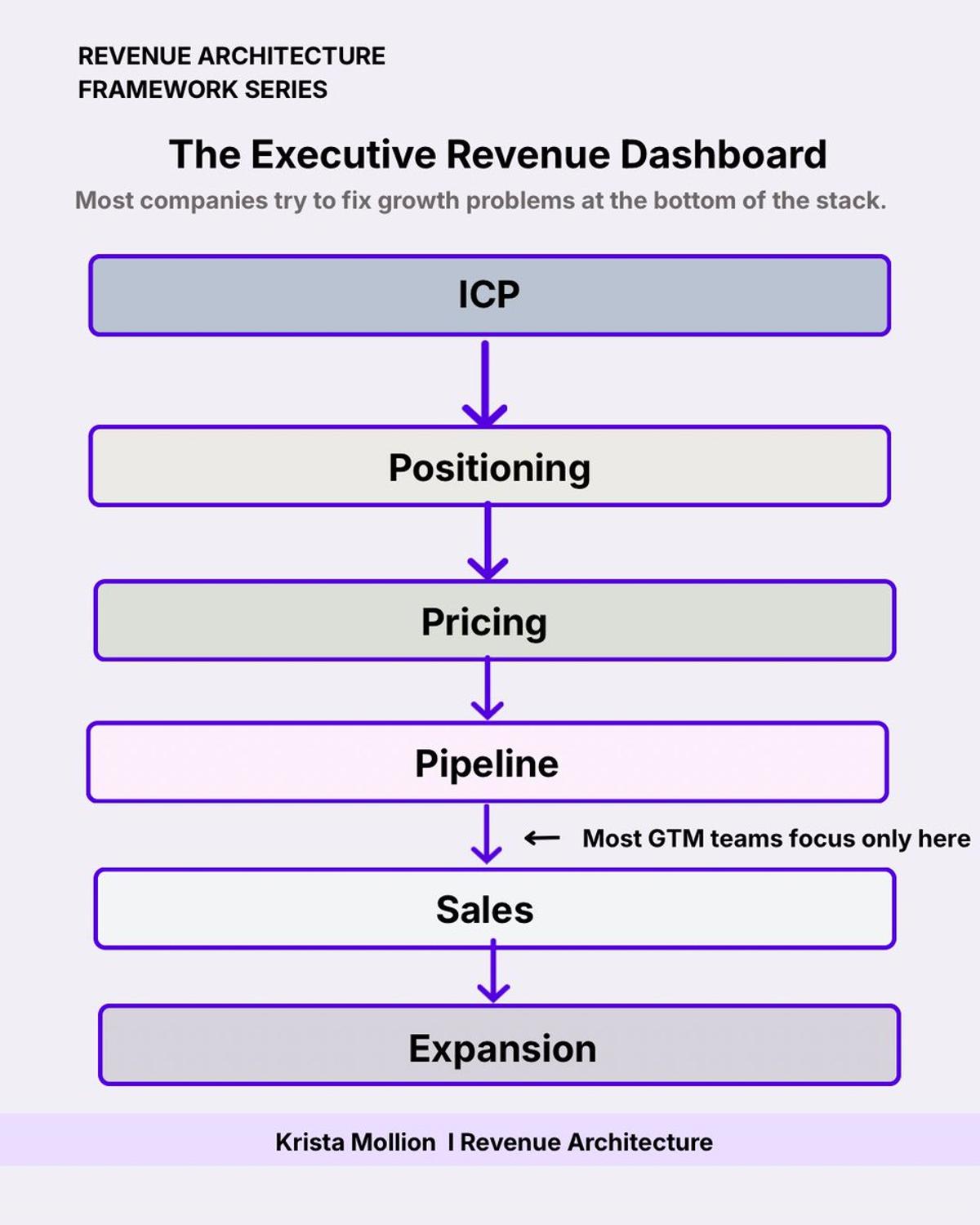
Revenue Architecture Beats Tactics for Predictable SaaS Growth
Most SaaS companies try to fix growth problems with tactics. More leads. More tools. More sales hires. But predictable revenue depends on something deeper: Revenue Architecture. The system connecting ICP, positioning, pricing, pipeline, and sales. I explain the framework here → https://t.co/y9I8gazKsu
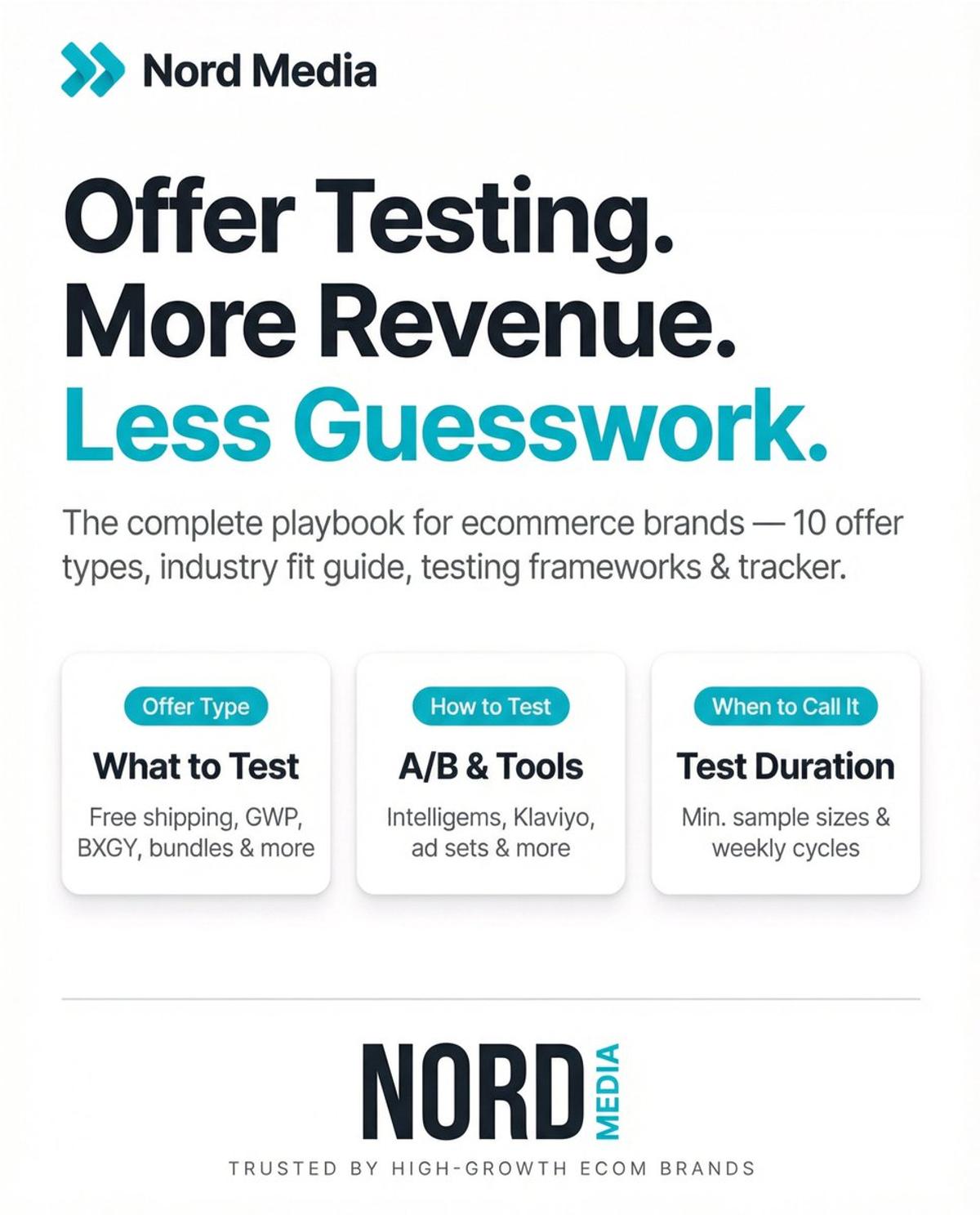
Master Offer Testing to Scale Beyond Seven Figures
Scaling your brand past 7 figures in revenue requires mastering offer testing. Retweet and Comment "OFFER" and I'll send you my new guide for how to structure and properly test offers. *** Must be following for me to DM ***...

Start at the Funnel Bottom for Rapid Pipeline Results
If paid media is set up correctly, you should start seeing a qualified pipeline within 30–45 days. Here's how we achieve that for our clients: Many B2B teams end up running paid media backwards. They start with awareness, build an...
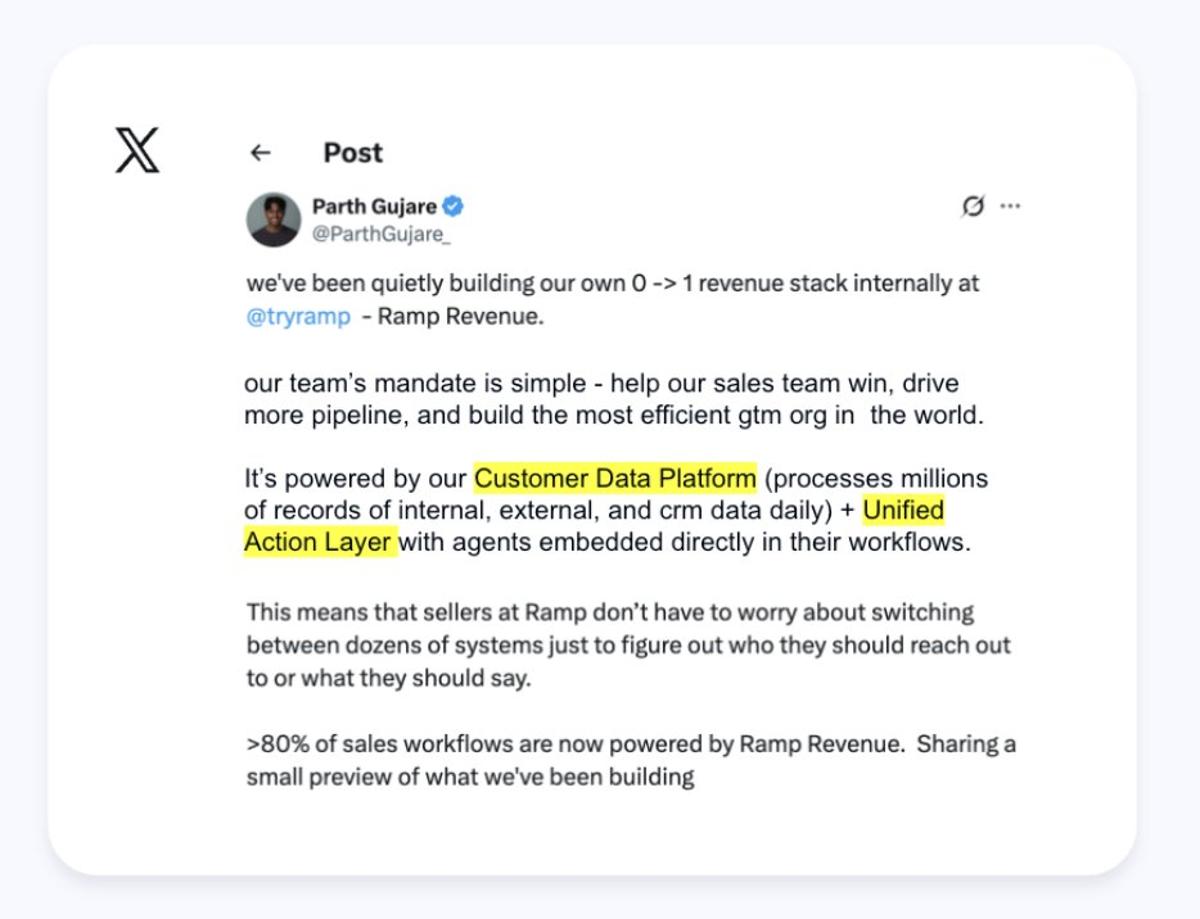
Context Is the iPhone Moment for GTM Success
A couple weeks ago @ParthGujare_ Senior Product Manager at Ramp posted about their internal revenue stack and what they had built for it. “A customer data platform “processes millions of records, internal, external, crm data daily”, A unified action layer with...

Icon AI's Downfall: Bad Execution, Ignored Feedback
What caused this? To early? Poor execution? Bad leadership? A bit of everything IMO. We tried it and used it - it was a mediocre product at times and was okay other times. But their support and unwillingness to implement feedback is what killed them. I...

Pentagon Accessed OpenAI via Microsoft, Bypassing AI Ban
Everyone is selling their software through third-party carveouts. Sometimes those third parties are the fifth-most valuable companies on Earth
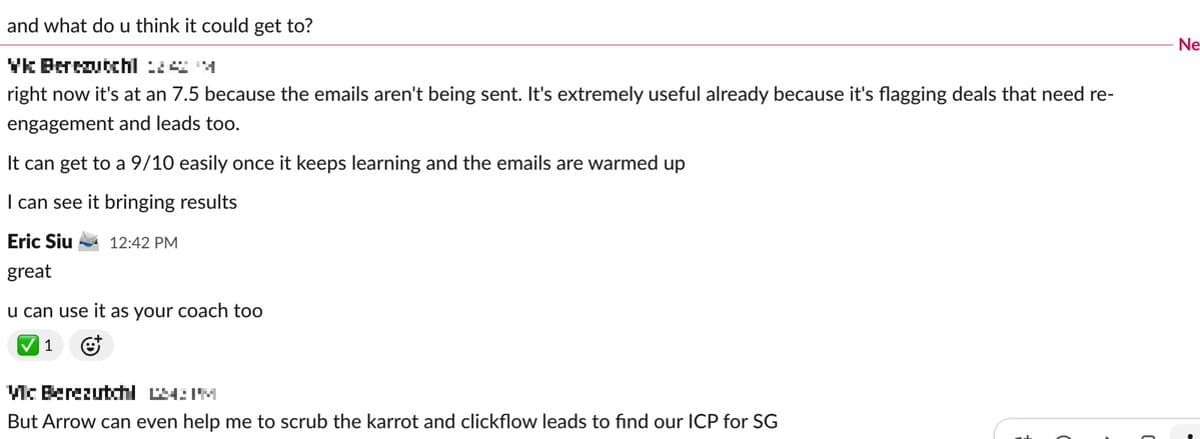
OpenClaw Agents Boost Sales via Slack Integration
Pls don't give me this BS that agents can't drive real business ROI. Here's an example of my OpenClaw agents invading our Slack and helping our sales team. The possibilities are endless. https://t.co/RGBDK21qyO

OpenClaw Setup Boosted Views From 358 to 85K
Building Live: The OpenClaw Setup That Took My Articles from 358 to 85,000+ Views https://t.co/2AfO60Gvta
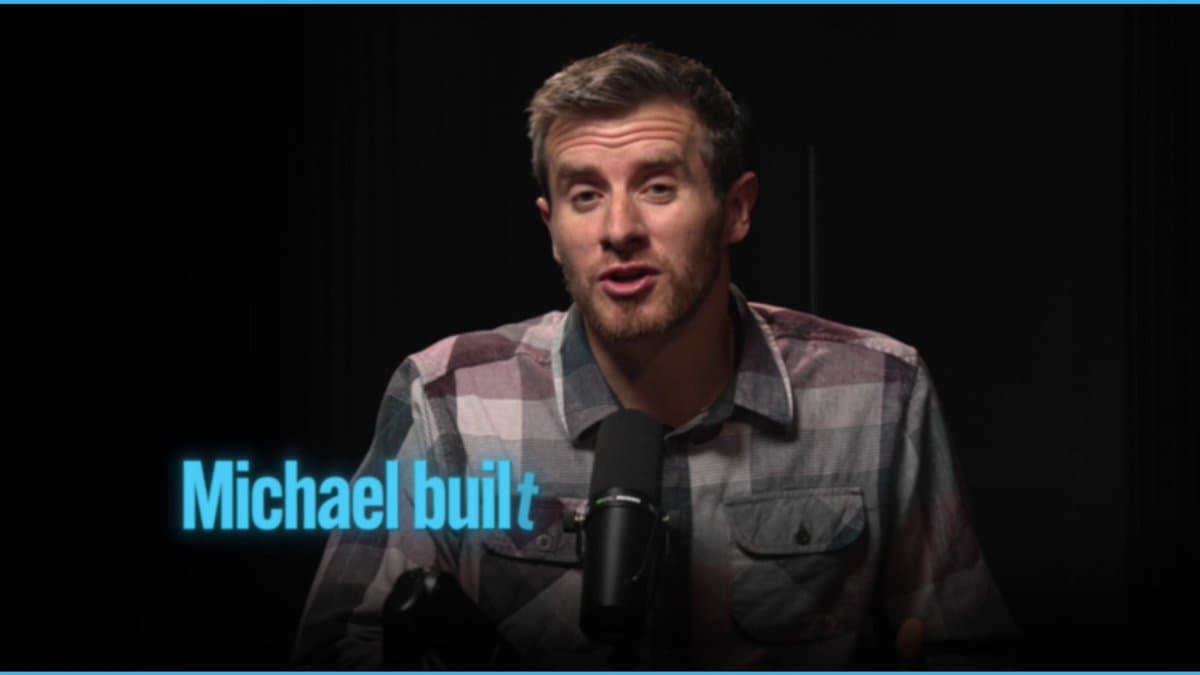
Coaching Strategies to Jump From $1M to $5M ARR
Stuck at $1M ARR. But the goal is to reach $5M. In this episode, I coach @MSliwinski on how to get his software company unstuck. Search "Nathan Barry Show" to watch. https://t.co/NAMZTWA7Ww

Capture Intent Signals in CRM Forms for Better Follow‑up
Brilliant: "A CRM-integrated form should capture intent signals, such as inquiry type, company size, role, or product interest. These fields do not add friction when designed properly, but they dramatically increase the quality of follow-up."

Build Your Own AI Sales Team Today
The future is about hybrid teams of humans and AI agents. But even today, you can start building your own personal team of simple, easy-to-use agents. If you work in sales or need to sell (because you're a founder/entrepreneur), you...

Use Data Experiments, Not Intuition, for Real Innovation
RT @VisionEdgeMktg 🧪 Stop relying on intuition. Start running business experiments. A/B test your ideas. Collect real data. Make smarter bets. That's how innovation actually works. https://t.co/ZKvfIAn54l #DataDriven #Innovation #BusinessStrategy

Stop Chasing Unicorn Prospects; Target Experienced B2B Buyers
When we apply a performance marketing mindset to the top of the funnel, we can end up putting a lot of effort and expense into building an audience that often isn't big enough, and sometimes isn't even real. In B2B...

AI Marketing Toolkit Grows: New Tools Added
The best list of #AI #marketing tools anywhere continues to expand: https://t.co/1MqMiJP4M3 New tools added recently include @flowith, Scribe V2 Realtime by @ElevenLabsDevs, Cellect AI, @humanic_ai, @vyrill, @HiclipAI, @recraftai, Pomelli by @GoogleLabs, and @Nimble.

Write for Real Customers, Not Giant Corporate Fantasies
Your next sale won't be a 1000-seat order from Google. But is your homepage written as if this is the target? Formal, obtuse, corporate-speak, pretending to be a mature, stable company. You’re alienating your actual best customers. https://t.co/2jsBd6Z3Ap

Seeking First Marketing Hire to Build AI Demand Engine
Most companies hiring a "Head of Marketing" are looking for someone to run a system. My friends Randy Stocklin and Santiago Jaramillo are looking for something a little different. They are looking for the first marketing hire for Pragmatico ,...

Teach AI to Think Like You: Build Your Knowledge Base
MarketingProfs AI Friday Forum is coming fast. It's next week, and I'm going to explore an idea: can you train AI to "think" like you? If so, how? Here are the details. Come and join us. Let's have FUN together....

Action Over Intelligence: Create, Test, Choose the Best
Smart people wait for opportunities, while "lucky" people create 50 opportunities, launch them, analyze, and then pick the best 1-2. Intelligence is overrated. Volume and action win.

Repeat Your Message: Fear of Redundancy Keeps You Poor
Being afraid of sounding like a broken record… keeps you broke By the time you're sick of repeating your message, your audience is juuuust starting to hear it Say it again

Hidden Data Insights Unlock Competitive Advantage
RT @VisionEdgeMktg 🔍 The non-obvious insights in your data? That's where competitive advantage lives. Look deeper. https://t.co/P1IGkxkQVc #DataDriven #Analytics #CompetitiveIntelligence

Calibration Scores Gradually Grant AI Autonomy
Calibration Loops allow your Claws/agents to become fully autonomous. If your Claws needs your permission all the time, you're the bottleneck. But you also can't let it yolo in the beginning when it's lacking so much context. So you have to train it...

Figma’s Silent Change Signals Fight for Design Infrastructure Control
In February 2026, Figma released version 126.1.2. One line in the changelog caught nobody's attention. It should have. The update stripped --remote-debugging-port on startup, with no announcement and no deprecation warning. Just gone. Overnight, developers who'd spent months building automation...

Leverage Ads to Scale Your Meta Success
Every time I read something like this. I just think. That's great.... and massive congrats to you, but what could you have done if you ran ads. Take what's working and apply it to Meta.

Low‑cost Sales Hubs Fuel Egnyte’s $300M Success
Egnyte's first marketing spend: $6,000 on SEM. "I was like, holy s***, that's a lot of money." Now they spend millions per quarter. Same playbook. But the real edge? Inside sales offices in Spokane, Raleigh, Salt Lake City. Not SF. $300M+ revenue. $137.5M raised....

Tactics ≠ Strategy: Learn the Key Distinction
A tactic list isn't a strategy. Here's the difference and how to fix it. https://t.co/Uwoumcge5e via @Kevin_Indig, @sejournal

Link Content Directly to Revenue to Prove Value
How to tie Content to Revenue and prove content marketing value [RevCO F... https://t.co/DrLnhaoEwf via @YouTube

Value Decline, Not Churn Rate, Drives Revenue Loss
Your customers are churning. But not for the reason you think. Most founders look at monthly churn, see 3-4%, and think "we're fine." But then they pull up their net revenue retention at 12 months and it's sitting at 70%....

Stop Mass Emails: Offer Relentlessly, Share Your Solution
You haven’t run out of people to reach out to. You’ve run out of offers. You sent one message to each person once. That’s not outreach. That’s a mass email, sent the long, hard, stupid way. Here’s what I’ve noticed about the...