
US Mortgage Payments Ease Slightly but Affordability Strain Persists
The average new mortgage payment in the United States slipped 2.4% year‑over‑year to $1,942 in 2025, offering modest relief to borrowers. Yet 24.3% of new homeowners still allocate at least 30% of their income to mortgage costs, a level deemed cost‑burdened. Generation Z faces the steepest strain, with 32% exceeding the 30% threshold and 10.2% of all borrowers spending 40% or more of their earnings on housing. High‑cost markets such as California remain the most unaffordable, while rising payments spread to Midwestern and Southern cities.
Why Is the Fed Holding Firm? The New Strategic Reality for Treasurers
The Federal Reserve has kept the federal funds rate steady at 3.50%‑3.75% for a second pause in 2026, moving from aggressive easing to cautious observation amid geopolitical energy shocks and a looming leadership transition. Simultaneously, the Fed is purchasing up...

US Set to Start Refunding $127 Billion in Tariffs
The U.S. Treasury will begin processing refunds on April 20 for $127 billion in tariffs that the Supreme Court struck down earlier this year. The Court of International Trade ordered the government to file a progress report by April 28. A new...

Report: Retail Sales Grew in March Thanks to Tax Refunds
Retail sales climbed for the sixth straight month in March, driven by larger-than‑expected tax refunds that offset rising gasoline prices linked to the Middle East conflict. Seasonally adjusted sales excluding autos and gas stations rose 0.4% month‑over‑month and 6.59% year‑over‑year,...

Scoop: Senate Plans to Grill Six Cabinet Officials on Trump's Budget
Senate Appropriations Chair Susan Collins (R‑Maine) will summon six Trump Cabinet secretaries for hearings on April 22, aiming to push a full‑year appropriations package through before the Sept. 30 fiscal deadline. The lineup includes Treasury, Health and Human Services, Commerce, Interior,...

Babies Beget Babies. That’s Both a Problem and a Policy Lesson.
The new NBER paper finds that exposure to babies increases the desire for children, creating a self‑reinforcing loop that may explain about 13% of the recent fertility decline. Economists argue that policies such as child subsidies, affordable housing, and better...
:max_bytes(150000):strip_icc():format(jpeg)/Quantitative-tightening-6361478_final-a184a253c81d408cb2d495236098555f.png)
Understanding Quantitative Tightening: How the Fed Reduces Market Liquidity
The Federal Reserve launched quantitative tightening (QT) in 2022, letting roughly $1 trillion of Treasury and mortgage‑backed securities mature without reinvestment to shrink its $9 trillion balance sheet. By reducing liquidity, QT pushes bond yields higher, raises borrowing costs and aims to...

NRF: Tax Refunds Help Offset Gas Prices as Retail Sales Grow in March
U.S. retail sales grew 0.4% month‑over‑month and 6.59% year‑over‑year in March, according to the NRF‑CNBC Retail Monitor. The surge was driven by larger tax refunds—averaging $3,521, up 11.1% from a year earlier—that helped cushion higher gasoline prices. Core retail sales,...

Treasuries Steady as Traders Assess War’s Inflation Risks
U.S. Treasury yields held near 4.30% as the latest producer‑price index came in below expectations, reinforcing bets for at least one Federal Reserve rate cut in 2026 despite lingering inflation concerns tied to the Iran‑Israel war. The PPI rose 0.5%...

PPI Wholesale Inflation Highest in 3 Years
The March Producer Price Index rose 4% year‑over‑year, the highest level since February 2023, while the month‑over‑month gain slowed to 0.5%. Core PPI climbed 3.8% YoY, marking the strongest reading in the past twelve months. Small‑business optimism slipped to 95.8, the...

Single-Family Permits Decline Sharply to Start 2026
Residential construction entered 2026 with a stark split between housing segments. Single‑family permits dropped 15.2% year‑over‑year to 62,034 units, reflecting higher borrowing costs and tightening affordability. Multifamily permits held steady, slipping only 0.5% to 38,215 units, showing resilience amid regional...

Wholesale Prices Rose 0.5% in March, Much Less than Expected Despite War Impact
The U.S. producer price index (PPI) rose 0.5% in March, well below the 1.1% consensus estimate. Core PPI, which strips out food and energy, increased only 0.1% month‑over‑month. On an annual basis, the all‑items PPI jumped 4%, the fastest 12‑month...
IMF Lowers 2026 Global GDP Growth Forecast to 3.1% vs 3.3% Prior
The IMF trimmed its 2026 global GDP growth forecast to 3.1% from 3.3%, citing the Middle East conflict and higher oil prices. The United States sees a modest downgrade to 2.3%, while the euro area falls to 1.1% and China...
Wholesale Prices Increased by 0.5% in the U.S. in March
The U.S. producer price index (PPI) rose 0.5% in March, well below the 1.1% consensus estimate. On a 12‑month basis the final‑demand index climbed 4.0%, the strongest annual gain since February 2023. Core PPI, which strips out food and energy,...

What Small Employers Are Telling Us About the Labor Market
ADP’s March payroll data shows turnover among firms with fewer than 50 employees dropped to 3.9%, the lowest level in nine years. The broader private‑sector turnover rate has hovered around 4.7% for the past three years, indicating relative stability. Small...

U.S. Small Business Sales Hold Steady in March as Consumers Spend More Per Visit
U.S. small‑business sales were essentially flat in March, posting a negligible 0.1% month‑over‑month increase and no year‑over‑year growth, according to the National Retail Federation. At the same time, the average transaction value rose about 3% to roughly $58 per visit,...
The Challenges Facing the New Head of the Federal Reserve
Kevin Warsh is set to replace Jerome Powell as Federal Reserve Chair pending Senate confirmation, inheriting a mixed economic backdrop. Initial jobless claims sit at a historic low of 202,000 and unemployment is 4.3%, yet total employment fell 0.4% year‑over‑year...

Bessent Tells Fed to ‘Wait and See’ on Cuts as War-Driven Inflation Clouds Bitcoin
Treasury Secretary Scott Bessent warned the Federal Reserve to hold off on interest‑rate cuts, citing the Iran‑related surge in oil prices that is stoking inflation. The Fed’s March minutes echoed this concern, pushing market expectations for the first cut out...

Most of Wall Street Points to High Oil Prices as the Driver of Inflation. A Maverick Johns Hopkins Economist Says...
Wall Street analysts quickly blamed the March 3.3% year‑over‑year CPI rise on soaring oil prices after Iran shut the Strait of Hormuz. Johns Hopkins economist Steve Hanke pushed back, arguing that the inflation surge mirrors a two‑year‑old expansion in the...

How Will AI Affect the US Labor Market?
Goldman Sachs researchers project that AI adoption across U.S. firms will span roughly a decade, potentially displacing 6‑7% of the workforce. If the transition is evenly paced, unemployment could rise by about 0.6 percentage points, with larger spikes if adoption...

Bessent: US Should ‘Wait and See’ Before Lowering Interest Rates
U.S. Treasury Secretary Scott Bessent told Semafor that the Federal Reserve should hold off on cutting interest rates until the fallout from the Iran war becomes clearer. He noted that despite a recent surge in headline inflation driven by oil...

Economy Likely Faces Just Temporary Setback From Iran War: Survey
A Wolters Kluwer survey of corporate economists finds 59% expect the inflation surge from the Iran war to be short‑lived, projecting 2.2% U.S. GDP growth this year. Yet the conflict has nudged recession odds to 35% for the next 12 months...

Labor Stagnation Leaves Little Room for Error
March payrolls added 178,000 jobs, but the three‑month average growth slipped to just 68,000, barely above breakeven estimates. The unemployment rate fell to 4.26% as labor‑force participation dropped 396,000, indicating that the decline reflects a shrinking pool rather than stronger...
Americans Hate the 2026 Economy
Despite solid macro indicators—4.3% unemployment, 3.3% inflation, flat S&P 500 and steady GDP growth—Americans remain overwhelmingly negative about the economy. A preliminary April 2026 University of Michigan consumer sentiment index fell to its lowest level since the survey began in...
Rates Spark: Equities Are Back, but Bonds Are Not - Why?
Equities have largely rebounded from the February‑28 Middle East turmoil, with the S&P 500 regaining roughly 80% of its losses, while high‑yield spreads have normalized. Bond markets remain under pressure as long‑tenor yields stay elevated, driven by stubborn inflation and higher...
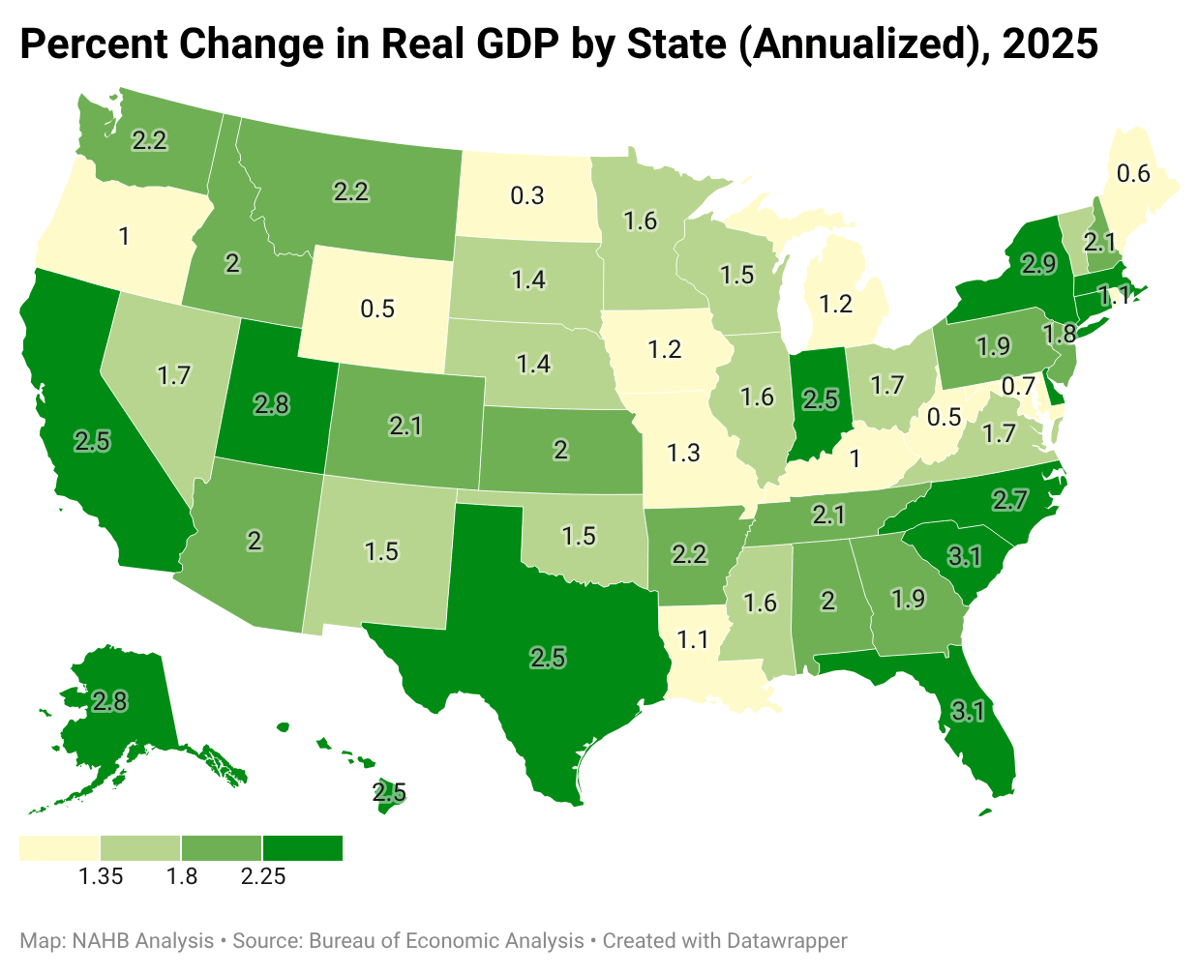
2025 Regional and State-Level GDP Data
The Bureau of Economic Analysis reported that U.S. real GDP grew 2.1% in 2025, marking a modest expansion after stronger prior years. Every state posted positive growth, but the pace varied widely, from a 3.1% increase in Florida and South...

Current Uses and Unmet Needs of Federal Economic Statistics
The Brookings Institution’s Economic Indicators Initiative released a paper outlining current uses and gaps in the Federal Statistical System (FSS). The system, which costs less than 0.1% of the federal budget, fuels Social Security inflation adjustments, retail inventory decisions, and...

Make Taxes Progressive and Collectable
Dean Baker’s CEPR paper argues that the U.S. tax code disproportionately benefits the wealthiest, and calls for a suite of reforms to make the system more progressive and enforceable. It proposes raising top marginal income rates, increasing the corporate tax...

U.S. Retail Sales Up State-by-State in December 2025
The U.S. Census Bureau’s December 2025 Monthly State Retail Sales Report shows total retail sales, excluding non‑store retailers, rose 2.7% year‑over‑year. Nineteen states and the District of Columbia posted positive growth, with New York leading at a 9.0% increase, followed by Hawaii...

ISM Prices Paid Has Posted One of the Largest Two-Month Moves on Record
The ISM Manufacturing Prices Paid Index surged 19.3 points over the two months ending in March, marking one of the steepest two‑month moves on record. The jump places the change in the top 2 % of observations since the index’s inception...

Real GDP Growth by State: Fourth Quarter 2025
The Bureau of Economic Analysis released real GDP data for all 50 states, annualized for the fourth quarter of 2025. The mean annualized growth was 1.8 percent, with the median state, New Jersey, matching that figure. South Carolina posted the fastest growth...

Univ of Michigan Consumer Sentiment Index Drops to All-Time Low on War Worries
The University of Michigan’s consumer sentiment index fell to 47.6 in early April, an all‑time low and a 10.7‑point drop from March, far below analysts’ forecast of 52. The decline reflects heightened anxiety over the Iran conflict and rising energy...
‘It Will Become a Problem': Jamie Dimon Says America's $39 Trillion Debt Will Mean Volatile Markets and Rising Rates
JPMorgan Chase CEO Jamie Dimon warned that the United States’ $39 trillion debt will eventually trigger market volatility and higher interest rates. He highlighted that the government already spends over $1 trillion a year on debt service, a figure projected to double...

Rate Hike Bets Increase After the Failed US-Iran Talks as Energy Prices Remain Elevated
Traders have raised expectations for rate hikes after the collapse of US‑Iran peace talks, which revived fears of a prolonged conflict. WTI crude oil climbed back above $100 per barrel following President Trump's announcement of a naval blockade in the...

The Federal Reserve's April Inflation Forecast Is In -- and It Just Keeps Getting Worse for Wall Street
The Cleveland Federal Reserve’s nowcast pushed its April inflation projection to 3.56% YoY, up from 2.40% in February, as the Iran‑Israel conflict choked the Strait of Hormuz and spiked oil prices. Gas prices surged roughly 40% to $4.16 a gallon,...

Inflation Could Hit 4.2% This Year: 3 Stocks to Buy Now to Protect Your Portfolio
The OECD’s April 2026 outlook projects U.S. inflation at 4.2%, well above the Federal Reserve’s 2.7% forecast, driven by geopolitical tensions and tariff policies. Higher inflation threatens consumer spending, prompting investors to seek assets that can preserve purchasing power. Analysts highlight...

The Weaker US Job Ladder Has Slowed Wage Growth
A new NBER paper finds that upward job mobility in the United States has halved since the 1980s, limiting workers' ability to move to higher‑paying firms. The authors develop a novel measure using CPS data and show the gap between...

America’s Next Fed Chair Is Caught in a Vice
The Federal Reserve’s upcoming chair transition is unfolding under intense political pressure from President Donald Trump, who routinely attacks current Chair Jerome Powell on social media. Powell also faces a DOJ inquiry into the Fed’s headquarters renovation contract, adding a...

Why Inflation Is the Economic Problem of the Decade
Inflation has re‑accelerated, highlighted by a 21.2% jump in gasoline prices in March—the largest monthly surge since the 1960s. The overall CPI rose 3.3% year‑over‑year, its highest level in almost two years, while a Fed‑preferred inflation gauge showed a 4.1%...

Interest Rates Are Headed Lower — Real Yields Suggest a Half-Point Fed Cut Is Coming
U.S. Treasury real yields have risen to their highest level since the 2008 financial crisis, signaling that nominal rates may soon ease. Economists’ natural‑rate (r‑star) estimates place the neutral rate near 0.9%, well below the current Fed funds rate of...

Trump Endorses ‘Focused’ Immigration Enforcement Funding Bill
President Donald Trump publicly endorsed a Senate‑crafted reconciliation bill that would fund Immigration and Customs Enforcement and Border Patrol, signaling GOP confidence in a fast‑tracked, immigration‑only funding effort. The meeting with Senate Budget Chair Lindsey Graham and Majority Whip John Barrasso...

A US Debt Crisis Is Coming –Diversify Your Investments
The United States’ national debt has climbed past $39 trillion, representing 124% of GDP, and interest obligations are set to top $1 trillion annually by 2026. War expenditures in Iran have already exceeded $40 billion, while a Supreme Court ruling stripped away a...

Trump Vowed To Lower Inflation, But He Is Driving It Up, Says Pete Buttigieg: 'Tripled From Just One Month Ago'
Vice President Pete Buttigieg tweeted that inflation has tripled in just one month, accusing President Donald Trump of reversing his campaign promise to lower prices. The claim contrasts with Trump’s repeated pledges to bring down inflation as his top priority....

Former Fed Official Argues Against Fed Independence
Former Fed Vice Chair for Supervision Randal Quarles told a Shadow Open Market Committee audience that the legal shield preventing presidential removal of Board members should be scrapped, but argued the Fed’s decentralized structure would still keep monetary policy insulated from...

News Wrap: Inflation Report Shows the Biggest Increase Since 2024
The Labor Department’s consumer price index rose 3.3% year‑over‑year, the fastest increase since 2024, driven by gasoline prices that posted their biggest monthly jump in six decades. Stripping out food and energy, core inflation barely moved, indicating modest underlying price...

Iran War: Expensive Oil Drives Rising Inflation in U.S.
The ongoing Iran‑War has choked oil tanker traffic through the Strait of Hormuz, pushing diesel prices up 55% year‑to‑date and sparking a sharp energy‑price shock. In March, the energy component of the CPI jumped 10.9%, while the gasoline index surged...

Housing Market in a ‘Psychological Freeze’ as Confidence Falls
U.S. inflation accelerated to 3.3% in March, driven by a 10.9% surge in energy prices, prompting the Federal Reserve to likely keep rates steady. Consumer confidence plunged to a 47.6 index, a 10.7% monthly drop, creating a "psychological freeze" in...

Beltway Buzz, April 10, 2026
President Donald Trump’s FY 2027 budget proposal slashes the Department of Labor by roughly 26%, eliminates the Women’s Bureau and trims the National Labor Relations Board, while adding $20 million to the EEOC. The plan also restructures the Office of Federal Contract...

Inflation Is Hitting These Consumers Hard In Iran War
Delta Air Lines’ stock jumped after it reported Q1 earnings and announced capacity cuts and higher fees as jet‑fuel costs surge. Airline fares rose 2.7% in March and are up 14.9% year‑over‑year, the steepest increase among consumer services. Jet‑fuel prices...

Reignited Inflation Could Push Social Security COLA Past 3% Next Year
The U.S. Department of Labor reported a 3.3% year‑over‑year CPI increase for March, propelled by a 10.9% surge in energy prices amid the Iran conflict. The sharp 0.9% monthly rise marks the strongest one‑month jump since the 2022 pandemic‑driven inflation...